Stronger IN …. Specious Misrepresentation

Analysis of just one tweet from the Stronger IN campaign shows both its cavalier disregard for factual accuracy and the dishonesty of its overall message

Even with two months of an acrimonious EU Referendum contest still to go, the scaremongering of Stronger IN, the Remain Campaign’s principal vehicle, has already acquired semi-legendary status. Except not, possibly, in the way it anticipated and intended.

Because, with its campaign blatantly mirroring closely the EU-phile Cameroon Government’s Project Fear, every instance of Stronger IN disingenuousness, selective interpretation and outright misrepresentation is rightly attracting immediate and widespread challenge and derision, followed almost every time by a swift and effective rebuttal.

Today has been no exception: but it’s perhaps worth deconstructing one such instance in detail, to show the extent of the deception which is, increasingly, the Remain campaign’s principal (if not its only) tactic.

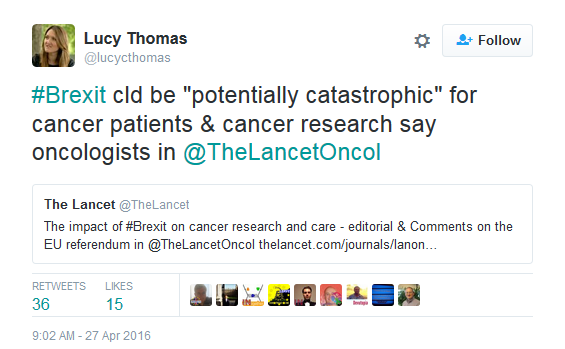
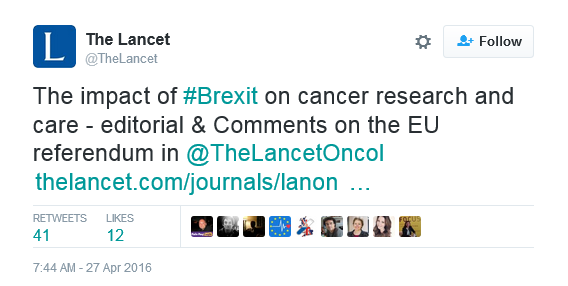
At 0920 this morning, Lucy Thomas (@lucycthomas ) Stronger IN’s Deputy Director, tweeted thus:

2016.04.27 Cancer ThomasThe implication that Thomas’ tweet clearly intends to convey – that the UK’s specifically leaving the EU would adversely affect, “potentially catastrophically”, not only individual cancer patients’ survival chances but even the future of cancer research itself, instantly looks suspicious. Because, as most people with more than a passing interest in UK current affairs know, the UK’s cancer survival rates, compared to those of other advanced countries, aren’t actually particularly good, even while we’re in the EU.

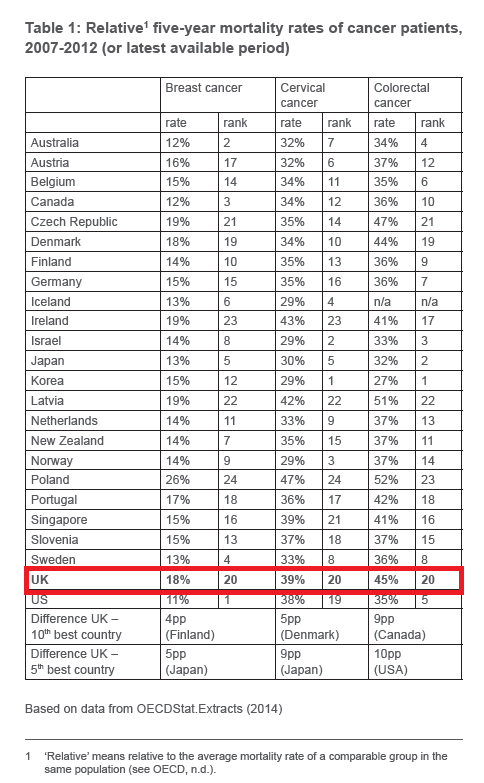
As the chart below shows, in a grouping of 24 countries, we rate pretty badly – 20th overall, in fact. On relative 5-year mortality rates for cancer patients, over the five-year period 2007-2012, not only are we much, much worse than our Anglosphere cousins the USA, Australia, Canada and New Zealand: significantly, we’re also worse than European, but non-EU, Norway and Iceland.

UK Cancer Survival RatesNHS 5-year cancer survival rate OECD

At a more detailed, and solely European level, the same outcomes continue. For, as the chart on the right shows, just compared with Germany and The Netherlands, our 5-year survival rates, over the period 2007-2012 for breast, cervical and colorectal cancer were the worst of all three.

A quick Google search then establishes (in The Guardian, no less) that UK cancer survival rates trail 10 years behind other European countries. It’s worth quoting a two or three sentences in full:

“Five other European countries (Finland, Germany, Italy, the Netherlands and Norway) also recorded better survival rates for lung cancer in the 1990s than Britain in the 2000s.”

“For colon cancer six European countries (Finland, France, Italy, the Netherlands, Norway and Sweden) had better survival rates in the 1990s than Britain achieved 10 years later.”

“In the 2000s 19% of British patients diagnosed with stomach cancer survived. Better survival rates were recorded a decade earlier in Austria, Germany, Italy, Norway and Sweden.”

Norway again. Better cancer survival rates than the UK, and 10 years before. Evidently, not being in the EU isn’t a factor holding back Norway’s progress in tackling the scourge of cancer.

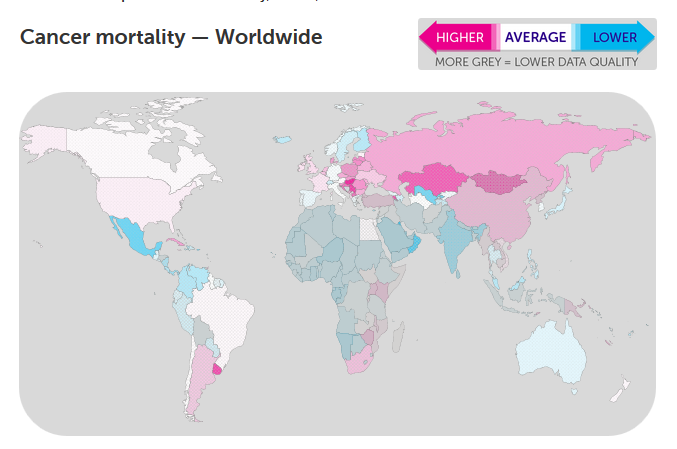
A further quick search yields Cancer Research’s data on worldwide cancer mortality rates, and the chart below:             

Cancer mortality worldwide 2012

It’s immediately obvious that non-EU Switzerland, non-EU Iceland, and non-EU Norway all have lower cancer mortality rates than the UK. In fact, non-EU Switzerland and non-EU Iceland have lower mortality rates than all the rest of the EU, bar Sweden and Finland. Clearly, cancer survival prospects seem, if anything, to be inversely-correlated with EU membership, rather than the opposite.

The empirical data therefore directly contradicts the impression Thomas’ tweet  seems to want to convey.

Next, the content of that link in the actual The Lancet tweet, of which Thomas’ is a Retweet-With-Comment, bears closer examination.

2016.04.27 Cancer Lancet

Perhaps by now unsurprisingly, the article turns out to be inherently speculative, tentative, non-specific, certainly non-medical, and primarily an expression of political viewpoint. Again, it’s worth quoting one or two sentences:

“Part of the inherent difficulty with this debate is that the repercussions of leaving can only be speculated on”

“These unknowns mean that points of argument are often semantic, and emotionally led.”

The article attempts to make two main points. First, it implies that the specific act of withdrawing from membership of the EU political union would be the determinant of worse prognoses and outcomes for UK cancer patients. But, as we’ve seen above, from the better survival rates achieved in non-EU countries, even in Europe, that’s a viewpoint which seems wholly unsupportable.

Second, it argues that ceasing to be in the EU’s political structures presages a diminished level of medical-science co-operation. But, apart from offering no convincing argument why this should be so – why do we need to be in political union with, eg Canada, to co-operate mutually on medical science? – the assumption on which The Lancet’s assertion is based itself appears to be at variance with reality.

The chart below, taken from the UK Medical Research Council’s 2014/15 report, shows the policy influence on UK medical science by originating location:    

UK medical science policy sources

In fact, a mere 7% of policy influence on UK medical science originates from within the EU. The equivalent UK figure is 56%: and it’s evident, moreover, that the residual 37% far outstrips the EU’s contribution of 7% to UK medical science policy origination.

Quite how Brexit would therefore so “potentially catastrophically” affect both UK cancer patient outcomes and UK cancer research is, to say the least, unclear.

This micro-checking exercise on just one tweet from the Stronger In campaign probably took no more than 10-15 minutes, including the time spent tweeting the findings as they became apparent. But what it reveals is a reality totally at variance with the impression its Deputy Director is disingenuously trying to impart.

Lucy Thomas’ narrative is factually inaccurate, specious and dishonest – a perfect metaphor, perhaps, for an entire Remain campaign that’s Stronger In misrepresentation than it is in anything else.   

Thoroughly agree with this article? Vehemently disagree with it?

Scroll down to leave a comment

Follow A Libertarian Rebel on Twitter

  Delicious Save this on Delicious

Your Advice Is Not Required, Mr President

An open letter to President Obama on British sovereignty, democracy, and the EU Referendum

Dear Mr President

Welcome to the United Kingdom: we hope you enjoy your last official visit to our shores as Head of State. But we also strongly recommend that, while renewing your acquaintance with our own Head of State, you reflect on the immeasurable historical importance, to both our countries, of independent nation-state sovereign democracy: and then conclude that for you to intervene politically in our forthcoming EU Referendum would traduce both our countries’ past histories, not to mention our own current hospitality, and in a way we find entirely unacceptable.

Questions for Obama on Europe

You’re going to try and browbeat us, Mr President, into voting to remain in the EU: in a democratically deficient, supranational political union that you would never even dare recommend to your own fellow-Americans as a political institution into which they should subjugate themselves.

We’ll return to the specifics of that particular piece of hypocrisy later: but you also evidently propose to compound the hypocrisy by pretending that your intervention has our own best interests at heart.

We’re not fooled. We’re well aware that, in governmental, political and diplomatic circles, the so-called Special Relationship is often a platitude thrown by the unscrupulous to the masses to conceal that the United States resolutely and sometimes ruthlessly acts in what it perceives as its own interests, even to the detriment of its own allies’.

We accept that, however, as being no less than how a major power should defend what it sees as its interests – but what we do not and will not accept is your pretence that a grossly-disadvantageous political arrangement for us is somehow in our interest, because it primarily serves your own.

We have a long institutional memory, Mr President. We know how, in the aftermath of World War II, America took advantage of our precarious financial state to insist on the return to convertibility of sterling, thus allowing the dollar to supplant it as the primary currency in large parts of the world.

We know how, to help promote your predecessors’ then already-incipient preference for a pan-European political union, US Marshall Plan funds were lavished on the fascist and collaborationist states whom we had sacrificed so much blood and treasure to help defeat, while we in Britain struggled to rebuild our own infrastructure and society via loans extended by America on unfavourable terms.

We know how the US threatened to destroy sterling by selling all its sterling reserves during the Suez Crisis of 1956, in order to supplant British influence in the Middle East with its own via a strategy of supporting Arab nationalism.

We know how the 1960s débacle over the aborted Skybolt nuclear weapons delivery system revealed your State Department’s making it an arm of US foreign policy that Britain must be in the (then) EEC, whatever the cost to it economically or democratically, because that was key to US interests.

More recently, Mr President, we’re well aware you have been, not merely the most Britain-unfriendly POTUS in modern history, but also arguably one of those most antipathetic to wider Western interests.

Obama Fawning SaudisWe know you have near-humiliated yourself and your country in making obsequious obeisance to the autocratic Wahhabist-Salafist rulers of a Saudi Arabia that funds Jihadism, executes apostates and jails dissenters. Indeed, you arrive in Britain fresh from abasing yourself to a Saudi Arabia that now threatens to inflict enormous damage on your economy if currently classified material exposing its complicity in 9/11 is revealed.  

We know you have sanctioned a path to the development of nuclear weapons by an Iran that makes no attempt to conceal what it sees as its theocratically-mandated destiny to eliminate a democratic nation-state from the face of the earth and extirpate its people, while in the interim hanging young men from cranes in public for being gay.        

Obama dances the tando while Europe Brussels burnsWe’re also aware that, as recently as last month, even as people fought for their lives and Brussels reeled in shock from violent terrorism  – perpetrated by the supremacist religio-totalitarian Islamist ideology that you apparently cannot even bring yourself to name – you were tango-ing the night away in Buenos Aires, canoodling up to an Argentinian regime that still maintains its egregiously-tenuous claim to a British sovereign territory, over 90% of whose British inhabitants declare, via self-determination referendum, their overwhelming wish to remain British. The satirical cartoons captured it so perfectly, didn’t they?

Reasons Brits believe why Obama opposes BrexitSo please don’t insult our intelligence, Mr President, by pretending your impending “advice”, that it’s essential for Britain’s interests for it to remain in the EU, is merely the counsel of a friend who has only our own best interests at heart. We know full well that that is not the case: only 4% of us think it even might be, as opposed to 51% who are under no illusions that US wishes, not British interests, are uppermost in your motivations. You are, in short, no friend of Britain.       

Now consider the European Union you are assuring us that it would disastrous for us to leave, were it to be translated into the American sphere.

Are you prepared to tell Americans they’d have a safer and more secure future, if only they’d agree to give up their independence, sovereignty and representative democracy to submerge themselves in a new supranational political union including Mexico, Nicaragua, Venezuela, Guatemala and Paraguay, which was determined to arrogate ever-increasing powers to itself from the democratically-elected national governments of its component nation-states, as an inexorable process of creating one single pan-American superstate?

Are you prepared to tell Americans they’d be far better off in such a pan-American political union whose highest judicial authority was a court in Bolivia, consisting mainly of academic lawyers unfamiliar with American common-law traditions, but which would nevertheless be superior to, and override, your own Supreme Court?

Are you prepared to tell Americans it would be much more to their advantage to immerse themselves in a political union of which one of the cornerstones was the totally free movement of people between the 30+ states from Alaska to Tierra del Fuego, with entitlements to generous welfare in their destination country, despite massive economic disparities between them?

Are you prepared to tell Americans it would be so much better for them, in such a political union, for 70% of their laws to be made by an unelected, bureaucratic, corrupt, unaccountable, viscerally anti-democratic Pan-American Commission in Bogota, whose commissioners they weren’t allowed to elect and certainly not vote out, but to which they nonetheless had to send $80 million a day for the privilege?

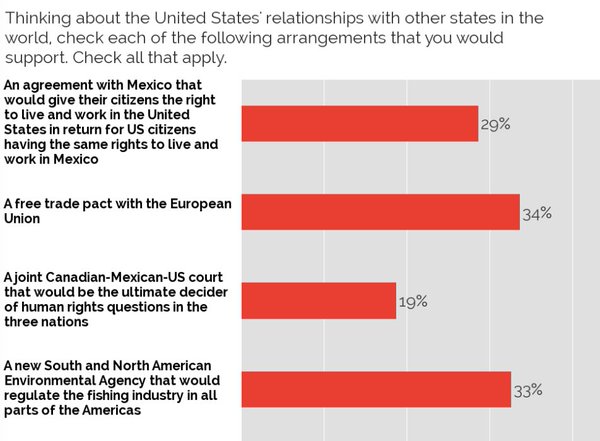
Obama asks us to stay in what Americans wld never tolerateActually, Mr President, we already know the answer to these questions: you would never suggest to Americans any such thing, because they have already indicated that no more than a third, at most, would support anything remotely like the political settlement to which you  insist disingenuously it is in our own best interests to remain shackled. So until you are prepared to recommend Americans to give up their sovereign democracy to the kind of polity you wish to see continued to be imposed on us, we respectfully suggest that you butt out of our Referendum. Interestingly, over 100 of our own elected lawmakers seem to agree.

At the core of our EU Referendum, standing way above all issues of economics, trade or migration, is one very simple principle, but one whose incontestable, absolute necessity for government by democratic consent it is impossible to over-state: that the laws governing the citizens of a discrete-demos polity can legitimately be those, and only those, made by, and only by, the representatives directly elected by the citizens of that polity, and whom they can remove from office via the ballot-box at the next election.  

The founding fathers of the great nation whose elected leader you, Mr President, will thankfully soon no longer be, considered these principles to be of such paramount importance that they and thousands of their fellow-patriots in the Thirteen Colonies were prepared to sacrifice their own lives to secure them for themselves and their future descendants. So much so that, in a few weeks’ time, on the Fourth Of July, you will celebrate the 240th anniversary of their final success in gaining their independence from a distant imperial power determined to keep its subjects in subjugation.

That you now come to us, to seek for your own interests to persuade us not to take this opportunity to recover self-government on these immutable principles for ourselves, from the 21st century equivalent of that distant imperial power determined to keep its subjects in subjugation, we find nothing short of grotesque.        

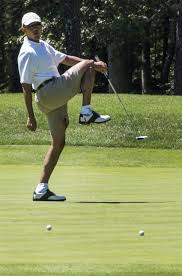
Obama GolfWe respectfully suggest, Mr President, that you abandon your plans to intervene in our democratic referendum. Perhaps you could profitably use the time to make a second and final visit to your new apparently ideological near-soulmate Fidel Castro, before the old tyrant is summoned to account by the Grim Reaper.  Or possibly to work on your golf technique, which looks as though it could use some improvement.

Your advice on our vote to decide our future EU destiny is not needed.


Thoroughly agree with this article? Vehemently disagree with it?

Scroll down to leave a comment

Follow A Libertarian Rebel on Twitter

Delicious Save this on Delicious

Tax-Havens: Also A Force For Good

Far from being solely amoral, piratical facilitators of crime, kleptocracy and evasion, so-called tax-havens in fact also play a valuable role in promoting economic efficiency and curbing State-predation  

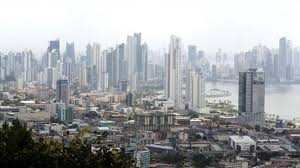
Tax havens Panama CitySo-called tax-havens have a bad reputation. In public and political minds, influenced almost wholly by the clamour of either wilfully-ignorant or Leftist-populist media and political hacks, they’re all, without exception, places solely where unsavoury associates of autocrats and plutocrats soak up the sun in between furtively stashing suitcase-loads of ill-gotten gains in anonymous numbered accounts.

As we’ve recently seen all too starkly. Because one of the main features to become glaringly obvious in the Panama Papers leaks, and in the domestic political furore in the UK which has followed it, is a self-evidently widespread inability (or possibly unwillingness) of the politico-media class and commentariat to differentiate the few truly-nefarious tax-havens from the more numerous well-run and properly-regulated offshore financial centres (OFCs) – they are decidedly not the same thing: or to distinguish illegal loot-hiding, money-laundering and tax-evasion, by corrupt despots, criminals and others, from the entirely legal use of OFCs in perfectly legitimate investment and tax-avoidance.

As so often, reality is both more complex, and more nuanced, than media-driven populist perception.

For a start, on the basic issue of definitions. The OECD lists four criteria which a territory or jurisdiction must fulfil in order to qualify as a tax-haven, as opposed to an OFC:

  1. Imposing no, or only nominal, taxes, even domestically
  2. Lack of transparency
  3. Laws and practices that discourage or even prevent automatic exchange of [tax-purposes] information with other governments on the beneficiaries of its tax regime
  4. No stipulation that the activity domiciled in its jurisdiction be substantive

On these criteria, there are relatively few true tax-havens: even the OECD lists only four, and, on its Automatic Exchange Of Information criteria, a mere two.

Tax havens Waterfront Grand CaymanMoreover, and more importantly, the vast majority of the Crown Dependency and British Overseas Territory OFCs, which Labour leader Jeremy Corbyn incorrectly labelled as tax-havens and proposed arbitrarily supplanting their democratically-elected governments to place them under direct rule from Westminster, don’t even fall into the “tax-havens” category at all.

So when no-one seriously opposes measures to prevent, detect and punish both those who undertake criminal tax-evasion, money-laundering and loot-concealment and the few residual disreputable genuine tax-havens which do facilitate them, the real objections by governments, commentators and so-called social-justice campaigners to the legitimate use of OFCs or any low-tax jurisdictions must originate from elsewhere.

Those objections arise from two principal, and unsurprising, sources. Firstly, the misunderstanding, derived from popular fallacies, of the economic good that low-tax jurisdictions promote: and secondly, the competitive threat they represent to the otherwise-unconstrained power of high-taxing, high-spending states to extract taxes from their economies and populations almost ad infinitum.

To address one of the most popular fallacies – that money deposited in OFCs or low-tax jurisdictions is somehow irretrievably “lost” to the global economy. This is just arrant nonsense.

First, it wrongly assumes there is a fixed amount of global capital whose geographical distribution creates a zero-sum game, where any partial deployment of it to Location A must automatically reduce that available in Locations B-Z. In fact global capital is both dynamic, and fungible, and continues being created in those parts of the so-called “losing” mainstream onshore economies that aren’t sensitive to geographically-differing tax rates.

Tax Havens BermudaSecond, it assumes that all capital deployed to low-tax jurisdictions stays there, static. This isn’t necessarily the case – small islands generally don’t have much potential for domestic infrastructure investment or large-scale economic activity – and it’s especially not the case in a period of low or even negative real interest rates. Although the total of assets located in an OFC may change only slowly, that ignores the stock-vs-flow issue, where many of its components parts may be being directed into other forms of investment in other locations, and subsequently repatriated, on a regular basis.

Inasmuch, too, as the location of capital and/or assets in the low-tax jurisdiction encourages their investment to generate a return not achievable if based in a higher-tax jurisdiction, the OFC is actually promoting more FDI in the investment location. In this way, the availability of low-tax OFCs makes them conducive to an increase in overall international investment and in global capital, not its depletion. They are not “poaching more than their fair share” of international capital, but acting as a conduit for its more productive and optimal investment back into mainstream onshore economies.

Third, international systems of taxation don’t always cope well with avoiding the dangers of double-taxation. If you’re an investor (and remember, you may well be, even via an ISA or your employer’s pension scheme) in a fund set up in a country that levies a withholding tax on redemption payouts, but those redemption payouts aren’t taxable domestically in your own country, then recovering the tax that’s been wrongly withheld from you is going to be difficult. By providing a tax-neutral environment, low-tax OFCs perform a valuable role in making sure that your investment, even an indirect one, isn’t taxed twice. That benefits you.

Tax havens Mossack Fonseca PanamaFourth, the fallacy assumes the “losing” country is automatically forced to raise its own domestic tax-rates to replace the tax-revenue “lost” when assets are relocated to a low-tax OFC. Countries, however, don’t operate in isolation from their international environment: lower tax-rates in other jurisdictions act as a restraint on mainstream onshore governments’ own tax-rate policies. Both firms and workers in those economies therefore benefit in purely micro-economic terms from overseas low-tax OFCs, in the form of lower taxes domestically than might be levied otherwise.

Next, low-tax OFCs also fulfil a vital function in providing a safe harbour for wealth legitimately created and held, against the tendency of inherently corrupt, dictatorial  & kleptocratic regimes to predate on it.

Depending on the definitions chosen, there are approximately 170-190 countries in the world: but only a minority are full democracies where the government is subject to the rule of law and scrutiny by a free Press. The Economist Intelligence Unit’s Democracy Index 2014 in fact lists a mere 24 as full democracies and a further 52 as flawed, out of a total of the 167 rated, leaving over 90 regimes described as either hybrid or (the majority) authoritarian. Perhaps not surprisingly, there’s a correlation between the latter categories and the Transparency International Corruptions Index 2015’s assessment of the most corrupt countries.

Most & Least Corrupt Countries 2014

These are countries where even if, against all the odds, an honest entrepreneur, investor or businessman manages legitimately to amass capital and assets, they are liable to be arbitrarily seized at any time by the regime, either unashamedly or via a quasi-criminal or complicit judiciary, and confiscated. By existing at all, low-tax OFCs furnish a safe refuge for such assets. In this role, rather than encouraging or facilitating corruption, they are in fact operating so as to thwart it.

Benefits of Tax CompetitionLastly, low-tax OFCs form a valuable macro-economic brake on the overall ability of excess-spending, excess-taxing governments to otherwise levy punitively-high taxes without restraint. In the absence of the tax-rate competition provided by lower-taxing jurisdictions, it’s unlikely that governments, viscerally-disinclined on both ideological and electoral grounds to curtail State intervention and largesse, would not take the opportunity to impose economically-damaging higher taxes generally. 

It’s primarily for this reason that the member-states of supranational political unions like the EU are so enthused by the prospect of cross-border harmonisation of taxes, or centralised democracy-proof pan-European fiscal control, as the corollary to curbing the legitimate activities of low-tax offshore financial centres. 

The vocal but unthinking critics of low-tax OFCs, in their haste to condemn what they see as the obvious, miss a point – that they are also a force for good. The existence, and legitimate activities, of low-tax OFCs both promote greater economic, capital-allocation and investment efficiency, and indirectly benefit employers, employees and consumers in the mainstream onshore economies by protecting them from excess State predation.     

Thoroughly agree with this article? Vehemently disagree with it?

Scroll down to leave a comment

Follow A Libertarian Rebel on Twitter

Delicious Save this on Delicious

Why The Red Lights All Show Green

In theory, Environmentalism ought to be a conservative, or at least apolitical, philosophy: but, in its politicised Climatism mutation, it’s been captured and exploited by the Left and Centre-Left, as a means to pursue Leftist ends 

Between small-“c” conservatism, especially in its classical Burkean tradition, and environmentalism in that word’s true, literal sense, there should, on the face of it, be a natural philosophical affinity.

Burkean conservative thought holds that society makes better progress, and simultaneously better preserves its legacy for future generations, not by the tearing-down of its structures and customs in orgies of radical, revolutionary fervour: but by preserving and perpetuating, though also adapting, established social, political and cultural institutions that have stood the test of time.

Englands green & pleasant landIt contends that the environment in which we find ourselves, not only the social, economic and cultural but also the physical, is not ours exclusively to re-make afresh solely out of desire to indulge the narcissism of the immediate, or even just to satisfy present needs; that we are not its absolute, unfettered owners, but trustees, stewards and custodians: that the corollary of societal betterment is an obligation to safeguard for those who have gone before the inheritance which they bequeathed to us, and in turn to pass it on as our legacy to generations yet unborn.

On this argument, then, environmentalism – in that word’s true, literal, sense – should be primarily a concern of philosophical conservatives – even its “conservation” synonym suggests as much.

Yet, because of the well-documented hijacking of the environmental movement by the hard-Left following the fall of the Berlin Wall, it’s now across that part of the ideological spectrum that spans from far/hard-Leftism to Cameroon ‘Liberal’-Centrism where the new politicised Environmentalism predominates.

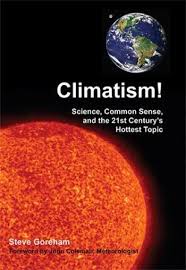
cover climatism steve gorehamA better name for it than “Environmentalism” is Climatism, after Steve Goreham’s excellent book of the same name, debunking its dubious scientific claims and political prescriptions. It bears little resemblance to Environmentalism in its original, true, conservation-oriented roots: Climatism is its mutation into the more familiar, stridently-collectivist, statist, anti-capitalist, intolerant-of-dissent, authoritarian secular Green Religion – eco-socialism, eco-fascism, eco-communism, or whatever specific eco-variety of Leftism one cares to assign it.

And so, unsurprisingly, it’s politicians ranging from Hard-Left to ‘Liberal’-Centre – perhaps we should just call them Climatists as convenient shorthand, to save time agonising over whether they’re eco-socialists, eco-fascists, eco-communists, or just eco-opportunists – who seem regularly to place the most reliance on it, to justify almost anything. As can be seen from merely a quick selection from the UK political scene in the last month or so.

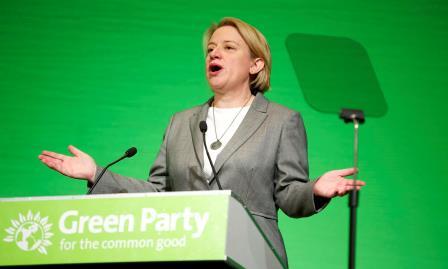
natalie bennett green party spring conf 2016First out of the traps, as you might expect, are those über-Climatists, the Green Party. In her keynote speech to its 2016 Spring Conference, leader Natalie Bennett employed well-worn Climatism-misanthropic memes to bemoan both the availability of relatively-inexpensive, reliable energy, and the greater mobility and travel opportunities which our 21st century prosperity has brought within the reach of vast numbers:

“The government is encouraging, subsidising, the frackers, the oil-drillers, the destructive open-cut coal miners. It’s promoting new roads and new airport runways”

Not content with that, Bennett went on to propose in effect  State control, not merely of monetary policy, but money creation itself, and also its deployment into the economy:

“We must build a future with a new system of money creation that puts resources into the real economy rather than casino finance”  

Red Ed pro-EU speech Mar 16But here, for example, adducing Climatism to advocate Britain’s continued membership of the EU, is Labour’s Red (or rather, Green-Left) Ed Miliband – progenitor of arguably the most damaging piece of legislation ever passed by Parliament, and written at his invitation by Friends Of The Earth’s deep-Green ideologue Bryony Worthington, the 2008 Climate Change Act – in his recent pro-Remain speech:

“That’s why we need to be in the European Union. Take the most important threat of all: climate change. It just isn’t realistic to think one country can do this on its own. It’s only EU legislation that is forcing any action from this Government”

There are, incidentally, at least three blatant falsehoods contained in those short four sentences, but for the purposes of this argument, we’ll let that pass.

Jezza Corbyn straight talkingHere too, this time enlisting Climatism in the cause of State-directed investment, control of markets, and curbs on business freedom, is Labour’s Hard-Left leader Jeremy Corbyn:

“We need a state that invests. This means we can shape markets and shape the goods they produce. All of this must be driven by democracy in the production of energy.”

Tim Farron Spring Conf 2016Now, also embracing Climatism to justify a vote to stay in the EU, comes Liberal Democrat leader Tim Farron, in his speech to the party’s Spring Conference:

“We face vast international challenges: climate change, the refugee crisis, a global economy. Do we best tackle these together or on our own? We are stronger together. We are Stronger In.”

aileem mcleod snp spring conf 2016Next up, citing Climatism as justification for greater wealth redistribution and overseas aid, administered and dispensed at one remove from full democratic accountability and control, is the SNP’s Scottish Government “Climate-Change” Minister, (suitably-attired in Green, naturally) Aileen McLeod:

“We have doubled the innovative Climate Justice Fund, a global first that is supporting some of the world’s poorest communities to deal with the impact of climate change”

Nicky Morgan 4

Finally, impeccably metropolitan-Cameroon ‘Liberal’-Centrist Education Secretary Nicky Morgan, blatantly and desperately recruiting Climatism as a helper to try and win over the self-appointed trendy and the youth vote in the Government’s increasingly flailing and fear-mongering campaign to keep Britain in the EU, in her pro-Remain speech of 29 March:

“Whether it’s tackling poverty or protecting the environment and tackling climate change, young people know that our voice and impact are magnified by playing a leading role through the EU” 

It’s nigh-on impossible not to be struck by the remarkable, and consistent, similarity between many of the prescriptions advanced by Climatism and the Climatists, and policies that are recognisable Hard-Left, Centre-Left and even ‘Liberal’-Centrist shibboleths, but for which they struggle to gain popular consent if advanced openly via the normal democratic process. To document the main ones:

Democracy-bypassing supranationalism.

Unlike UKIP and the Conservative Right, all the parties referenced explicitly favour removing swathes of public-policy decision-making away from domestic dependency on voter consent to mainly unelected, unaccountable, anti-democratic supranational bureaucracies.

The SNP knows its peculiar variety of nationalist state-socialism, while presently-dominant in Scotland, has minimal, if any, political traction south of the border. The LibDems and the Greens are psephologically near-irrelevant. Labour, in its post-Blairite iteration and despite its lip-service platitudes, has never really trusted democracy to back its policies since its three successive shattering defeats of the 1980s. The currently-reigning social-democratic, paternalist, ‘liberal’-Cameroon wing of the Conservatives openly disdains the Party’s robust classical-liberal pluralists.
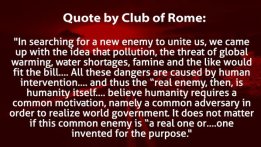
Club of Rome New Enemy quote

To all of these, the attraction of ensuring the implementation of electorally-unobtainable policy, by re-locating its origination and direction well away from vulnerability to democratic rejection, is irresistible. And what better ostensible justification for it could there be than the supranational regionalist or even globalist eco-stewardship they assert is inseparable from Climatism?

Thus, their near-unanimous support for, in particular, Britain’s continued EU membership, with its incipient pan-EU supranational energy-union and emissions-trading scheme which Green campaign groups still insist is not climate-policy at all, but a neo-industrial policy.

Greater State control of monetary policy, economy and markets.

Hard-Left Labour and the Greens are at least quite open about it. Between them, they overtly intend, in the name of Climatism, a much more economically-interventionist and controlling State: one that not only usurps control of monetary policy from an independent central bank, but also inclines towards almost directing producers what to produce and even consumers what to buy. As near to Soviet-style central planning, in fact, as the West has seen since that model’s deserved ignominious collapse in failure in the 1980s.

But they’re by no means alone. All the featured parties favour more State involvement in the economy to some degree or other, and in some way or other. Think of the LibDems’ Green Investment Bank: the Cameroons’ risibly ill-designed and ill-fated Green Deal: and the eco-benefits claimed by Osborne to justify his ludicrously-expensive and crony-corporatist deal with EFD and China over the Hinkley Point nuclear power facility.

Higher Taxes.

Climatism offers ample opportunities with which to justify the increase in the State’s overall tax take, and therefore its share of national GDP, that so beguiles the hard-Left, the Fabian “Progressives”, and the paternalist ‘Liberal’-Centrists alike. Beguiles them, because common to them all are the Left-ish –

  1. assumption of the State as indispensable and irreplaceable enabler:
  2. conviction that the State really does know better than the citizen how his money should be spent: and
  3. innate distrust of leaving wealth, as Gladstone put it, to “fructify in the pockets of the people”.

Higher eco-taxes on petrol and diesel, in addition to excise duty and VAT, which mean that tax of one kind or another accounts for up to 70% of the pump price. Green levies and taxes aimed at “carbon” reduction, to be recouped from domestic consumers, and which load their energy bills by up to 15%. Environmental obligations imposed on businesses, but which inevitably have to be passed on to the purchasers or consumers of their products in higher prices. Air Passenger Duty, supposedly a targeted incentive for reduced “carbon” emissions, but in reality an indiscriminate, scatter-gun, catch-all tax on overseas holidays and business.

These aren’t direct taxes, in the sense that they’re visible deductions from monthly or weekly pay-slips: they’re more insidious, in that they’re indirect, or hidden, secondary-effect, stealth taxes. But here’s the sting – they still come out of the poor taxpayer’s same wallet or bank account, and they still wind up in the same Treasury till for disposing by the State that, remember, knows best. Leftists of all persuasions love that.

Forced Income and Wealth Redistribution.

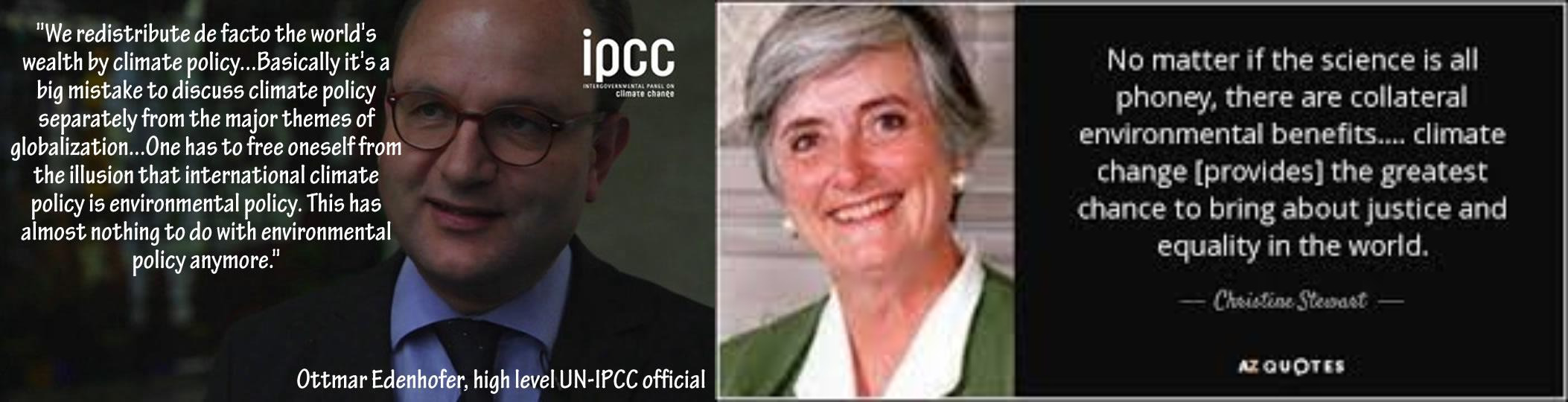
Climatism’s high apostles make no secret of the redistributive aims of the secular Green Religion. Here, for example, are Ottmar Edenhofer, Co-Chair of IPCC Working Group III, and former Canadian Environment Minister, Christine Stewart: they make no attempt to conceal the true, socialist-redistributive objectives of globally-directed, nation-state democracy-immune Climatism.Edenhofer-Stewart comp 2
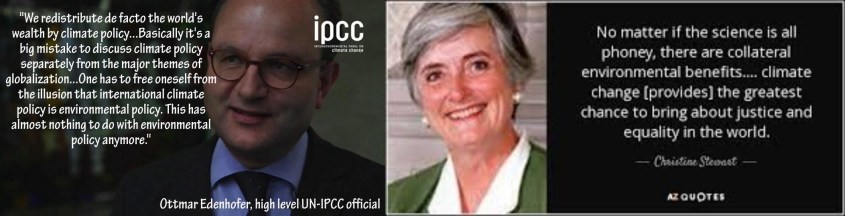
It doesn’t require a great leap of the imagination to discern the same sentiments in Bennett’s “putting resources into the real economy”, or the SNP’s “Climate Justice” Fund: as Friedman, especially, shows us, any movement with “Justice” as its suffix is almost unfailingly in reality a campaign for wealth/income abstraction and redistribution via State-coercion. And the universal support among our chosen Party luminaries for Britain’s continuing EU membership is a pointer, too: the EU seeks ever-more control over member-states’ economic and fiscal policies, with greater distribution explicitly included in its aims.

Curtailment of Personal Freedom.

The broad church that constitutes the Left in its widest sense distrusts individual liberty: philosophically, it remains in thrall to the Rousseauian concept of the human born pure but corrupted by his surroundings: to the inherent perfectibility of human society, given only sufficient power residing in the hands of the State. Climatism furnishes myriad openings to justify the extension of restrictions on personal freedom – and in how noble and incontrovertible a cause! – nothing less than the salvation of the planet itself.

Thus the increasing exhortations against flying (remember the Green Party’s Caroline Lucas, equating flying to Spain on holiday with murder by stabbing?), and the public implicit shaming of those whom the self-appointed arbiters of eco-propriety deem to have exceeded their allocated entitlement: the vocal disapproval of food choices on the laughably-flawed “logic” of grazing-space or food-miles: the drive to install smart-meters or third-party control systems into private homes to monitor, and even remotely-curb, energy consumption.

 Intolerance and Suppression of Dissent.

Few political movements have exhibited the vicious intolerance of dissent from the Green orthodoxy for which Climatism is, rightly, reviled – with the possible exception, that is, of those found in totalitarian states.

Dispute the received wisdom, that the mere 3% of atmospheric CO2 that results from human activity is catastrophically dangerous while the residual 97% that results entirely from natural climatological phenomena somehow isn’t, and you will be met, not with an attempted explanation (because there isn’t one, apart from the basic premise being wrong), but ad-hominem abuse, usually including an adverse judgment or three disparaging your moral worth as well as your motives.

Challenge why global average temperatures have been flat for 19 years despite continued rising atmospheric CO2, and you will be called, not an adherent to Popper’s Scientific Method, but the catch-all insult of “denier” – which is quite rich, considering that Climatists, to cling to the Green Orthodoxy, are themselves forced to deny 4½ billion years of more or less constant climate change, ever since the Earth’s formation, and often far more dramatic than any over which Climatism professes to agonise.

Confront the quaint notion that increased floods from (entirely natural) climate change are better prevented, not by improving flood defences but subsidising inefficient, expensive renewables off the backs of the poor’s energy bills, and you will be treated, not with discussion but with ferocious scorn and derision (but little else).

This is pure Leftist technique, the late 20th/early 21st century manifestation of what’s in Alinsky’s Rules For Radicals (from which Obama, incidentally, draws so much of his inspiration). “Your views are so self-evidently morally-repugnant (alternative: “driven solely by greed“)”, goes the Leftist narrative, “that they absolve me from any obligation even to debate the issue with you at all, especially as my aims are noble and altruistic, so that their ends in any case justify whatever means are required to realise them“. It’s called Shutting Down The Argument. Leftists (and Climatists) deploy it routinely.

None of this multi-faceted consistency of aims and policies between Leftism and Climatism should surprise, given the historical circumstances in which they came together. The 1989 collapse of Soviet-style communism and the end of the Cold War deprived the Left almost overnight of the models – economic, cultural, societal and geo-political – which for 70 years it had revered as inspiration for and validation of its state-authoritarian, collectivist, anti-capitalist, anti-Western philosophy.

The nascent environmental movement was the ideal candidate to replace it. It offered, not just an alternative justification for totalitarian-inclined, anti-capitalist, anti-Western, anti-freedom disaffection, but one with an even wider potential: this time, the oppressed victims, deemed to be in need of salvation from exploitation and subjugation by liberty, capitalism and free-markets, were not merely the downtrodden working-class masses: they were humanity in its entirety, and even the Earth itself.

Green New Red 3As described and referenced above, the takeover of the environmental movement by the hard-Left proceeded over the next 10 years or so, and it continues to this day, to the extent that Green and Socialist policies and outlooks are now virtually indistinguishable from each other on the Left of the politico-ideological spectrum.

It’s why the prescriptions advanced by and in the name of the secular Green Religion of Climatism bear such an uncanny, but strictly non-accidental resemblance to what Leftist political-economy has long advocated. Green really is the New Red. The red lights of politics, from the palest tinge of pink to the deepest shade of crimson, are all showing Green.

Thoroughly agree with this article? Vehemently disagree with it?

Scroll down to leave a comment

Follow A Libertarian Rebel on Twitter

Delicious Save this on Delicious

Flat-Earth Hour

The WWF’s fatuous Earth Hour is a marriage of cynical Green eco-propaganda with scientifically-illiterate virtue-signalling

Every year, it happens. Despite “climate change” justifiably figuring ever-lower in their major concerns reported by people in surveys around the world, every year it still happens.

wwf earth hour 2The World Wildlife Fund, today a wealthy mega-corporation with slick marketing, more concerned with promoting undemocratic one-world government to prevent enterprise-capitalism and free trade moving millions from poverty into prosperity than it is with saving pandas or polar bears – the latter of which are doing just fine, thank you, despite its relentless but mendacious climate-alarmism – enjoins the world to plunge itself into darkness for an hour, to “save the planet”.

This isn’t the place to launch into a detailed exposition of the numerous manifest flaws in the theory of catastrophic global warming being attributable solely to the mere 3% of atmospheric carbon-dioxide that results from all human activity. It would make this an article of 8,000 words rather than 800. But for the purposes of this article, just hold two thoughts in your mind. First, that despite the measured atmospheric concentration of CO2 having continued to rise, global average temperatures have been flat for nearly 19 years. And second, that the Earth’s historical record shows no significant CO2-temperature correlation anyway.

earth hour comp

But, even if you refuse to believe what logic should tell you, that you can no more “fight climate-change” that you can “fight” tomorrow morning’s sunrise: if you uncritically accept the Green orthodoxy: the point to realise about Earth Hour is that your gesture – because, make no mistake, that is what it is, not a “contribution” – will actually be futile.

Firstly, a pinprick one-hour interruption to the overwhelming majority of residential light use that occurs at night will have no emissions-reducing effects whatsoever, on anything. At night, most power stations run at the same capacity as during daytime peak demand periods, and produce electricity (and thus the same barely-measurable amount of greenhouse gas anyway), whether it is being used to create light or not. There is no way sufficiently economically- or technically-feasible to store this excess power produced at night  – which is why electricity generators sell off-peak power so cheaply to run our electric hot water systems at night, which function as virtual batteries. Hydro and gas-fired plants are responsive to fluctuating power demand: but others are not.

Secondly, in Britain, domestic household consumption accounts for only ~30% of overall energy use. Heating and hot water represent ~80% of that ~30%, while lighting accounts for a mere ~9% of it. In other words, under 2.7% of Britain’s energy consumption can be blamed on a recklessly eco-uncaring population “destroying the planet”, as the WWF would have you believe, by having lights switched on at night.

Thirdly, just consider the language used to justify a minusculely-effective measure that will achieve staggeringly little, if anything, apart from potentially more traffic accidents and crime. “Climate change is the most serious threat facing people and nature”, pontificates the WWF. You might, however, think that continued sluggish growth in the global economy, mass-migration from a Middle East mired in religious schism-induced turmoil, and the global threat from expansionist, violent-supremacist Islamist-Jihadism, are far more serious than a now 19 years-halted global average temperature rise of just ~0.8°C in 150 years as the Earth recovers from the nadir of the Little Ice Age.

North Korea good on climate change

Mind you, there is one place on Earth where deep-Green ideology’s eco-argument, flawed as it is, clearly resonates. As the satellite photograph shows, North Korea is the most enthusiastic observer of Earth Hour on the planet. So much so, in fact, that it’s observed every hour – every night. This is what the WWF wants us us to emulate.

If you really feel you’ll be making a contribution to saving Gaia by sitting in the dark or in candlelight for an hour this evening, repeating what, for thousands of years, people suffered out of dire necessity and lack of alternative, go ahead. But all you’ll be doing is unthinking, narcissistic virtue-signalling, telling yourself and your neighbours what a good and caring person you are, while simultaneously demonstrating both your scientific illiteracy and your gullibility to cynical Green eco-propaganda.

It’s nearly 140 years now since Thomas Edison patented the first modern light bulb. It allowed us to light our homes and our public spaces like never before. It’s a small but powerful symbol of man’s victory over what for aeons was a terrifying natural phenomenon: darkness, and its companion, the unknown. The WWF’s misguided war on light via its fatuous Flat-Earth Hour is a perfect metaphor for Green-environmentalism: it wants to return us to the Dark Ages.

Thoroughly agree with this article? Vehemently disagree with it?

Scroll down to leave a comment

Follow A Libertarian Rebel on Twitter

Delicious Save this on Delicious

The Heseltine Fascination

Chancellor George Osborne’s enduring deference to Michael Heseltine’s 1970s model of state-crony corporatism will lead to poor policy, regionally and nationally

Osborne budget boxUnderstandably, most of this week’s post-Budget reaction focussed on two things – Osborne’s continuing failure to ameliorate Britain’s worsening structural fiscal position, and the introduction of the illiberal (and almost certain to be largely-ineffective) sugar tax.

Less noticed, however, was how two Osborne announcements reveal, not only his ongoing attachment to the 1970s-style state-crony corporatism epitomised by (Lord) Michael Heseltine, but even his enduring fascination for Heseltine himself.

The first instance came just after Osborne’s reference to the Greater London Authority moving towards full retention of its business rates. He added:

“Michael Heseltine has accepted my invitation to lead a Thames Estuary Growth Commission and he will report to me with its ideas next year.”

To anyone familiar with the history of Heseltine’s political-economy, this should have rung warning bells. First, the very name “Thames Estuary Growth Commission” itself carries connotations of the semi-bureaucratic, state-interventionist, “Government picking winners” model of infrastructure development that Heseltine has long so admired (and of which more later).

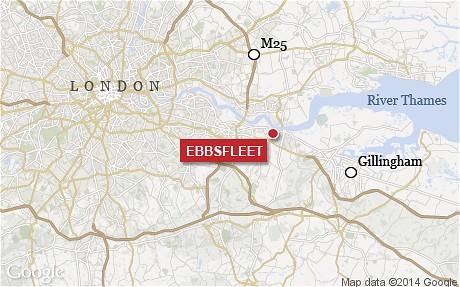
ebbsfleet-map 2014 v3Second, it recalled Osborne’s previous, and underwhelming, foray into Thames Estuary development. In the 2014 Budget, he announced, to the now habitual fanfare, that “Britain’s first Garden City in 100 years”, including 15,000 houses, would be built at Ebbsfleet. Critics, however, soon pointed out that a mere 15,000 houses hardly amounts to a Garden City, plus the inconvenient fact that Ebbsfleet itself, sitting on a flood-plain with an average height of just 2 metres above sea level, bordering the Thames Estuary, might be a, shall we say, less-than-ideal site for a new Garden City.

 Two years later, just 65 of the planned 15,000 houses have been built.

Then, shortly afterwards, Osborne named-checked the National Infrastructure Commission (beginning to sound familiar?) which he’d established under the aegis of the Treasury last year, and proclaimed the following:

“They recommend much stronger links across northern England. So we are giving the green light to High Speed 3 between Manchester and Leeds”

HS3 would, of course, be an extension of HS2, which is itself far from certain to go ahead, being mired in controversy:

  • Its projected cost has risen inexorably from even the risibly-low estimate of £50 billion once peddled unconvincingly by the Government, which, astonishingly, excluded off-balance-sheet costs.
  • It would have to be funded almost exclusively by borrowing, when the National Debt is already £1.5 trillion and rising.
  • HS2 IEA WellingsIts claims for economic regeneration of the North are dubious.
  • It is, and is likely to remain, beset by planning approval disputes and housing-blight claims, for years.
  • Its claimed service improvements could be met by lower-cost alternatives.

HS2’s flaws were comprehensively and forensically exposed by Dr Richard Wellings’ 2014 paper for the Institute of Economic Affairs.

Heseltine Infrastructure CommissionTurn now to Osborne’s National Infrastructure Commission itself. Who does one find adorning the ranks of its Commissioners? Why, none other than ……. Michael Heseltine.

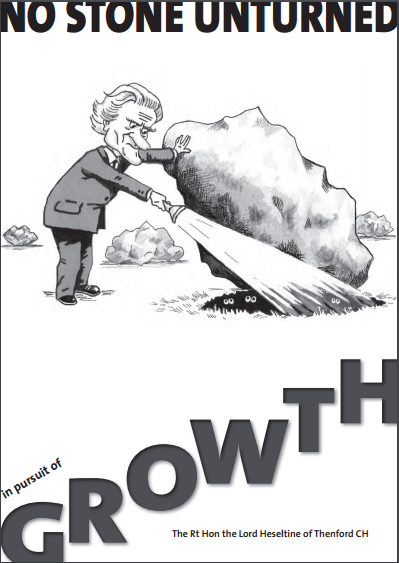
Heseltine was recruited into the Treasury, with Osborne’s approval, to “advise” on infrastructure development and urban renewal, because of his 2012 report “No Stone Unturned In Pursuit Of Growth” that purported to be a putative blueprint for stimulating economic growth.

In its 89 recommendations, however, over 80 of which the Coalition accepted, it presented in miniature a picture of the interventionist-government corporatist state of the 1960s and 1970s: the decades in which Heseltine cut his political teeth, and for which its practitioners could, despite its manifest flaws, conceive no alternative.

It showed that Heseltine remains an unrepentant apologist and enthusiast for Big Government: that his vision for stimulating economic growth is one of national industrial policy, governmental top-down oversight, regional-quango consensus investment, local council-level enterprise partnerships with spending grants. For Heseltine, Adam Smith’s invisible hand must, it seems, be subsumed within multiple layers of statist-corporatist glove.

Heseltine no stone unturnedHis is an approach that instinctively eschews solutions based on economic liberalisation, deregulation and free markets: like regional pay to mitigate any crowding-out effect of nationally-set pay rates, especially in the public sector, on local job opportunity uptake: like encouraging more non-State free schools and academies, with the freedom to adjust their curricula to make them attractive to students who will be seeking employment in the area: and like, above all, unblocking the planning process in which so many developments can get bogged down.

He appears to favour what he termed “growth funds” being allocated through new Local Enterprise Partnerships. But given that the money would come from people and businesses via the tax system in the first place – Government has no money of its own – quite why government and the local quangocracy would be better judges of investment potential than savers, investors and businesses themselves was not explained. Not much of Gladstone’s enjoinder to let money “fructify in the pockets of the people” there.

Heseltine’s recommendations were roundly criticised at the time by a Professor of Economic Geography at the LSE(!), no less, as “a return to policies, many of them not particularly successful, that were developed in different times, to tackle different challenges”. It’s difficult to suggest these words don’t equally apply in 2016.

The FT’s Janan Ganesh wrote in late 2012 that Heseltine’s prescription for encouraging infrastructure development was very much a Gaullist vision. This still resonates: Heseltine’s vision is more akin to France’s state-dirigisme of Les Grands Prôjets: yet it’s in France where the State’s share of GDP persists at an unsustainably-high 50+%, unemployment is at levels not seen for two decades, and competitiveness continues to fall.

osborne delivers budget 16mar16Osborne’s reverence for Heseltine is misguided, and counter-productive. To stimulate the infrastructure growth of the future, Britain needs, not reheated 1970s-style regional industrial policy predicated on state-interventionism, but a comprehensive supply-side revolution. We need a smaller state, lower, simpler and flatter taxes, less-onerous workplace regulation, a freer and more responsive education system, and a major reform of planning law.

Sadly though, while we have a Chancellor of the Exchequer so ideologically in hock to Heseltine’s state-crony corporatism, that will remain an impossible dream.

Thoroughly agree with this article? Vehemently disagree with it?

Scroll down to leave a comment

Follow A Libertarian Rebel on Twitter

Delicious Save this on Delicious

The Incredible Shrinking Chancellor

Formerly seen – not least by himself – as a master strategist and astute political operator, George Osborne’s authority is eroding before our eyes

“Events, dear boy, events”, former Prime Minister Harold Macmillan is reputed to have replied when asked to predict the factor most likely to derail his political plans. He meant “the unexpected”: in modern political parlance, the “unknown unknowns” that can, and almost always do, erupt, unforeseen, seemingly out of nowhere, to blow the most carefully-crafted plans off course.

Chancellor of the Exchequer George Osborne could be forgiven for spending more time than usual ruefully recalling Macmillan’s remarks at the moment. Because, since the start of 2016, his plans for his own political advancement have been derailed spectacularly, to an extent which, on 1st January, he can surely scarcely have imagined. Yes, partly by some of those unknown unknowns: but, ironically, also by his own blunders. His stature and authority are crumbling astonishingly, virtually on a daily basis.

Osborne with shadesYet, contemplated from Osborne’s New Year’s Day breakfast table, 2016 must have looked satisfyingly promising. First, Budget Day on 16 March would give him the opportunity to continue the centre-leftwards tack started in his 2015 Autumn Statement, designed to capitalise politically on Corbynite Labour’s charge towards hard-Leftism, by hoovering up disaffected Blairites and Labour moderates into the Cameroon social-democracy-leaning Big Tent.

Second, David Cameron would round off his tour of European capitals pressing for EU reforms at the Brussels EU Heads of Government Summit over the weekend of 19-21 February. True, he’d return with only trifling and essentially cosmetic reforms. But, accompanied by some lurid Brexit-alarmism, a Cabinet united in campaigning for Remain, and a “helpful” media narrative, they should be just enough to persuade a risk-averse British electorate to vote to stay in the EU. Clearing the way for Cameron to resign in triumph as Prime Minister and Party Leader some time in 2017 or 2018, and leaving Osborne in pole position to see off any  challenge and ascend to No 10.

Except it hasn’t quite worked out like that. In fact, it’s rapidly going pear-shaped. “Events, dear boy, events”.

Take the EU “re-negotiation”. Yes, Cameron did indeed return from Brussels with a “reform” deal: but one of such abject and transparent paucity, ineffectiveness and unenforceability, that it had unravelled, and been both rightly exposed and excoriated for it, within 72 hours. And to such an extent that the Government’s official Remain campaign strategy adopted, almost from Day 1, what had been hoped would be the back-up strategy of Project Fear. Any plausible pretence that there is a “reformed” EU at all has been dropped. Brexit-scaremongering Project Fear, to all intents and purposes, is the  Remain campaign.            

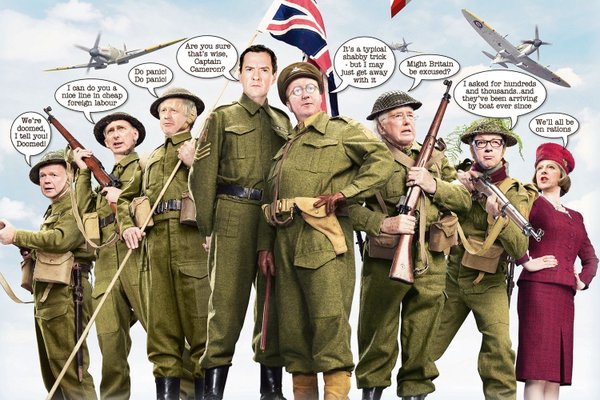
Conservatives - Careers before countryThen, from Osborne’s point of view, came the bombshell. He must surely have reckoned that both Boris Johnson and Michael Gove would be reliably on side, fully signed up to the Government’s official position, as fellow-advocates for Britain staying in even the risibly non-“reformed” EU that was on offer: Boris because of his general pro-EU and internationalist outlook, including a desire to see Turkey in the EU, and Gove because of his personal loyalty to Cameron. Before the Brussels summit of 19-21 February, even this political cartoon was circulating: the Party heavy-hitters, including Boris and Gove, lined up, Dad’s Army style, in Captain Camwaring’s pro-EU Home Guard platoon.

Not any more. Because in fact, the opposite happened. Boris, after much public and private agonising, declared for Leave, and Gove, with what must be one of the finest personal statements to grace British politics for a very long time, did the same.

Those two “defections”, I suspect, rocked Osborne back on his heels: not just on account of their unexpectedness, but also because of their implications, both for the EU Referendum itself, and consequentially, for Osborne’s own political future. On the Leave campaign, to Boris’ public appeal is added Gove’s principled integrity and intellectual heft. They make the outcome of the Referendum far closer and far less predictable: that the Government and Remain could actually lose it, and that Leave could triumph in a vote for Brexit, really isn’t beyond the bounds of possibility.

If that happens, despite his bluster, Cameron would, politically, be Dead Man Walking: and given that their political ideologies and fortunes have been so inextricably linked for 25 years, that means Osborne would too. Even with a wafer-thin Remain win, Cameron’s credibility, and thus Osborne’s, will be seriously damaged: the latter’s, possibly fatally, with intra-Party talk already being that the next leader will almost certainly have to come from the Party’s pro-Brexit wing.

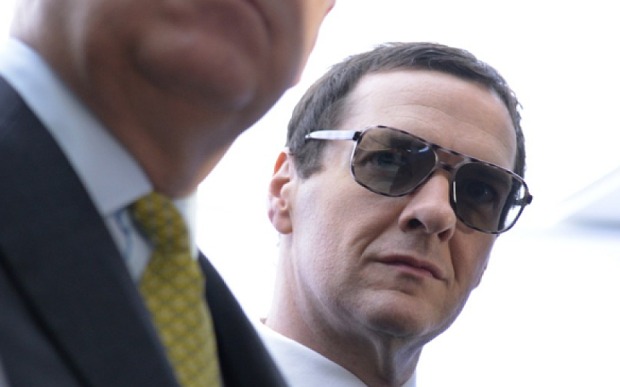
osborne looking grimNo wonder Osborne has suddenly seemed such diminished figure, thrown off balance, ever since. His prospects of following his planned and mapped-out route of a smooth ascent to No 10 in the wake of a benignly-departing David Cameron have suffered a severe blow: they may even be receding, a victim of Boris’ burgeoning popularity with Party members and activists since his ostentatious and publicity-maximising conversion to the Brexit cause.

And it gets worse. Because, intriguingly, in only the barely three weeks that have elapsed since the denouement of these events, a gaffe-prone Osborne has been either been caught out and had to retract hubristic claims, or forced to execute a sharp policy U-turn in an humiliating climb-down, or experienced an open challenge to his authority and rebellion from his own backbenchers, on no fewer than seven separate issues.

First, the Google tax deal. A clearly pleased-with-himself Osborne made extravagant claims for the £130 million agreement he had reached with Google, presumably on the calculation of reaping political capital from the vocal lobby opposed to any (entirely legal) tax-avoidance by multinationals. That soon unravelled, however, with the revelation that it covered a full 10 years of back taxes and amounted to an effective tax rate of only 3%, against the UK standard corporation tax rate of 20%. It concluded with scathing criticism of Osborne from his own backbenchers, both the Commons Public Accounts and Treasury Committees launching separate inquiries, and both Google and HMRC being asked to re-appear before themGoogle, meanwhile, are reportedly furious with Osborne for making self-aggrandising claims which have given them additional poor publicity.

Second, the claims of extra tax revenue from the lower top rate. Osborne boasted  that an additional £8 billion in tax revenue had been generated from the reduction in the top rate of tax from 50% to 45%, attributing the entire amount to the rate change. Unfortunately for him, that was quickly challenged as “precarious” by none other than the Institute for Fiscal Studies, on the grounds that it ignored any deferment factor and was more a one-off gain than a systemically-permanent windfall. We have heard no more about it.

Third, the planned tax-raid on pensions. Osborne had been planning a very Gordon-Brownian stealth-tax: to abolish higher-rate tax relief on pensions, and lower the threshold at which money invested in a pension pot starts to attract high, almost penal, rates of tax. The entirely predictable backbench uproar duly ensued, with Osborne’s plans being rightly denounced as simultaneously both economically-incompetent – disincentivizing prudent retirement saving – and politically-inept – targeting a natural Tory electoral constituency. They have been dropped.

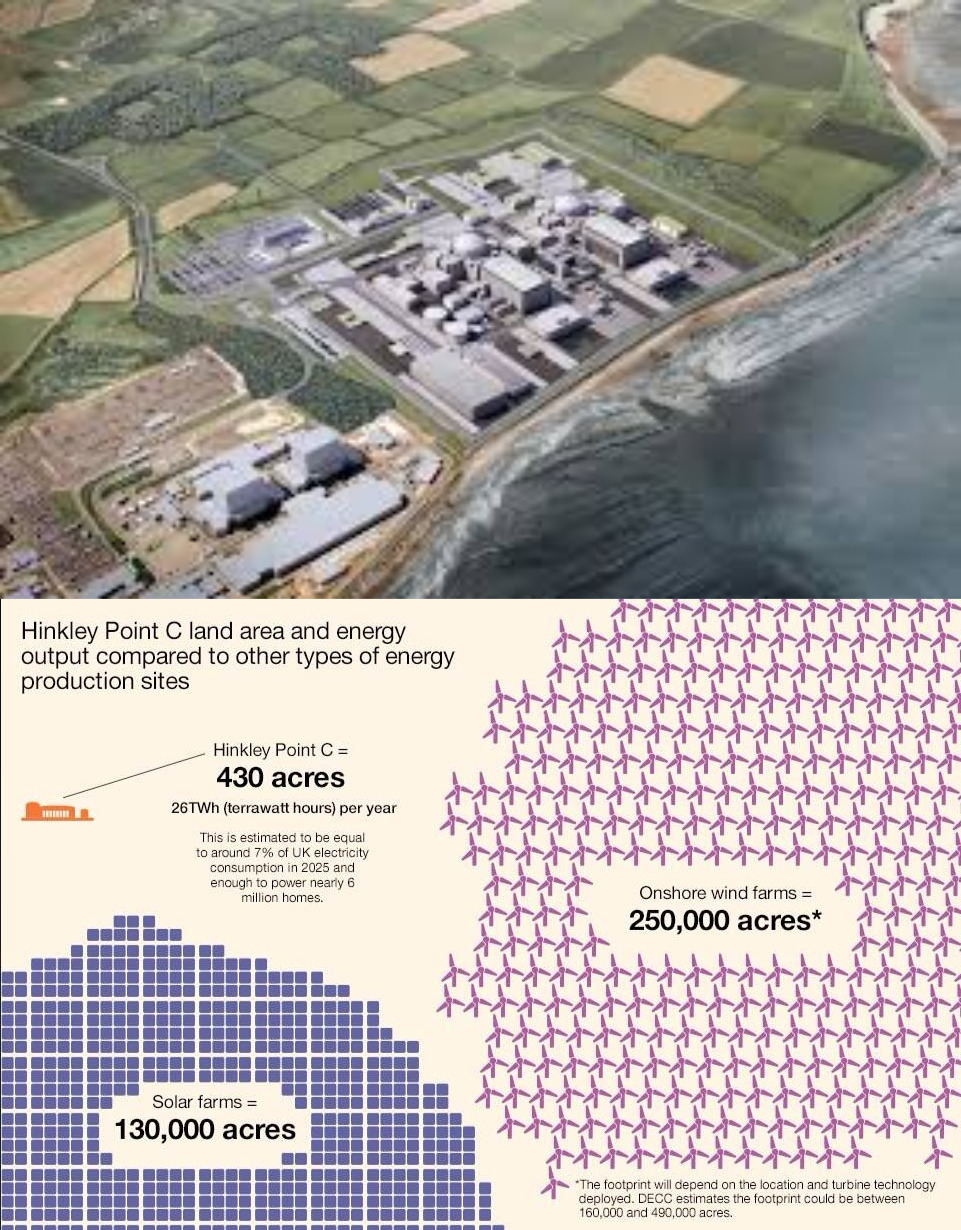
hinkley Point comp 2Fourth, Hinkley Point Nuclear Power Station. This was announced with much fanfare by Osborne on his September 2015 trade visit to China. The deal, was, though, subject to a £2 billion taxpayer guarantee to EDF, without which they would have struggled to secure project finance, and immediately attracted informed criticism because of its capital intensiveness and cost per MWh of output. It’s now emerged that the building cost has roughly trebled, the strike-price per MWh for its output has doubled, and the start date has been put back 8 years: all within 6 months. The calls for it to be scrapped as an expensive and uneconomic white elephant are growing.

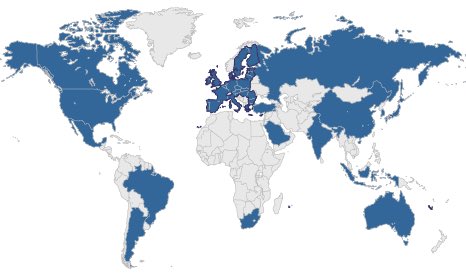
G20 vs EU How Do They Cope via Julia H-BFifth, the G20 warning against Brexit. At Osborne’s initiative, the plan was for the G20 group of advanced economies to warn Britain against exit from the EU. That quickly collapsed, to widespread derision, when commentators pointed out the inconvenient fact that 16 of the 20 G20 countries are actually outside the EU, yet self-evidently still manage to be in the top 20 economies globally. Prompting the question: how could they then credibly warn Britain, the 5th largest, that it must be inside the EU to ensure its very survival? Silence.
Sixth, this week’s Sunday Trading liberalisation débacle. Despite being warned of the likelihood of both the SNP yet again ignoring their pledge not to vote in Westminster on what are devolved matters in Scotland, and an incipient Tory backbench rebellion, Osborne nevertheless determined to push the Bill through the Commons. When it became apparent that the SNP and Osborne’s own backbenchers would indeed carry out their threats, there was a ham-fisted attempt to water down the Bill’s provisions, culminating in an humiliating rebuff from the Speaker who refused to accept a related Motion.  SNP MPs duly supported Labour, the Tory rebels duly rebelled, and an embarrassing defeat for the Government, plus the loss of the liberalisation measures, was the outcome.

Seventh, another Tory backbench revolt, against another Osborne tax rise, this time on motor fuel duty. Despite 74% of the pump cost of a litre of diesel or petrol now comprising tax, Osborne, it appears, had planned to use next Wednesday’s Budget to increase the duty even further. Cue the now normal resistance movement, by up to 150 MPs, and the plans for a hike in the duty are reportedly being shelved.

These kinds of setbacks aren’t unprecedented: Osborne has had wobbles before. Think of the Pasty Tax in the 2012 Omnishambles Budget: a previous attempt to raise fuel duty with effect from January 2013 which similarly had to be abandoned on backbench pressure: and the tax-credits imbroglio of 2015, when an Osborne converted, we were told, to “listening mode” was equally forced into an embarrassing retreat.

osborne looking grim 2But Osborne’s present troubles look and feel different, quantitatively and qualitatively. Quantitatively, because they’ve been coming thick and fast – no fewer than seven, and in just three weeks, which, I’d venture to suggest, is unprecedented. Qualitatively, because they contain an element which hasn’t been present in earlier iterations – a ready willingness, particularly among Tory backbenchers, not merely to voice misgivings, but vocally and robustly to resist, rebel, criticise and take to the media to denounce the Chancellor’s proposals in no uncertain terms, both as economically-disadvantageous and politically-inept.

The latter charge being especially ironic, and wounding. Because Osborne is, above all else, a Political Chancellor, far too prone to seeing virtually every aspect of economic and fiscal stewardship through the prism of partisan political triangulation. The shameless stealing of Blairite clothing in the form of a National Living Wage (aka, arbitrarily raising the floor price of labour to employers by State diktat) is but the latest example.

Osborne has long been lauded – not least by himself – as a political master-strategist. But, in truth, his excessive concentration on it, to the detriment of his economic and fiscal stewardship, has had decidedly mixed results. He’s been allowed to get away with increasing the National Debt by more in five years than even that preposterous antithesis of fiscal rectitude, Gordon Brown, managed in thirteen, largely because, when only 6% of the population know the difference between deficit and debt, few votes were risked by it.

Yet being master-strategist for two elections, 2010’s not won, even against Brown, and 2015’s, not expected to be won, but won mainly out of voters’ fear of a Labour-SNP government, tell a different story. As does the prevalence of the “austerity” narrative, despite the lamentable pace of deficit reduction. During the 2010-2015 Coalition, the overall rate of public spending reduction was a miserable 0.4% pa in real terms: supposed political master-strategist Osborne, however, succeeded in being portrayed as the heartless architect of Victorian-workhouse austerity, for the macro-fiscal equivalent of reducing a weekly £200 shopping bill by 80p.

So the last month’s acceleration in the decline of Osborne’s standing is partly an overdue reckoning: but its litany of serial hubris, politico-economic miscalculation, U-turn and climb-down, in just 20-odd days since the shock of Boris’ & Gove’s defection to the Brexit cause, have notably exacerbated its visibility. The wider appreciation of his Brown-like inveterate political-meddling and fiscal neo-Keynesianism, stealth-taxes and all, mean that the “Osbrowneomics” and “Osbrowne” memes are gaining wider currency.

osborne looking hauntedAs each successive Tory backbench anti-Osborne rebellion yields results, his critics are becoming more emboldened. They’re getting a taste for it, scenting blood. Osborne suddenly looks at bay, haunted, error-prone, wan, vulnerable, yesterday’s future, a fast-diminishing figure, in a way few can have predicted on 1st January.

He really is The Incredible Shrinking Chancellor, his stature and authority crumbling daily before our eyes.

Thoroughly agree with this article? Vehemently disagree with it?

Scroll down to leave a comment

Follow A Libertarian Rebel on Twitter

Delicious Save this on Delicious

Does Democracy End At Dover?

To support English Votes For English Laws, yet argue that the UK should stay in the EU, isn’t merely politically inconsistent, but intellectually incoherent

Conservative Party MPs, coming as they do overwhelmingly from English constituencies, have discovered a new enthusiasm for more representative democracy in the current Westminster Parliament. Whether this is solely out of high-minded philosophical principle, or from rather grubbier psephological considerations, one cannot say: but that the election to Westminster, at the May 2015 General Election, of 56 Scottish National Party MPs has re-awakened awareness among English MPs of the iniquities of the West Lothian Question is an indisputable fact.

SNP MPs HoC May 15To their credit, they’re right to be concerned. Despite the SNP’s pre-election pledges that its MPs wouldn’t use their votes in Westminster on issues affecting England which are devolved matters in Scotland, it wasn’t long before those promises were being broken. Scottish MPs have been inventive – some might say speciously so – in deploying a tortuously-constructed argument, that policies intended to apply only in England can somehow also have unexpected and (conveniently unspecified) adverse knock-on effects in Scotland, as a rationale for resiling from their prior commitment.

And so the issue of an exclusively English Parliament, or English Votes for English Laws, has come back into prominence. Irrespective of the precise method that will eventually be chosen to implement EVEL, English MPs are rightly re-asserting a fundamental principle: that the laws governing the citizens of a polity can legitimately be those, and only those, made by, and only by, the representatives directly elected by the citizens of that polity, and whom they can remove from office via the ballot-box at the next election.

So far, so democratically-exemplary. But after this point, things start to get more tricky. Because many of those English MPs have also declared that they will both campaign, and vote, for the UK to remain a member of the European Union. And the EU, as a polity, is a very, very long way from being democratically-exemplary.

To understand why, we have to consider the very concept itself of the demos. The collection of people, almost always most-definable territorially, whose citizens – even when not mutually-acquainted, or ethnically-homogeneous, or religiously-affiliated – nevertheless feel that they do share enough of a common identity, set of values, and sense of being (even distant) co-partners in a joint enterprise, that they will accept one legislature, and one body of laws, as being legitimate to govern them all.

There’s undoubtedly a strong English, and even a strong British demos. Superficially, I might not appear to have much in common with someone of a different ethnicity in Birmingham, or a different religious-affiliation in Bradford: but the point is, I do feel sufficiently like them, and sufficiently part of the same collective political enterprise with them, that I’m prepared to live politically-alongside them, under a democratically-elected government chosen by us all, and a body of laws, made only by that government or its similarly-elected predecessors, applying equally to us all. Even to the extent of consenting to part of my income or wealth being abstracted by a government which we have together elected, and redistributed to them if they’re in need. That’s what the demos means.

But there’s no EU-wide equivalent of this. I don’t feel remotely xenophobic or hostile towards someone in, say, Bialystok, or Bologna, or Bilbao: but, crucially, I also don’t feel anything remotely approaching such a sufficient degree of affinity, or sense of co-partnership with them in a common “European” political enterprise, that I want or am prepared to consent to be part of the same pan-European political space, under the same pan-European government, and the same pan-European body of laws.

There is little evidence of such unwillingness being anything other than strongly reciprocated, among hundreds of millions of people, all over Europe. That does not, as the EU likes to pretend, equate to “xenophobia”, or “nationalism”. It means merely that the criteria which must be fulfilled for a democratically-legitimate polity encompassing all 28 EU member-states to emerge and subsist aren’t capable of fulfilment by popular consent.

The ineluctable conclusion, therefore, is that, as history has so often proved but the EU is philosophically-resolved to ignore, the territorially-defined sovereign nation-state, governed exclusively by its own legislature that is democratically-elected by universal suffrage, is the largest political entity in which the pre-conditions required for a politically-legitimate demos can be fulfilled. To emphasise, there is no “European” demos.

So, I contend, the European Union is democratically-illegitimate as a concept at the fundamental level of political theory, even before we confront the physical democratic deficit of the European Parliament as its purported legislature.

Interior EU Parliament

To start with, even the basic numerical comparisons are strikingly unfavourable. The entire aggregate UK electorate elects a full 100% of Westminster MPs: but no more than a mere 9.7% of MEPs. The average number of electors represented by a Westminster MP is c.68,000: but for each of the UK’s 73 MEPs, that figure is c.840,000. (Intriguingly, the equivalent Luxembourg figure is c.77,000). How any UK MEP can properly represent and address the EU-relevant concerns of nearly 840,000 constituents is a moot point. But an irrelevant one: because even their theoretical ability to do so is so severely constrained by the democratic deficit of the Parliament itself.

EU Parl processMembers of the European Parliament, despite being elected, must be among the most politically-emasculated and impotent legislators in the democratic world.  MEPs, whether individually or collectively, can neither initiate, propose, reject outright, or repeal EU legislation. Those are all rights reserved exclusively to the unelected, and therefore both lacking-in-mandate and democratically-unaccountable, members of the EU Commission.

In the European Parliament, it’s the appointed, not elected, members of the European Commission, meeting in private, who have the sole right to propose, repeal or amend the corpus of EU laws, directives and regulation that constitute up to 70% of the new legislation having application in the United Kingdom. As the graphic shows, the Parliament’s role is barely even consultative: its legislative influence, I’d suggest, is, in practice, negligible.

Contrast that with the Westminster Parliament, where any MP may introduce a Private Member’s Bill, and moreover, via one of no fewer than three different methods available. Two of the greatest social reforms of the last 50 years – the decriminalisation and legalisation of both homosexuality and abortion – were both the outcome of Private Members’ Bills.

To pretend that this sham legislature somehow equates to, or confers on the EU, any democratic legitimacy whatsoever, is little short of a linguistic travesty. It is truly a Potemkin Parliament, rendering the European Union democratically-illegitimate in practice.

Paradoxically, one of the greatest, yet most perverse and least-deserved achievements of the EU is somehow to have convinced so many citizens of its member-states that, while, yes, there may be an element of democratic deficit about it, this is:

  • just an accidental by-product of the EU fulfilling its main aims of friendship and trade via economic co-operation; and/or-
  • regrettably necessary anyway to ensure the smooth functioning of the trading bloc.

To propagate this myth is a grotesque lie, and is cynically to stand both history and truth on their heads. For, as anyone with knowledge of the EU’s founding and history knows, not only was the EU primarily a political-integration project right from the start, with trade and economic convergence being merely its ostensible purpose to conceal that: but it was also deliberately conceived, designed and constituted specifically to be, not just undemocratic, but anti-democratic.

The EU’s founding fathers, particularly Monnet and Spinelli, were profoundly distrustful of voters, and viscerally antithetical to nation-state democracy. Building on original semi-utopian pan-European ideas circulating in the 1920s and 30s, they drew from the two World Wars the wrong conclusion: that it was the mere existence of nation-states in themselves, rather than the emergence within some of them (and only some of them, remember – when did Switzerland, Luxembourg or Norway last launch an aggressive war?) of fundamentally bad ideas like aggressive Communism, Prussian-Militarism, or Fascism, that inevitably led to war. It is this same self-delusion and deception that today leads the EU to claim implausibly that it, rather than NATO, has been and is the guarantor of a Europe at peace.

Monnet on subterfuge 2They set out, therefore, to promote the creation of a supra-national political entity in which the decisions and preferences of the citizens of sovereign democratic nation-states, expressed through the ballot-box, would be bypassed, ignored and ultimately superfluous, enabling rule by an appointed class of technocrats-bureaucrats, immune to the caprices of voters and the need to obtain their consent.

That ethos still prevails in the EU of today. It isn’t even particularly concealed or denied. It was expressed perfectly by the former President of the European Commission, the Maoist Jose-Manuel Barroso when insisting only a few years ago that “democracy is dangerous”. The EU’s democratic deficit is neither accidental, nor incidental. It is deliberate and fundamental to it, and was designed-in from the start.

This, then, is the gimcrack-polity, demos-lacking, democratically-flawed in both concept and practice, artificially constructed and imposed top-down by successive cadres of an unelected, unaccountable, largely self-selecting, pluralism-contemptuous, voter-consent-averse, bureaucratic-technocratic elite, and maintaining a near-powerless Potemkin Parliament as a sham legislature to provide a wholly unconvincing facade of democratic legitimacy, inside which so many of those English MPs who enthusiastically support EVEL – ostensibly in the name of representative democracy, remember –  nevertheless fully intend to vote to keep the United Kingdom locked..

F Scott Fitzgerald speculated that the ability to hold two contradictory opinions at the same time and still function was the mark of a first-rate intelligence: Leon Festinger suggested, on the other hand, that it was a strong indicator of cognitive dissonance. As far as those English MPs simultaneously supporting both EVEL and the UK’s continued membership of the EU are concerned, my inclination is to regard Festinger’s explanation as the more likely. Because their stance isn’t merely politically inconsistent: it’s also manifestly intellectually incoherent.

Thoroughly agree with this article? Vehemently disagree with it?

Scroll down to leave a comment

Follow A Libertarian Rebel on Twitter

Delicious Save this on Delicious