Tag: Business-Regulation

Brexit-Watch: Saturday 14 March 2020

Note: Longer and updated version of the article originally published at The Conservative Woman on Saturday 14 March 2020

A weekend update on some recent key Brexit-relevant story headlines, choosing five which, while not necessarily meriting a full-length article, nevertheless warrant two or three paragraphs of comment, rather than merely a couple of lines.  (NB: (£) denotes article behind paywall.)


Don’t be surprised if this virus delays BrexitTelegraph (£)

From the moment COVID-19 Coronavirus appeared on the horizon as something likely to cause more than the usual winter virus disruption, its use as an excuse to justify delaying Brexit was probably inevitable. The infection potential of both non-essential travel and face-to-face meetings are the grounds most often cited, but it’s also been suggested that the Brussels negotiators may just unilaterally decide to suspend negotiations anyway. Purely for medical reasons, obviously. . . .

Both economically and politically, Brexit is the government’s Number One priority after the Coronavirus outbreak, and as the Prime Minister is not conducting them personally, nothing should be allowed to interrupt them. Meetings can continue via video-conferencing from sterile areas.  The texts of drafts of agreements or appendices can be exchanged by email.  If the EU’s negotiators refused to continue with them, then the PM must make it clear that no extension of the Transition Period will be sought, and that Britain will revert to WTO terms in the event that no deal is reached.

Had the Coronavirus outbreak occurred in 2022 or 2023, causing a global downturn one or two years after full-and-final Brexit, would anyone have seriously suggested reversing Brexit and rejoining the EU as a response to it?  Of course not.  Then there’s no reason to defer it now, especially as Britain remains under EU trading and other rules including the Common Fisheries Policy, and also subject to ECJ jurisdiction, until the end of the Transition Period, which the EU itself defines as ‘until at least 31 December 2020 (my italics).


Von der Leyen on virus: ‘EU will do whatever is necessary’EU Observer

Which may be: not very much, or not very much that makes a significant difference, anyway. The EU, at least as represented, in Angela Merkel by a lame-duck German politician, in Ursula von der Leyen by a failed German politician, and in Christine Lagarde by a French Eurocrat widely thought to be unsuited to her present ECB role, have by the latter’s admission yet to come together at all, never mind developed a co-ordinated response, let alone sold it to member-states. 

The EU’s institutional sclerosis, along with its lack of a practical either fiscal or monetary policy toolkit commensurate with its supranational pretensions, will almost certainly prevent it coming to either a swift, or especially effective, decision.  So far, for all its resolute declarations, it has dithered but actually done very little.  All that the competition-lawyer-pretending-to-be-central-banker Lagarde managed to do as Head of the ECB was to spook the markets.

The effect of that inaction is already being seen in individual member-states reverting to unilateral decision-making at nation-state level, or in Germany at even regional level.  Nation-state governments are re-asserting themselves and, more importantly, are being seen to respond to their citizens’/voters’ demands in a way that the EU either will not, or more likely institutionally just cannot.  Nation-state borders are back, as their elected governments reimpose them without even bothering to consult Brussels, such is the perceived urgency of protecting their own citizens.

The utility, even the concept, of pan-European supranationalism is being severely tested by Coronavirus.  Anti-democratic supranational technocratic government, open borders and free movement are all now effectively dead, which means the EU in its present form is quite possibly terminally damaged. 

As far as the Brexit negotiations are concerned, this should all strengthen Britain’s hand, and is another reason why the talks should not be allowed to be interrupted or deferred.


Macron orders closure of all schools in France and warns he may even shut the country’s borders to control Coronavirus Daily Mail

For the Macron who was once the Davos/Bilderberg globalist oligarchy’s poster-boy for both ‘enlightened’ government by supranational technocracy and wide-open borders, this is an embarrassing climbdown.  However, in the same broadcast as he used to announce it, he also warned against ‘nationalist withdrawal’ as a pitfall to avoid at international level in the fight against the coronavirus pandemic, so policy-wise, he appears to be all over the place.

With Macron preoccupied with trying to reconcile securing the French nation against the Coronavirus outbreak with maintaining his EU-integration credentials, and both against the backdrop of difficult French municipal elections this coming Sunday and the next, his influence as one of the Intransigents on the Brexit negotiations is waning.


UK’s antivirus measures disguise radicalisation of Brexit FT (£) 

A slightly hysterical article from the FT‘s Europe Editor, claiming that Brexit is evolving into a project far more ‘extreme’ than even Leave-voters wanted in the 2016 EU Referendum, merely because Britain’s negotiators are concerned to ensure that it achieves visible separation from the EU’s political, regulatory and legal structures.

Barber quotes Britain’s withdrawal from the EU Safety Agency as evidence of this; yet goes on to conflate EU-centralised regulation of air safety standards regulation with ‘pan-European co-operation’, which clearly it is not.  Regulation is not ‘co-operation’.  It is to achieve the latter that we need to escape the former.

Barber then bemoans the UK’s alleged abandonment of Theresa May’s commitment to the so-called ‘level playing field’.  But the EU has made it abundantly plain that it interprets that phrase as UK perpetual alignment with EU rules, despite having no say in them and how they are formulated.  It’s hard to see his article in any other light than a polemic against any kind of Brexit which isn’t in-name-only.  Even after all this time.


EU’s demands in negotiations with UK revealed in draft treaty Guardian

The EU appears to have evidently learned very little, and therefore changed very little.  The draft continues to insist on ‘level playing field’ rules for (all) British and EU businesses, and also in regard to state-aid.  It maintains its previous demand for the ability of the European Court of Justice to hand down rulings binding on British Courts, and ongoing regulatory harmonisation with EU laws as they develop in other areas, effectively binding the UK to EU legislation, but with no input into it.

On fishing, it proposes ‘long-term’ (NB duration not specified) agreements on access to British waters but with each side’s percentage allocation also unspecified.  On security and intelligence matters, it requires Britain in effect to guarantee its continuing application of the European Convention on Human Rights, despite its manifest flaws, with data and intelligence sharing to be withdrawn if it does not.

The UK is expected to reject most of this as unacceptable, and rightly so.  The prospect of exiting the Transition Period without any satisfactory deal, therefore, goes up another notch, as does, inevitably, the futility and counter-productiveness of any extension of the Transition Period.

This in turn must prompt the question of whether it is worth Britain persisting in this charade at all, especially if it is to be prolonged on some spurious pretext using the Coronavirus outbreak as a transparent excuse. Better to abandon it now, declare negotiations at an end, prepare for a WTO/No-Deal exit from the Transition Period, and focus our energies on ameliorating the Coronavirus outbreak in this country.

Thoroughly agree with this article? Vehemently disagree with it?

Scroll down to leave a comment

And follow A Libertarian Rebel on Twitter and Gab

Brexit-Watch: Saturday 07 March 2020

Note: Longer and updated version of the article originally published at The Conservative Woman earlier today, Saturday 07 March 2020

A weekend update on some recent key Brexit-relevant story headlines, choosing four which, while not necessarily meriting a full-length article, nevertheless warrant two or three paragraphs of comment, rather than merely a couple of lines.  (NB: (£) denotes article behind paywall.)


Brexit row erupts after Barnier accuses UK of planning to ditch human rights commitmentPolitics Home

In a typically disingenuous combination of red herring and attempt to assert EU extra-territorial jurisdiction over the post-Brexit UK, Barnier has accused the UK of ‘refusing to continue to apply’ the European Convention on Human Rights (ECHR) after full-Brexit. This is arrant nonsense.

The ECHR is the creation of the immediate post-WW2 Council of Europe, is enforced by the Council’s European Court of Human Rights (ECtHR) in Strasbourg, and is separate and distinct from the EU.  The latter is not even a signatory to the Convention, merely requiring new member-states to be signatories, and the EU has no jurisdiction over it.

It’s conceivable however that, once freed of the obligation to be a signatory to the ECHR by virtue of its EU membership, the UK could decide after Brexit to enact its own Bill of Rights (possibly linked to a written Constitution) and, as part of that, withdraw from either the ECHR in full or merely from the jurisdiction of its ECtHR.

As Lawyers for Britain‘s Martin Howe QC explains, there’s a compelling case for such a move.  The Strasbourg human rights court has come to mirror some unsatisfactory features found also in the EU’s own European Court of Justice, principally a tendency to judicial activism rather than interpretation, introduction into European human rights law of concepts not present in the original text, and the predominance of the Continental Codified, rather than English Common Law, legal tradition.

Barnier in effect wants the EU to have the power to direct the democratically elected government of an independent sovereign nation-state on which international treaties and conventions it should or should not sign up to. That is an outrageous demand that deserves to be dismissed out of hand.


Paris versus London: the clash of the financial centresJohn Keiger, Briefings for Britain

Having failed, in the immediate aftermath of the 2016 EU Referendum, to persuade many, if any, City-based European banks to move their London operations to Frankfurt or Paris, the French are now coming back, but cloaked in the EU flag, for another attempt.  The possibility that this is sabre-rattling as part of French domestic politics’ general background noise to the upcoming French municipal elections this month, where Macron looks likely to be embarrassed at least, can’t be ruled out.

Despite the European Banking Authority having made the move, London’s sheer size, global reach, expertise, power and capacity for innovation as an international financial centre compared to Paris suggests this will be a futile quest.  Even if this were not a factor, the far more onerous and restrictive, and significantly slower-deciding and less flexible, regulatory regimes covering both financial services and labour markets would surely be a disincentive.

The threat to withhold passporting rights from UK banks doing business in France looks similarly unlikely to succeed.  The French may have introduced this whole issue into the negotiating mix as a giveaway to be traded off in return for getting something else.


Negotiating deals with both the EU and the US will be tricky for Britain: but it does have a trump card Shanker Singham, Telegraph (£)

The overriding difference between the two sets of negotiations is this: that while both parties in the UK-US negotiation will focus on economics and trade, both parties in the UK-EU negotiation will not.  For the EU, this deal isn’t about economics and trade, but about politics, in particular, Brussels’ semi-existential political need to try and limit the competitiveness of an ex-member on its north-western doorstep, even at the price of harming its own member-states’ economies. That is bound to maintain, if not incrase, its tendency to intransigence.

Britain taking up its seat at the WTO this week, for the first time as an independent member in nearly 50 years, has sent what ought to be a powerful signal to Brussels that, if it continues to try to insist on setting both our regulatory environment and legal order after Brexit, then we are quite prepared to walk away and go WTO.


We must not allow the EU to bind our hands in trade negotiations with other partners Stephen Booth, Conservative Home

In what’s been appropriately described as a ‘multi-dimensional game of chess’, and despite the demands likely to be made on our trade negotiating resources and expertise, for Britain to conclude, or at least substantially conclude, as many overseas trade deals as possible during 2020, in parallel to the trade-talks with the EU, must be an imperative.

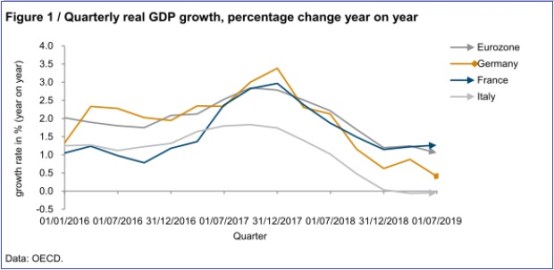
In macro terms,  one vital fact should not be overlooked. Time is not on the EU’s side. The Eurozone economy is suffering its slowest growth in 7 years. Internally, its rate of GDP growth continues to decline, while externally, it accounts for an ever-diminishing share of global GDP growth.

EU quarterly real gdp growth 2016-19

EU declining share global GDP growth

Seeing the UK reach trade deals with the parts of the world which are growing, not stagnating, is essential towards disincentivising the EU from continuing to insist on its absolutist level-playing-field on, e.g.,  state aid, environmental and labour standards, an approach which is intended, not so much as to facilitate trade, as to protect its own heavily regulated economies from competition.

Thoroughly agree with this article? Vehemently disagree with it?

Scroll down to leave a comment

And follow A Libertarian Rebel on Twitter and Gab

Brexit-Watch: Saturday 29 February 2020

Note: Longer and updated version of the article originally published at The Conservative Woman earlier today, Saturday 29 February 2020

A weekend update on some recent key Brexit-relevant story headlines, choosing four which, while not necessarily meriting a full-length article, nevertheless warrant a paragraph or two of comment, rather than merely a couple of lines.  (NB: (£) denotes article behind paywall.)


Dealing with the French: Frost versus Barnier, Bacon versus DescartesRobert Tombs at Briefings for Britain

Few are better qualified than Professor Tombs to expound on the historically different approaches to philosophy and law which govern the respective attitudes of the French and English towards the negotiating of treaties.  The former view the opening text as sacred, to be departed from only minimally, if at all: for the latter, it is merely a starting point from which give-and-take bartering can proceed towards, eventually, a mutually acceptable outcome.

Personally, I find it a curious paradox how, when it comes to the nuts and bolts of trade negotiations, it’s the British who are pragmatic and transactional, while the Brussels Eurocrats are institutional and inflexible: but that, when it comes to the philosophical question of EU membership per se, it’s the Eurocrats who are transactional, emphasising alleged economic advantage, while the British are constitutional, prioritising the principles of sovereignty, democracy and self-government over the risk of temporary economic disruption.

Anyway, to the schism identified by Professor Tombs must be added current domestic politics among the main EU protagonists. In Germany, Merkel’s originally anointed successor as CDU party leader and Chancellor having withdrawn, the contest has now degenerated into an unedifying struggle between two fairly unimpressive male apparatchiks.  In France, an already unpopular Macron faces municipal elections in late March from which he is likely to emerge weakened.

The two diametrically different approaches, coupled with more volatile both French and German domestic politics, could well turn the Brexit trade-talks into a dialogue of the deaf.  In which case, the likelihood of Britain deciding that further negotiation is pointless, and walking away to WTO terms, will become even greater.


EU’s uneven playing field revealed – Germans, Belgians, Italians, French are the worst offendersFacts4EU

This is about the EU’s restrictions on the power of member-states’ national legislatures on state-aid and competition. Yet despite the insistence by Barnier on ‘red lines’ for a ‘level playing field’ regarding his demand for continuing UK-EU ‘regulatory alignment’ after Brexit, the EU is, as ever, the greatest breaker of the rules it purports to impose on others.

Germany, France, Belgium and Italy all receive favourable state-aid dispensations at between three and four times the rate Britain does. Some ‘level playing field’. . . .  Moreover, identifying where responsibility lies for administering the rules is typically shrouded in bureaucratic obfuscation. It would be futile focusing on this area to the detriment of others in negotiation.

Once again, it’s possible to envisage this issue causing Labour some trouble domestically, especially if the party, though nominally united, has ongoing tensions between the soft-Left faction of presumed winner Starmer and the defeated hard-Left camp grouped around Long-Bailey.  Remember, Corbyn repeatedly appeared torn between his desire as a Remainer to stay within the EU’s ambit and his desire as a socialist to use taxpayers’ money to prop up failing businesses.


UK-EU: a question of trustFinancial Times (£)

Briefly, for those unable to breach the paywall, the article references the spat between Britain and the EU on the former’s accusation that the EU resiled from its offer of a Canada-style Free Trade Agreement, and the latter’s accusation that Britain is resiling from a previous agreement not to re-open aspects of Theresa May’s Political declaration. It goes on to regret the end result of the document supposed to guide the negotiations being at the centre of a feud.

It’s hard not to see a combination of naïveté and anti-Brexit EU-philia at work here.  These negotiations were always going to be conducted in an atmosphere of bad faith on the EU’s side.  The reason isn’t hard to discern.  Going back to Professor Tombs’ article, for Britain, these negotiations are transactional: for the EU, on the other hand, they are near-existential.

As the Bruges Group remarked this week. . .   

Indeed.  But that’s also slightly to miss the point.  The EU is conceptually incapable of treating us like any other country.  Alone among other countries who joined it, we have chosen to repudiate and quit their to them noble but to us neo-imperial Project.  For that, in their world-view, we are heretics who must not only be punished for our apostasy but be seen to be punished for it.  If that sounds quasi-religious, it’s because it is.  These negotiations were pre-destined to be acrimonious.


The UK and EU Negotiating Mandates ComparedGlobal Vision

It’s clear from this comprehensive, up-to-date summary, including all the developments of the past week, that behind the spin disseminated via the headline/soundbite-wanting media lie some potentially insoluble points of contention.

Fishing is the obvious and arguably also the most difficult one since, despite its relative insignificance economically, it is hugely important politically and even almost symbolically, given its public profile: one can easily see it being the bellwether by which the whole deal is judged.  The UK has rejected both keeping current levels of access for other EU member-states, and sequencing.  It could be the difference between an agreement and WTO.

The so-called level playing field and rules of origin issue, and I think we can expect EU obduracy on financial services, torn as it is between mercantilist envy of the City’s dominance and knowledge of EU firms’ dependence on it. Generally, if the EU refuses to budge on demanding its own legal order be supervening, the UK has made it clear there will be no agreement.  Don’t delete your online WTO guide just yet.

Thoroughly agree with this article? Vehemently disagree with it?

Scroll down to leave a comment

And follow A Libertarian Rebel on Twitter and Gab

Brexit-Watch: 22nd February 2020

Note: Longer and updated version of the article originally published at The Conservative Woman earlier today, Saturday 22 February 2020

A weekend update on some recent key Brexit-relevant story headlines, choosing four which, while not necessarily meriting a full-length article, nevertheless warrant a paragraph or two of comment, rather than merely a couple of lines.  (NB: (£) denotes article behind paywall.)


The EU’s absurd and ever-changing position reminds us why Britain voted to leaveTelegraph (£)

Global Vision’s Shanker Singham on how, having originally offered Britain a Canada-style free trade deal with add-ons, the EU has backtracked to the extent of demanding a provision which it doesn’t insist on even in its FTAs with China and the USA: namely a guarantee that whenever the EU changed its laws, the UK would follow suit, in perpetuity.  This would in effect subordinate our own trade’s legal architecture to EU state aid rules and ECJ oversight.

Brussels also demands what it calls ‘dynamic regulatory alignment’; meaning in effect that, to secure a FTA, the UK would need to become a rule-taker from Brussels with no say in how those rules were set.  Both moves are perfect examples of the intransigence which caused us to vote to leave in the first place.  But Johnson will need to be watched to ensure there is no backsliding or dilution of our refusal to capitulate to this.


The EU isn’t interested in free trade with the UK, just political domination –  Briefings for Britain (formerly Brexit)

An argument whose first premise has been amply borne out this week by Brussels’ attempt to move the goalposts, firstly, by trying to hedge a Canada-style deal about with onerous conditions, in what looks like a naked attempt to hobble Britain’s ability to compete against an over-regulated, sclerotic EU.

Secondly, by Barnier’s ill-tempered refusal of a Canada-style trade deal on transparently spurious grounds of geographical proximity.  And thirdly, by even demanding the return of the Elgin Marbles to Greece as part of any trade deal. 

With the growing presence of nation-state populists in both member-state and European parliaments, making Brussels desperate to make life outside the bloc as difficult as possible for Britain, the argument’s second premise is no less valid.


Post-Brexit funding row breaks out in BrusselsTimes (£)

Very much at the forefront of Eurocrats’ minds, in the sense of trying to show the remaining 27 member-states, by its treatment of Britain, just how difficult it will make life outside the bloc for any other country which decided to emulate Britain and leave, taking its contributions with it.  Brexit leaves a €75 billion-sized hole in the next 7-year budget.

The implications for member-states’ internal politics are significant.  Germany’s extra payments are 6 times France’s, and Merkel’s CDU is under electoral pressure from the Eurosceptic AfD.  France’s low-level Gilets Jaunes insurrection each weekend shows no sign of abating, and the Marion Maréchal (Le Pen) led Rassemblement Nationale expects to make big gains in this year’s French municipal elections.  Just to make life more difficult for Macron, the Dutch, with an economy only one-third the size of France’s, are objecting to paying EU contributions 70 per cent higher than France’s.


What Keir Starmer would mean for BritainFT (£)

To which headline must of course first be added the caveat: if he becomes Labour leader.  Admittedly, it looks unlikely that he won’t, but Rebecca Long-Bailey has the endorsement of Len McClusky’s Unite Union and, as far as I can establish, no candidate has ever won the Labour leadership without it.

In the short term, Starmer as leader will impact more on Labour’s internal politics than on the course of Britain’s exit.  Johnson has a compliant Parliamentary party with an unassailable majority, so Starmer won’t be forcing any change of policy.  He will however be far more soft-Brexity and even Rejoin-inclined than Corbyn, so could arouse some disquiet among Labour MPs in Brexit-voting seats who narrowly survived December’s massacre and could be the next bricks in Labour’s Red Wall to tumble.

What he will bring to the table, however, is a lawyer’s far greater ability than Corbyn possessed to absorb the fine detail of any agreements, and then subject Johnson to forensic questioning on them.  Boris is a big-picture blusterer, not a details man, so he could well under-perform when put under this kind of pressure.  Coupled with growing resentment at his eco-policies, this could well cause his popularity and approval ratings to dip.  So Starmer could impact internal Tory politics as well.


What these four articles taken together show is that the EU is visibly in big trouble on several fronts.  Not mentioned in any of the four above is the mountain of bank debt on the books of the ECB, which potentially limits it from engaging in any further quantitative easing to try and boost currently slowing growth in the sclerotic Eurozone. 

If only our own negotiators would recognise it, and leverage it to drive a harder and more advantageous deal for Britain.  Though if the evident intransigence of the EU is a guide, it surely increases the chance of our eventual exit on WTO terms.

Thoroughly agree with this article? Vehemently disagree with it?

Scroll down to leave a comment

And follow A Libertarian Rebel on Twitter and Gab

Just What – Or Rather Who – Is Driving Theresa May on Brexit?

Two in theory separate but in practice closely-aligned groups of anti-democratic vested interests are influencing, with her concurrence, Theresa May’s obdurate pursuit of a Soft-Remain Brexit-In-Name Only       

Note: longer and updated version of the article originally published at The Conservative Woman on Wednesday 24th October 2018

On the “what” of Theresa May’s catastrophically-inept, stubborn, secretive, submissive and duplicitous conduct of the United Kingdom’s Brexit negotiations, there is little room for doubt.

The original story, of her deceitful complicity in the covert No 10 operation that gestated her infamous Chequers Plan – which she obstinately persists in clinging to, despite its manifest flaws and rejection by both colleagues and Brussels alike – has received extensive media coverage.

Since then, the details of her successive capitulations to, and appeasement of, the EU’s intransigence, such that the position she is now reduced to claiming is a meaningful EU exit that delivers the Referendum result is scarcely distinguishable from continuing membership at all, have received equally widespread publicity.

In summary, having let herself be totally outmanoeuvred on the Northern Ireland backstop – with the connivance, on this and much else, of  a Civil Service opposed to Brexit in principle and resolved either to dilute it to insignificance, or thwart it altogether – she now proposes a £57 billion-costing, non-voting vassal-state transition until 2022, before a permanent Customs Union, adherence to EU Internal Market rules, inability to strike external trade deals, continuing subservience to the European Court of Justice, and possibly also even surrendering domestic control over tax policy.

And that’s disregarding her also signing away UK Defence and military autonomy to the incipient European Defence Union on the sly.

What UK Gov has agreed re EU Defence

So there’s no lack of knowledge or detail about what May is doing.

In contrast however, the “why?” of May’s incompetent, disingenuous and potentially-disastrous, yet doggedly determined prosecution of a soft-Remain (non)-Brexit has received little attention in comparison. This may be an understandable omission in the urgency of reporting and analysing day-to-day developments: but it’s surely as equally important. It’s time we started considering the possibilities seriously.

First, is it just an admittedly truly staggering level of ignorance and incompetence, but nothing more? May’s failings of both competence, intelligence and leadership are hardly either unknown or doubted: indeed, I’ve argued myself earlier this year that she should be ousted and replaced on those grounds alone.

But it does seem unlikely that anyone could be merely incompetent to May’s degree. Nor would it account for the combination of calculated deviousness and intolerant-of-dissent petty authoritarianism by which she had her Chequers Plan formulated behind the backs of Cabinet, MPs, Party and country, then pre-cleared with Merkel, before imposing on her Cabinet without prior warning, on pain of dismissal. Other factors must surely be in play.

A conspiracy theory occasionally advanced is that the myrmidons of the Deep-State – or the New-Class Establishment Elite if you prefer – which always was and remains viscerally opposed to Brexit, have something on May and/or her husband which would be acutely embarrassing, even resignation-inducing, if revealed, and can therefore control her approach to Brexit. Adherents hint darkly for example, about how the Home Office Inquiry into allegations of Westminster organised child sexual abuse was effectively neutralised during her reign.

But is this not also unlikely for a self-described “goody two-shoes” whose idea of taking daring risks is skipping though a field of wheat? Besides, if so, wouldn’t she have anyway used her 6-year tenure as Home Secretary to ensure that any such material was safely buried, as Jack Straw is widely rumoured to have done with MI5 files on the New Labour hierarchy’s past Communist allegiances?

In her Sunday Telegraph article of 21st October, Janet Daley suggested that a submissive May is surrendering to the EU’s playing hardball with her in the Brexit negotiations because both it and she are impressed by the constant stream of out-of office Referendum-repudiating Remainer politicians dancing attendance on it in Brussels, assuring it that Brexit can be stopped if it continues to display the intransigence it has to date.

I don’t buy this. If the EU is knowledgeable enough about current UK politics to know that May is in deep trouble, and is a pushover, then it’s surely also knowledgeable enough about current UK politics to know that the opinions of the Unreconciled Continuity-Remainer political claque epitomised by Blair, Clegg, and Major actually carry very little weight in UK. The theory that May is capitulating to its intransigence because it thinks that they represent UK public opinion and that she is in fear of it, seems to me to just not stand up.  

For what it’s worth, my theory is this: that May is knowingly, in effect willingly. being held hostage by, and dancing to the tune of, two nominally separate but very closely aligned groups.

Theresa's Puppet-Master Olly RobbinsFirstly, the Number 10, Cabinet Office, and Foreign Office officials, in whose hands – having little discernible knowledge, judgement or confidence of her own – she has been ever since taking office, who are reportedly uniformly opposed to Brexit, and of whose private and unreported contacts behind the scenes with EU officials we are unaware.

Secondly, the pro-Remain side of Big-Business that’s essentially crony-corporatist rather than competitive free-market capitalist, and which channels its collective view to Government through the CBI, which represents predominantly that particular type of business organisation.   

There a reason why May, instinctively a big-government statist, might be particularly receptive, both to the blandishments of this particular lobby, and to the idea that “business” equals the CBI.  

To the extent that she is ideologically wedded to anything at all, May seems much more inclined to the EU’s preferred model of state-interventionist, crony-corporatist “Rhenish capitalism” than she does to the quintessentially Anglosphere small-state, low-tax competitive free-market model of capitalism. She did after all join the Conservative Party in 1973 when it was led by Heath, who thought very much along those lines.

Remember, too, the CBI was fiercely pro-Remain, despite its undistinguished record of having being wrong about almost every major issue for the last 100 years. including nationalisation, Prices and Incomes Policy, the Exchange Rate Mechanism, and, most of all, the UK joining the Euro.

EU Lobby LandCBI-type pro-Remain Big-Business finds EU membership most congenial. First, the EU’s regulation-heavy regime is highly susceptible to corporate lobbying – in 2016 there were an estimated 37,000 lobbyists in Brussels alone – for regulation and restrictive practices that favour the interests of large producers over those of consumers, and which tend to entrench oligopoly rather than generate competition. In addition, the EU’s secretiveness and lack of transparency at the very least facilitate outright corruption.

Second, the large CBI-type corporates that do the lobbying have the economies of scale to cope with the mountains of EU-originating red tape, forced compliance with which cripples their smaller, nimbler potential rivals, especially innovative start-ups. And the deal which May currently wants to accept would in effect keep all UK business, not just the mere 15-20 per cent of it involved in exporting to the EU, subject to the EU regulation which Big-Business specifically lobbies for in pursuit of its own anti-competitive interestContinuing membership for all intents and purposes thus acts acts as a barrier to entry for its competitors.

There has already been persuasive circumstantial evidence of Big-Business complicity in, if not influence on, the Government’s conduct of Brexit. Readers will remember how, in the earlier iteration of Project Fear about a No-Deal Brexit, in the run-up to May’s infamous Chequers Summit, Business Secretary and arch-Remainer Greg Clark emerged as not merely been the willing mouthpiece of pro-Brussels, crony-corporatist Big-Business, but perhaps its persuasive script-writer too.

And it’s still going on. But keep that name in mind. Because for some time, there have been unsubstantiated rumours that the same Greg Clark – possibly the ideal choice for the role of the Government’s Big-Business’ fixer, being so utterly uncharismatic and unremarkable as to be virtually anonymous – had long assured Japanese motor manufacturers in the North-East that Britain would be remaining in the Customs Union come what may, despite all the guarantees for public consumption that Brexit would involve exit from both it and the Single Market.

Corroboration, however, is now starting to emerge. In an article for Conservative Home on Tuesday 16th October, Stewart Jackson – former Peterborough MP and more recently Chief of Staff to David Davis when the latter was May’s Brexit Secretary – openly called Greg Clark’s dealings with Nissan “dubious”and condemned Clark’s refusal to publish his correspondence with the company, despite Clark having pledged to do so to the House of Commons.

Jackson went to say that pro-Remain Chancellor Philip Hammond, plus Clark and his officials, were briefing, from January of this year, that the UK would be staying in the Customs Union, and that the Irish backstop was the cleverest possible wheeze to ensure that this happened. Significantly, perhaps, those allegations have not been refuted.

Jackson is not alone. Recently, Daniel Moylan, former both deputy chairman of Transport for London and chairman of Crossrail, has openly disparaged online the anti-Brexit “fightback of vested interests and their Cabinet advocates”, and also speculated  whether, as now seems highly likely at least, such a secret promise was indeed given by Clark, with May’s blessing, to the motor industry.

If so, then it would at the time have been totally inconsistent with the vision of Brexit that May was publicly advancing so clearly in her Lancaster House and later Mansion House speeches. And even now, the UK negotiating team appears to be closing down every significant element of Brexit: one by one: laws, trade deals, money.

The theory, therefore, about why May is prosecuting Brexit in the way that she is – deceitfully and secretively negotiating the softest of Soft-Brexits, not in the wider interests of the British people and economy and honouring the Referendum result and her own 2017 Manifesto pledges, but in the narrow sectional interests of anti-Brexit Whitehall and pro-Remain Big-Business – at least appears plausible.

And it leads on to another, equally intriguing, one.

For two years, the Cameron and then May Governments have been excoriated for having failed to plan in advance for the possibility of a Leave vote in the EU referendum, for instructing officials not to prepare for one, and for not doing very much to plan its implementation for several months afterwards.

But what if we were all looking in the wrong direction, and Plan B was there all the time, hiding in plain sight? What if a contingency plan for a Leave vote was prepared, in secret, and the title of that contingency plan was: ‘Theresa May’? And prepared because it had been determined, at the deepest, innermost levels of the State, that whatever the Referendum result, even an 80:20 win for Leave, Britain’s exit from the EU could not be allowed to proceed?

May coronation July 2016 1On this theory, there was an intention that a Leave vote would never be honoured if it occurred, but muted, if not thwarted. So did Cameron assist by resigning to be conveniently replaced, in a rigged MPs-only coronation, by a Theresa May who, although a Remainer, had basically spent the entire campaign hiding behind the sofa, so that she was available and not too tainted by it when Cameron resigned?

A May who then proceeded, under the sway of, and with the full co-operation and support of, the equally pro-Remain, anti-Brexit Civil Service, backed up by a similarly inclined Big-Business and reliably on-message media, purposely to delay, dilute and diminish Brexit, including calling the unnecessary 2017 General Election? 

By writing, in concert with her closest confidantes only, a Manifesto whose contents even Cabinet Ministers were unaware of, and hardly saw before its launch? And then by deliberately throwing the election via a lacklustre campaign and crucial manifesto gaffe on long-term social care halfway through it, in order to weaken her own Commons majority and thus make it harder to get any pro-Brexit legislation through an anti-Brexit Parliament?

Fanciful? Maybe. But we live in strange political times. Who would have thought, three and a half years ago, that in the Autumn of 2018 we would have a Prime Minister whom large parts of her party believe to be complete disaster, but is kept in place out of genuine fear of her being replaced by a 1970s Trotskyist throwback as Leader of the Opposition?

Thoroughly agree with this article? Vehemently disagree with it?

Scroll down to leave a comment

And follow A Libertarian Rebel on Twitter

The Overpowering Stench of Treachery

The sheer scale and level, exposed by the past week’s revelations, of Theresa May’s deceit and double-dealing on Brexit have created an overwhelming miasma of perfidy that now envelops her, her Government, and her Party

Note: this is the longer (and updated) version of the article originally published at The Conservative Woman on Wednesday 18th July 2018.

If there was already a whiff of treachery surrounding Theresa May’s Machiavellian double-dealing revealed in her Soft-Remain (non)-‘Brexit’ plan sprung on her Cabinet at Chequers on Friday 6th July, then the past week has transformed it into nothing short of an overwhelming stench.

On Thursday 12th July, it emerged that May had not, as she claimed, merely ‘shown’ her plan to German Chancellor Angela Merkel: as many had suspected, correctly as it turned out, it had actually been submitted for approval. At the Chequers ‘summit’, the now-resigned former Brexit Secretary David Davis was, reportedly, told by May that her plan could not be changed, because ‘I have already cleared it with Angela Merkel’.

What an admission. Britain’s head of government requesting approval of her plan for Brexit, (if the ‘Brexit’ label can any longer be accurately applied to it all) before its disclosure even to her own Cabinet, from a foreign leader who, if not an enemy, must certainly be regarded as an adversary.

2018.07.12 Me Theresa Chamberlain Betrayal in our timeWas May really so naïve as to imagine that its content would not immediately be relayed to Michel Barnier and the EU’s negotiating team? If so, that surely beggars belief. Several less than flattering comparisons with Chamberlain’s 1938-1939 undue deference to Hitler inevitably followed, but were hardly excessive. May’s No. 10 Downing Street team reacted by issuing an (unconvincing) denial of the words allegedly used to Davis, but, tellingly, not of their substance.

Then, late on Saturday 14th July, came the bombshell. Former (and also-resigned) Minister of State at the Brexit Department, Steve Baker, revealed the covert, cloak-and-dagger operation, mounted by 10 Downing Street and presided over by May, not only deliberately to foil a Brexit which would fulfil the pledges of May’s 2017 General Election Manifesto and her Lancaster House and Florence speeches, so as to engineer as a substitute for it the Soft-Remain plan presented to the Chequers ‘summit’ as an unalterable fait-accompli, but also secretly to use the Brexit Department’s functions and output as deception and camouflage to fool Ministers, MPs and the public into believing that a genuine Brexit was being pursued.

Baker’s quotes were, and are, political dynamite, and almost defy belief:

An establishment elite, who never accepted the fundamental right of the public to choose democratically their institutions, are working towards overturning them.’

‘The Brexit Department was effectively a Potemkin structure designed to distract from what the Cabinet Office Europe Unit was doing for the Prime Minister’

May had willingly deceived not just us, the voting public, but even her own Ministers and MPs. She mobilised them to defeat the Lords’ Brexit-wrecking amendments in the House of Commons over the past few weeks, so as to preserve the façade of a plausible-sounding Brexit. At the same time, she was presiding over a secret plot cynically to deceive and exploit her own Brexit Department as a camouflage to conceal her Cabinet Office Europe Unit’s backstairs operation to procure her preferred Soft-Remain (non)-Brexit, in collusion with the EU negotiators.

In hindsight, it’s easy to see why the Eurocrats refused to negotiate with us on the basis of May’s fabled ‘Red Lines’, if they were at the same time being privately sounded out on what became the Chequers Deal. The ineradicable suspicion is that Brussels was being secretly assured all the time that our ‘official’ negotiating stance was mere theatre for the consumption of the gullible masses, and that the UK would accept whatever crumbs were chosen to be dropped from the Brussels table, at whatever cost.

Almost simultaneously, from sources close to Airbus, came allegations that May’s arch-Remainer inner circle had manipulated it into issuing, in the week preceding the Chequers ‘summit’, its much-publicised dire warnings about the dangers for jobs and exports of a No-Deal Brexit.

However, this commentary, by someone with the technical knowledge to know, suggests that the reality is rather more prosaic and long-term, and that subordinating the commercial imperatives of aircraft manufacturing to fulfilling the short-term expediencies of politicians with an agenda isn’t always the wisest course.

Whatever its effect, Airbus’ ‘welcome’ anti-Brexit contribution had, it was said, been agreed after discussions with the Government – presumably signifying Business Secretary and arch-Remainer Greg Clark having been not merely the willing mouthpiece of pro-Brussels, crony-corporatist big-business, but also its helpful script-writer too.

That, in the midst of all this, both Business Minister Andrew Griffiths’ forced resignation after sending over 2,000 ‘lewd’ texts to two female constituents, and the Government awarding a £2billion RAF contract, not to its compliant partner-in-deception Airbus, but to Boeing, passed almost without comment, spoke volumes.

Political observers were still trying to digest the Baker revelations when May herself appeared on the BBC’s The Andrew Marr Show on Sunday 15th July: though not before claiming, somewhat incredibly in The Mail On Sunday that she was ‘fighting for the Brexit that the British people voted for’, but later contradicting herself by issuing her ‘Back my Brexit, or I’ll abandon any Brexit’ threat.  How the latter was meant to assist the former was unclear.

Predictably, May’s interview with Andrew Marr did not go well. It culminated in what May obviously intended to be the takeaway soundbite, but which backfired spectacularly. Her “People may have voted with their hearts, but I have to be hard-headed” remark successfully managed to disparage 17.4 million Leave voters by condescendingly portraying them as merely un-thinking and emotion-driven.

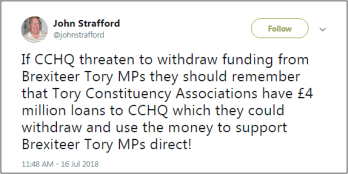
It emerged later that day that, as if No 10 threatening dissenting Ministers with a walk home from Chequers on Friday 6th July wasn’t petty enough,  Conservative Central Office was now apparently contemplating threatening to withhold centrally-disbursed funds from Brexiteer Tory MPs.

2018.07.16 Strafford Tory threats de-fund Brexiteer MPsAlthough, if true, its enthusiasm for this may be tempered by the prospect of some of the £4million loans extended to it from constituency associations being recalled and used locally to support Brexiteer MPs, it did tend to show May’s claque behaving more like the henchmen of a paranoid Mafia boss than the office of the Prime Minister in a democracy.

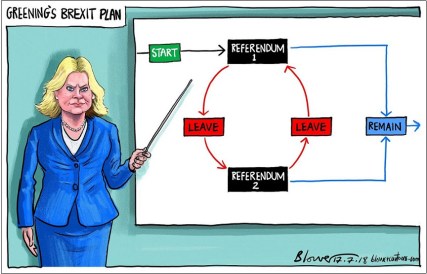
The morning of Monday 16th July brought what is arguably the next phase of the Remainer-Elite’s Project Overturn Referendum, Justine Greening’s proposal for a second vote on  Brexit. Which is curious, to say the least, given her January 2017 assertion that, although she was a pro-Remain campaigner and voter, nevertheless ‘we have to respect the overall democratic result.’

Greening re 2nd Ref via Change Britain

If incredulous initial observations, that this was less likely to be an original idea conceived by Ms Greening, hitherto most noted for proposing that individuals be empowered to change their gender merely by ticking a box on an official government form, than a pre-planned, scripted, intervention using her as the designated mouthpiece, may have been merely churlish, the subsequent trenchant criticism and the  widespread derision heaped on her suggested Referendum question – two Leave options to split the Leave vote, but only one option for Remain – was more than justified.

Justine Greening's 2nd referendum planThe afternoon of Monday 16th July saw May make a statement to the House of Commons on the previous weekend’s NATO summit. Standing at the Despatch Box, and with a completely straight face, she criticised Russian President Vladimir Putin for ‘undermining democracy’. Not for the first time, she gave the impression that her brain simply does not connect her mouth with her memory.

The House then debated the Taxation (Cross-Border Trade) Bill. After (rightly, but, predictably, for the wrong reasons) May had accepted four amendments tabled by Brexiteers of the backbench European Research Group, the consequences of which would be effectively to render May’s Soft-Remain (non)-Brexit Plan unacceptable to the EU, the most die-hard Tory-Remainer MPs retaliated by actually voting with Labour, the Liberal-Democrats and the SNP, against the Government trying to pursue the Ultra-Soft Brexit they claim to want.

We thus saw alleged ‘Conservatives’, plotting with Leftists to prevent the Government honouring the very Manifesto commitment on which those same ‘Conservatives’ had been content to stand for election and be elected, a mere 13 months ago.

On the morning of Tuesday 17th July, those same die-hard Tory-Remainer MPs were reported to again be aiming to defeat their own Remainer-dominated Government in further debate on the Cross-Border trade Bill that evening. Despite knowing full well that, should they succeed in defeating the Government, that could precipitate a General  Election whose outcome was likely to be a Corbyn-led Government, no fewer than 12 of them voted with Labour and other Leftist parties in a way that reflected starkly their anti-Brexit recalcitrance and desire to see it halted it in its tracks, whatever the cost to their Party.

The 12 Remainer rebels

They failed. Thanks to 5 brave Labour-Brexiteers defying their Party and voting with the Government, not to ‘support the Tories’ but to uphold democracy, the Government won the vote by 307 votes to 301. This almost certainly means that the May-Robbins Soft-Remain (non)-Brexit Plan will be dead on arrival in Brussels, containing provisions that the EU could probably never accept.

However whether a Prime Minister, who by now evidently lacked the authority even to persuade MPs to award themselves five extra days’ paid holiday by bringing Parliament’s Summer Recess forward, would have even noticed is in itself debatable.

To an extent, the Greening proposal and the Parliamentary antics of the die-hard Tory-Remainer MPs are peripheral to the reek of deliberate betrayal now pervading the May Administration and the upper reaches of the Conservative Party. But they are nevertheless an integral part of it.

With the possible, and even then disputable, exception of Blair on Iraq, I personally cannot recall in recent political history an example of a Prime Minister practising sheer anti-democratic duplicity and deception on a level and scale equivalent to what has been revealed about May in the past week.

While pretending to be implementing the democratically-expressed wishes of the British electorate, she has in fact been systematically deceiving her own Cabinet, Ministers, MPs, activists, voters, and the public, in order to manifest the wishes of a small coterie which clearly regards both the demos and the institution of democracy with undisguised contempt, and as something to be ignored, if not covertly circumvented, if it delivers an outcome uncongenial to them.

Moreover, the Party that she nominally – and I use the word advisedly – leads cannot escape the charge of complicity in her perfidy. Which other Ministers were in on the plot? Who knew what, and when? At the very least, that the majority of its MPs, even now, support her desire to mute if not negate the largest mandate for one specific policy in British political history leave them open to that charge.

Were her chicanery and double-dealing, and their own charlatanry, restricted to matters of domestic politics, they might, though still egregious, evade the ultimate accusation of treachery. But they are not. They prejudice and endanger, not only the enduring public consent for our constitutional settlement and the continuing validity of our democracy, but also the nature of our relationship with a foreign power who, though it may not be an enemy, is arguably an adversary and certainly not, in this matter, a friend. It is this latter element which surely makes the accusation of treachery tenable.

The present ‘Conservative’ Party, at least in its higher echelons of command, has been exposed this past week as a morally-bankrupt cesspit of political putrefaction, a rotting, decaying husk. In another, perhaps better, time, a Prime Minister accused of what Theresa May now, with justification, stands accused of, would have been defenestrated within days, if not hours. That she is allowed to cling insecurely to office, incompetent and ineffective in everything she does except calculated betrayal, is the visible manifestation of the overpowering stench of treachery that envelops her and her Party.

Thoroughly agree with this article? Vehemently disagree with it?

Scroll down to leave a comment

And follow A Libertarian Rebel on Twitter

We Must Re-Create The Brexit Movement

The Brexit Movement, prematurely wound down after the EU Referendum, needs re-creating to continue making the case for it, so as to keep pressure on the Government to deliver it.

Note: this is the long (and updated) version of an article first published at The Conservative Woman on Friday 17th November 2017.

Like many ConWom readers, I suspect, I spent the early dawn hours of Friday 24 June 2016 in a state of ecstatic semi-euphoria that the British people had ignored the pro-EU hectoring of the massed ranks of the New Establishment and their globalist backers, and had voted to leave the EU. It didn’t last very long.

Such was the furious reaction of the Remainer-Elites and their compliant media courtiers to their unexpected defeat that, before the day was out, I’d become convinced that while we had won the Referendum battle, we certainly hadn’t yet won the war, and that the celebrations of some, on the assumption that all that was needed to achieve Brexit had been done, were hubristic and perilously premature.

I even tweeted as much, as this selection from my Twitter timeline between early that Friday morning and late that evening shows (with apologies for the profanities…)

But sadly, this is precisely what happened after the Referendum. The Vote Leave campaign wound down: its principal Conservative politicians dived headlong into the internecine strife within their party from which its Remainers emerged predominant, while its successful CEO, Matthew Elliott, decamped to the Legatum Institute.

On the Leave-EU side of the Brexit movement, an insufferably bombastic and complacent Nigel Farage resigned as leader of UKIP to forge a new career in the media as the man who won the Brexit that hasn’t occurred yet. UKIP meanwhile has collapsed into virtual irrelevance after the two most credible replacements were seen off by the residual Farageistes, is now led by a non-entity, and is near-invisible. 

A couple of pro-Brexit campaign groups persist, but active mainly on social-media only. One of them, connected to the Leave-EU movement, has a website where it’s comparatively rare that the space taken up by the text of a blogpost actually exceeds the space taken up by images accompanying it. 

In effect, the loose coalition that delivered that historic vote by 17.4 million people to retrieve their sovereign nation-state popular democracy from supranational unaccountable-elite technocracy, and the communications infrastructure that made it possible, has all but dissolved.

It’s this article’s contention that this has been a catastrophic error: that developments,  not only since the Referendum generally but specificially more recently, are placing Brexit in ever-greater jeopardy: and that the Brexit movement needs to be re-constituted and go back on to a war footing, to fight for what the British people voted for, and even contest if need be the second referendum which I personally believe to be the Unreconciled Remainers’ end-objective.

Although the Leave coalition subsided, the Remain campaign never ceased. Unlike Vote Leave and Leave-EU, the pro-Remain Open Britain campaign has never wound down, and continues to make the anti-Brexit case.

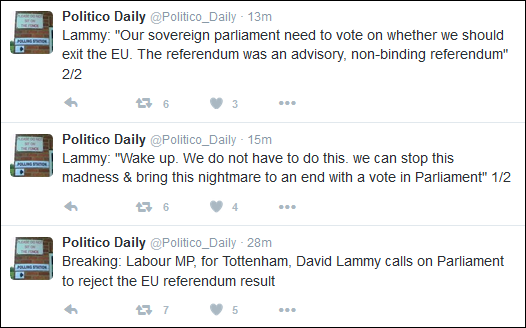
Readers will recall the ugly post-Referendum orgy of anger and hatred directed by ‘liberal’ Remainers and their cheerleaders at Leave voters, the constant attempts by the academic and judicial elite to delegitimise the Referendum result, and the sometimes near-hysterical anti-democratic polemic of, to name only two egregious but typical examples, the philosopher A C Grayling and Labour MP David Lammy, so I need not reiterate them.

It intensified once again during the Gina Miller litigation designed to facilitate a majority pro-Remain House of Commons vetoing the Government’s Article 50 notification. But it lessened somewhat after Parliament voted by 494 votes to 122 to authorise the triggering of Article 50 by 31st March, and matters reached a sort of uneasy equilibrium.

But then came May’s ill-advised, mismanaged General Election. When she and the Conservatives were returned drastically weakened, the Continuity-Remain movement was re-invigorated and its political, civil service, media, academic and judicial channels have visibly stepped up their campaigning by several levels of magnitude. They’re making the running: they look increasingly confident that Brexit really can be stopped and the Referendum reversed, and a majority-Remain Government seems at best half-hearted in response.

Now the fight is intensifying even more with the tortuous passage through Parliament of the EU Withdrawal Bill. The parties of the pro-EU Left have made clear their intention to conduct a guerilla war against it, voting against even the clause setting out its overall purpose, aided by 15 or more Unreconciled-Remainer rebels on the Tory back benches, some with considerably less honourable motivations than others.

In passing, let’s dismiss the disingenuous platitudes so many of these utter about wishing to do no more than “improve” the Bill. In many cases, it’s self-serving cant. They want to keep us in the Single Market and Customs Union, and under the jurisdiction of the European Court of Justice,  not out of genuine concern for our post-Brexit trade prospects or the position of UK-resident EU nationals, but to engineer either a Brexit-in-name-only, or one which is so close to EU membership that re-joining would seem like a logical step.

Many remain unreconstructed supporters of the EU Project and Britain’s submersion in it. It’s long been clear that, for them, the prime attraction of EU membership lies in is its very anti-democracy: it enables them to put as much policy-making and as many decisions as possible beyond the reach of what they see as the capricious domestic democratic process and an electorate whose views they by-and-large do not share and for whom they harbour a visceral contempt.

If some of the amendments being proposed already seem very technical and legalistic, be prepared: worse is yet to come. In this very detailed long-read published on 12th November at Brexit Central, Professor David Campbell of Lancaster University sets out how the legislative process of Brexit could become almost impenetrably bogged down in the morass of a quasi-constitutional conflict over the supremacy of the Judiciary, or Parliament.

It doesn’t look impossible that it could establish the supremacy of the Judiciary over that of Parliament. Just think what that would do to the prospects of Brexit happening at all. That partly explains, in my view why such an ardent anti-Brexiteer as Labour’s Keir Starmer is so keen to maintain the jurisdiction in post-Brexit Britain of the European Court of Justice.

Professor Campbell concludes that we may need an Assertion Of Parliamentary Sovereignty Act to make Brexit tamper-proof from judicial-activist usurpation of the powers of Parliament to implement the express instruction of the electorate.

If the EU Withdrawal Bill is set to have a rocky passage through Parliament, imagine how difficult it would be for a minority Government to push legislation, whose effect would be to prevent the pro-Remain Judiciary from blocking Brexit on constitutional grounds, through a marginally pro-Remain Commons and a majority pro-Remain despite unelected Lords.

Another potential complication emerged on 14th November, with a European Court of Justice ruling that EU citizens who become British do not lose the right to bring a non-EU spouse from a non-EU country to live with them in the UK. The continuing post-Brexit application of ECJ human-rights rulings is figuring strongly in debate on the EU Withdrawal Bill, so this is a further area where continued pro-Brexit advocacy is lacking.

May herself arguably opened a new front in the anti-Brexit campaign with her speech to the Lord Mayor’s Banquet on Monday 13th November. Yes, it is possible to interpret her remarks on Russian interference in Western elections as a desperate ploy to divert attention from her domestic travails: but it’s also possible to interpret it as a fresh attempt to de-legitimise by association the entire Brexit vote, especially the evening before the EU Withdrawal Bill was re-introduced into Parliament, with every prospect of the Unreconciled Remainers on her own back benches determined to vote it down on any pretext?

The signs are ominous. The EU is refusing to move on to talks about a post-Brexit trade relationship unless its exorbitant financial demands are agreed. Each UK concession on these is banked, not reciprocated, and met with merely a request for a larger sum. On 20th November, it even had the temerity to demand in effect an EU veto on UK domestic tax, environmental and business-regulatory policy after Britain has left the EU.    

Its intransigence is being encouraged by a UK media overwhelmingly hostile to Brexit and resolved to paint it in the worst possible light. Sir Humphrey, for whom Britain’s EU membership has been axiomatic for 40 years and thinks Brexit a monumental folly of crude populism-appeasement, is dragging his feet.

The Government is being forced by its weakness and wafer-thin, DUP-dependent, majority into unwanted concessions. It’s conceding votes in Parliament on aspects of Brexit which, with the clear instruction delivered by the Referendum result, should no longer be in play at all. In these circumstances, that it might, to win a crucial vote, concede a second Referendum, either on the terms of our exit, or even on the decision itself to leave, can’t in my view be ruled out.

If that comes about, the Remainers will have achieved what has been their prime objective – and also the EU’s, for it has an unsavoury record of ignoring plebiscites with unwelcome outcomes and requiring electorates to vote again and again until they come up with the “right” answer.

And then what? Unlike Vote Leave and Leave-EU, the pro-Remain Open Britain campaign has never wound down, and continues to make the anti-Brexit case. Continuity-Remain could gear-up for a second EU Referendum comparatively quickly. The money would come flooding in.

It’s victory, though, would be far from a foregone conclusion. Since June 2016, the electorate has seen the EU moving faster towards ever-greater integration and centralisation in ways the Remainers denied were even being contemplated. It’s seen how so many of the scaremongering predictions of Project Fear failed to materialise. A second Referendum could be won with another Leave vote.

But not without a campaign organisation. Even without a second Referendum, Brexit feels in enough danger to justify the reconstitution of the Leave coalition, if only to continue to make the case it made so effectively in the first half of 2016, and hold the Government’s feet to the fire. The Brexit movement needs to be re-created.

Thoroughly agree with this article? Vehemently disagree with it?

Scroll down to leave a comment

And follow A Libertarian Rebel on Twitter

The Tories Don’t Deserve To Win – Labour Deserves To Lose

Neither the Tories, with their statist, triangulating Manifesto, nor Labour, with its destructive socialist vision, deserve victory in this General Election

In a few hours, this General Election will be all over bar the results and their consequences.  Yet the usual anticipation of Election Night is muted by an almost palpable sense of relief at the approaching end of a campaign offering such a lacklustre, uninspiring choice.

For Theresa May and the Tories  it was supposed to be the Brexit Election: where, wanting both a bigger Parliamentary majority and her own popular mandate to implement it, she would offer a vision of a Britain mitigating the risks but also exploiting the advantages from recovering political and economic sovereignty.

Both, paradoxically, dictate some loosening of State and regulatory shackles on the economy, a facilitation of innovation and entrepreneurship: especially as the economy inevitably goes through a period of uncertainty and flux as powers are repatriated and trading relationships either reset or forged from new. But that isn’t what we’ve got.

The first intimations were reasonably heartening, But then came the Manifesto.

2017 Manifesto on Core Beliefs

Disparaging talk of “untrammeled free markets”, belief in “the good that government can do”, and abhorrence of “inequality”. The context leaves little room for doubt that the offer to voters is one of an interventionist State, concerned not so much with opportunities, but with outcomes.  

Further on, we are promised an Industrial Policy, a National Productivity Investment Fund, worker representation on boards, and a commitment to continue spending 0.7% of GDP on virtue-signalling foreign aid.

Finally, we get to this Greenery-gullible horror. Yet it accompanies a pledge to give British voters “the lowest energy costs in Europe”, notwithstanding that those two aims are mutually incompatible.

Worse still, it’s to be achieved, not by slashing Green taxes and encouraging more competition among energy providers via supply-side measures, but by capping prices: the same policy that, as recently as 2015, the Tories rightly damned as economically-illiterate when included in Labour’s election manifesto by Green-Left Red Ed Miliband.

So, in aggregate, a largely social-democratic policy programme, advocating a version of active-state Rhenish corporatism that would not look out of place in the manifesto of any milquetoast European Christian-Democratic party.

One can speculate endlessly on the reasons why. Possibly they lie in the fact that May is an instinctive paternalist (should that be “maternalist”, I wonder?) technocrat who’s unconvinced of, as Martin Durkin puts it, the potential of free markets to liberate and enrich.

Perhaps, because Labour has gone so far Left, she was persuaded that a Clinton-Blair style triangulation, with the Tories parking their tanks on “moderate” Labour’s lawn, would work electorally. Maybe she was afraid of frightening off the 2 or 3 million Labour voters who voted for Brexit and want to see it happen, and also the One-Nation tendency in her own party still looking for any excuse to derail Brexit. Who knows?

Then there’s been the campaign itself. May  – and it has been almost exclusively May, from battle-bus, through campaign literature, to media, and all points in between – has come across as by turns either robotically evasive, or uncomfortable and unconvincing when pressed on detail.

The forced U-turn on Social Care brought her campaigning deficiencies into sharp focus, but combine that with her natural somewhat leaden, flat-footed demeanour, plus a requirement to face an inquisitorial public & press far more often than she’s ever had to do before, and the result has been, not failure, but certainly sub-par performance.

Both she and her Party, have emerged from the campaign diminished, and not just in opinion-poll ratings, either. “Strong and Stable” has become something of a stick to beat her with. The whole thing has been rather insipid, disappointing, and very far from enthusing.

Consideration of Corbynite-Labour’s hard-Left manifesto need not take us as long. “Insipid” isn’t a description that could remotely be applied to it: “terrifying” or “economically-catastrophic” hardly begins to cover it, such is the red-in-tooth-and-claw programme that unrepentant socialist Jeremy Corbyn has in mind for the country.

The appalling consequences of a Corbyn-led Labour government have comprehensively dissected, with this by Andrew Lilico being merely one of the latest.   

As Lilico points out, fiscally and economically Labour would impose on Britain the highest level of taxation since World War II: the nationalisation, almost certainly without compensation, of the most important industries: a return to widespread (and excess) unionisation: deliberately punitive taxes on financial services designed specifically to deter private capital: and the effective collectivisation of private business property through imposing public interest duties inimical to both private property rights and commercial interest.

Moving from the general to the particular, just one example can suffice to show hard-Left Corbynism’s economic wrong-headedness. Despite favouring continued uncontrolled mass immigration, Labour proposes to deal with the housing shortage by a price-cap on new houses.  

All that that is likely to achieve is a shortage of new houses. If Labour really wanted to boost the supply of low-cost new houses, it would pledge to ease planning restrictions, not threaten to impose State price and even purchaser – priority to State employees, naturally – controls on builders. 

Non-economically, a Corbyn-led Labour government would see restrictions on the police, the reduction of the Army to a notional force only, and the withdrawal of Britain from its role in international security.

And this before even considering the implications of Corbyn’s 30+-year record of not only sympathy but vocal backing for all manner of anti-British, anti-Western groups, including those engaged in active terrorism, even on British soil.

And thus we come to the end of a singularly uninspiring campaign on what should have been the most important election in Britain for decades. The great issue for which it was ostensibly called to reinforce has been barely discussed beyond trite soundbites and banal generalities.

Hard-Left Labour certainly deserves to lose this election, and lose it heavily: but the Conservatives, on their manifesto and especially on their stuttering and lacklustre campaign, really don’t deserve to win it, either.

Thoroughly agree with this article? Vehemently disagree with it?

Scroll down to leave a comment

Follow A Libertarian Rebel on Twitter

Delicious Save this on Delicious

Tax-Havens: Also A Force For Good

Far from being solely amoral, piratical facilitators of crime, kleptocracy and evasion, so-called tax-havens in fact also play a valuable role in promoting economic efficiency and curbing State-predation  

Tax havens Panama CitySo-called tax-havens have a bad reputation. In public and political minds, influenced almost wholly by the clamour of either wilfully-ignorant or Leftist-populist media and political hacks, they’re all, without exception, places solely where unsavoury associates of autocrats and plutocrats soak up the sun in between furtively stashing suitcase-loads of ill-gotten gains in anonymous numbered accounts.

As we’ve recently seen all too starkly. Because one of the main features to become glaringly obvious in the Panama Papers leaks, and in the domestic political furore in the UK which has followed it, is a self-evidently widespread inability (or possibly unwillingness) of the politico-media class and commentariat to differentiate the few truly-nefarious tax-havens from the more numerous well-run and properly-regulated offshore financial centres (OFCs) – they are decidedly not the same thing: or to distinguish illegal loot-hiding, money-laundering and tax-evasion, by corrupt despots, criminals and others, from the entirely legal use of OFCs in perfectly legitimate investment and tax-avoidance.

As so often, reality is both more complex, and more nuanced, than media-driven populist perception.

For a start, on the basic issue of definitions. The OECD lists four criteria which a territory or jurisdiction must fulfil in order to qualify as a tax-haven, as opposed to an OFC:

  1. Imposing no, or only nominal, taxes, even domestically
  2. Lack of transparency
  3. Laws and practices that discourage or even prevent automatic exchange of [tax-purposes] information with other governments on the beneficiaries of its tax regime
  4. No stipulation that the activity domiciled in its jurisdiction be substantive

On these criteria, there are relatively few true tax-havens: even the OECD lists only four, and, on its Automatic Exchange Of Information criteria, a mere two.

Tax havens Waterfront Grand CaymanMoreover, and more importantly, the vast majority of the Crown Dependency and British Overseas Territory OFCs, which Labour leader Jeremy Corbyn incorrectly labelled as tax-havens and proposed arbitrarily supplanting their democratically-elected governments to place them under direct rule from Westminster, don’t even fall into the “tax-havens” category at all.

So when no-one seriously opposes measures to prevent, detect and punish both those who undertake criminal tax-evasion, money-laundering and loot-concealment and the few residual disreputable genuine tax-havens which do facilitate them, the real objections by governments, commentators and so-called social-justice campaigners to the legitimate use of OFCs or any low-tax jurisdictions must originate from elsewhere.

Those objections arise from two principal, and unsurprising, sources. Firstly, the misunderstanding, derived from popular fallacies, of the economic good that low-tax jurisdictions promote: and secondly, the competitive threat they represent to the otherwise-unconstrained power of high-taxing, high-spending states to extract taxes from their economies and populations almost ad infinitum.

To address one of the most popular fallacies – that money deposited in OFCs or low-tax jurisdictions is somehow irretrievably “lost” to the global economy. This is just arrant nonsense.

First, it wrongly assumes there is a fixed amount of global capital whose geographical distribution creates a zero-sum game, where any partial deployment of it to Location A must automatically reduce that available in Locations B-Z. In fact global capital is both dynamic, and fungible, and continues being created in those parts of the so-called “losing” mainstream onshore economies that aren’t sensitive to geographically-differing tax rates.

Tax Havens BermudaSecond, it assumes that all capital deployed to low-tax jurisdictions stays there, static. This isn’t necessarily the case – small islands generally don’t have much potential for domestic infrastructure investment or large-scale economic activity – and it’s especially not the case in a period of low or even negative real interest rates. Although the total of assets located in an OFC may change only slowly, that ignores the stock-vs-flow issue, where many of its components parts may be being directed into other forms of investment in other locations, and subsequently repatriated, on a regular basis.

Inasmuch, too, as the location of capital and/or assets in the low-tax jurisdiction encourages their investment to generate a return not achievable if based in a higher-tax jurisdiction, the OFC is actually promoting more FDI in the investment location. In this way, the availability of low-tax OFCs makes them conducive to an increase in overall international investment and in global capital, not its depletion. They are not “poaching more than their fair share” of international capital, but acting as a conduit for its more productive and optimal investment back into mainstream onshore economies.

Third, international systems of taxation don’t always cope well with avoiding the dangers of double-taxation. If you’re an investor (and remember, you may well be, even via an ISA or your employer’s pension scheme) in a fund set up in a country that levies a withholding tax on redemption payouts, but those redemption payouts aren’t taxable domestically in your own country, then recovering the tax that’s been wrongly withheld from you is going to be difficult. By providing a tax-neutral environment, low-tax OFCs perform a valuable role in making sure that your investment, even an indirect one, isn’t taxed twice. That benefits you.

Tax havens Mossack Fonseca PanamaFourth, the fallacy assumes the “losing” country is automatically forced to raise its own domestic tax-rates to replace the tax-revenue “lost” when assets are relocated to a low-tax OFC. Countries, however, don’t operate in isolation from their international environment: lower tax-rates in other jurisdictions act as a restraint on mainstream onshore governments’ own tax-rate policies. Both firms and workers in those economies therefore benefit in purely micro-economic terms from overseas low-tax OFCs, in the form of lower taxes domestically than might be levied otherwise.

Next, low-tax OFCs also fulfil a vital function in providing a safe harbour for wealth legitimately created and held, against the tendency of inherently corrupt, dictatorial  & kleptocratic regimes to predate on it.

Depending on the definitions chosen, there are approximately 170-190 countries in the world: but only a minority are full democracies where the government is subject to the rule of law and scrutiny by a free Press. The Economist Intelligence Unit’s Democracy Index 2014 in fact lists a mere 24 as full democracies and a further 52 as flawed, out of a total of the 167 rated, leaving over 90 regimes described as either hybrid or (the majority) authoritarian. Perhaps not surprisingly, there’s a correlation between the latter categories and the Transparency International Corruptions Index 2015’s assessment of the most corrupt countries.

Most & Least Corrupt Countries 2014

These are countries where even if, against all the odds, an honest entrepreneur, investor or businessman manages legitimately to amass capital and assets, they are liable to be arbitrarily seized at any time by the regime, either unashamedly or via a quasi-criminal or complicit judiciary, and confiscated. By existing at all, low-tax OFCs furnish a safe refuge for such assets. In this role, rather than encouraging or facilitating corruption, they are in fact operating so as to thwart it.

Benefits of Tax CompetitionLastly, low-tax OFCs form a valuable macro-economic brake on the overall ability of excess-spending, excess-taxing governments to otherwise levy punitively-high taxes without restraint. In the absence of the tax-rate competition provided by lower-taxing jurisdictions, it’s unlikely that governments, viscerally-disinclined on both ideological and electoral grounds to curtail State intervention and largesse, would not take the opportunity to impose economically-damaging higher taxes generally. 

It’s primarily for this reason that the member-states of supranational political unions like the EU are so enthused by the prospect of cross-border harmonisation of taxes, or centralised democracy-proof pan-European fiscal control, as the corollary to curbing the legitimate activities of low-tax offshore financial centres. 

The vocal but unthinking critics of low-tax OFCs, in their haste to condemn what they see as the obvious, miss a point – that they are also a force for good. The existence, and legitimate activities, of low-tax OFCs both promote greater economic, capital-allocation and investment efficiency, and indirectly benefit employers, employees and consumers in the mainstream onshore economies by protecting them from excess State predation.     

Thoroughly agree with this article? Vehemently disagree with it?

Scroll down to leave a comment

Follow A Libertarian Rebel on Twitter

Delicious Save this on Delicious

Why The Red Lights All Show Green

In theory, Environmentalism ought to be a conservative, or at least apolitical, philosophy: but, in its politicised Climatism mutation, it’s been captured and exploited by the Left and Centre-Left, as a means to pursue Leftist ends 

Between small-“c” conservatism, especially in its classical Burkean tradition, and environmentalism in that word’s true, literal sense, there should, on the face of it, be a natural philosophical affinity.

Burkean conservative thought holds that society makes better progress, and simultaneously better preserves its legacy for future generations, not by the tearing-down of its structures and customs in orgies of radical, revolutionary fervour: but by preserving and perpetuating, though also adapting, established social, political and cultural institutions that have stood the test of time.

Englands green & pleasant landIt contends that the environment in which we find ourselves, not only the social, economic and cultural but also the physical, is not ours exclusively to re-make afresh solely out of desire to indulge the narcissism of the immediate, or even just to satisfy present needs; that we are not its absolute, unfettered owners, but trustees, stewards and custodians: that the corollary of societal betterment is an obligation to safeguard for those who have gone before the inheritance which they bequeathed to us, and in turn to pass it on as our legacy to generations yet unborn.

On this argument, then, environmentalism – in that word’s true, literal, sense – should be primarily a concern of philosophical conservatives – even its “conservation” synonym suggests as much.

Yet, because of the well-documented hijacking of the environmental movement by the hard-Left following the fall of the Berlin Wall, it’s now across that part of the ideological spectrum that spans from far/hard-Leftism to Cameroon ‘Liberal’-Centrism where the new politicised Environmentalism predominates.

cover climatism steve gorehamA better name for it than “Environmentalism” is Climatism, after Steve Goreham’s excellent book of the same name, debunking its dubious scientific claims and political prescriptions. It bears little resemblance to Environmentalism in its original, true, conservation-oriented roots: Climatism is its mutation into the more familiar, stridently-collectivist, statist, anti-capitalist, intolerant-of-dissent, authoritarian secular Green Religion – eco-socialism, eco-fascism, eco-communism, or whatever specific eco-variety of Leftism one cares to assign it.

And so, unsurprisingly, it’s politicians ranging from Hard-Left to ‘Liberal’-Centre – perhaps we should just call them Climatists as convenient shorthand, to save time agonising over whether they’re eco-socialists, eco-fascists, eco-communists, or just eco-opportunists – who seem regularly to place the most reliance on it, to justify almost anything. As can be seen from merely a quick selection from the UK political scene in the last month or so.

natalie bennett green party spring conf 2016First out of the traps, as you might expect, are those über-Climatists, the Green Party. In her keynote speech to its 2016 Spring Conference, leader Natalie Bennett employed well-worn Climatism-misanthropic memes to bemoan both the availability of relatively-inexpensive, reliable energy, and the greater mobility and travel opportunities which our 21st century prosperity has brought within the reach of vast numbers:

“The government is encouraging, subsidising, the frackers, the oil-drillers, the destructive open-cut coal miners. It’s promoting new roads and new airport runways”

Not content with that, Bennett went on to propose in effect  State control, not merely of monetary policy, but money creation itself, and also its deployment into the economy:

“We must build a future with a new system of money creation that puts resources into the real economy rather than casino finance”  

Red Ed pro-EU speech Mar 16But here, for example, adducing Climatism to advocate Britain’s continued membership of the EU, is Labour’s Red (or rather, Green-Left) Ed Miliband – progenitor of arguably the most damaging piece of legislation ever passed by Parliament, and written at his invitation by Friends Of The Earth’s deep-Green ideologue Bryony Worthington, the 2008 Climate Change Act – in his recent pro-Remain speech:

“That’s why we need to be in the European Union. Take the most important threat of all: climate change. It just isn’t realistic to think one country can do this on its own. It’s only EU legislation that is forcing any action from this Government”

There are, incidentally, at least three blatant falsehoods contained in those short four sentences, but for the purposes of this argument, we’ll let that pass.

Jezza Corbyn straight talkingHere too, this time enlisting Climatism in the cause of State-directed investment, control of markets, and curbs on business freedom, is Labour’s Hard-Left leader Jeremy Corbyn:

“We need a state that invests. This means we can shape markets and shape the goods they produce. All of this must be driven by democracy in the production of energy.”

Tim Farron Spring Conf 2016Now, also embracing Climatism to justify a vote to stay in the EU, comes Liberal Democrat leader Tim Farron, in his speech to the party’s Spring Conference:

“We face vast international challenges: climate change, the refugee crisis, a global economy. Do we best tackle these together or on our own? We are stronger together. We are Stronger In.”

aileem mcleod snp spring conf 2016Next up, citing Climatism as justification for greater wealth redistribution and overseas aid, administered and dispensed at one remove from full democratic accountability and control, is the SNP’s Scottish Government “Climate-Change” Minister, (suitably-attired in Green, naturally) Aileen McLeod:

“We have doubled the innovative Climate Justice Fund, a global first that is supporting some of the world’s poorest communities to deal with the impact of climate change”

Nicky Morgan 4

Finally, impeccably metropolitan-Cameroon ‘Liberal’-Centrist Education Secretary Nicky Morgan, blatantly and desperately recruiting Climatism as a helper to try and win over the self-appointed trendy and the youth vote in the Government’s increasingly flailing and fear-mongering campaign to keep Britain in the EU, in her pro-Remain speech of 29 March:

“Whether it’s tackling poverty or protecting the environment and tackling climate change, young people know that our voice and impact are magnified by playing a leading role through the EU” 

It’s nigh-on impossible not to be struck by the remarkable, and consistent, similarity between many of the prescriptions advanced by Climatism and the Climatists, and policies that are recognisable Hard-Left, Centre-Left and even ‘Liberal’-Centrist shibboleths, but for which they struggle to gain popular consent if advanced openly via the normal democratic process. To document the main ones:

Democracy-bypassing supranationalism.

Unlike UKIP and the Conservative Right, all the parties referenced explicitly favour removing swathes of public-policy decision-making away from domestic dependency on voter consent to mainly unelected, unaccountable, anti-democratic supranational bureaucracies.

The SNP knows its peculiar variety of nationalist state-socialism, while presently-dominant in Scotland, has minimal, if any, political traction south of the border. The LibDems and the Greens are psephologically near-irrelevant. Labour, in its post-Blairite iteration and despite its lip-service platitudes, has never really trusted democracy to back its policies since its three successive shattering defeats of the 1980s. The currently-reigning social-democratic, paternalist, ‘liberal’-Cameroon wing of the Conservatives openly disdains the Party’s robust classical-liberal pluralists.
Club of Rome New Enemy quote

To all of these, the attraction of ensuring the implementation of electorally-unobtainable policy, by re-locating its origination and direction well away from vulnerability to democratic rejection, is irresistible. And what better ostensible justification for it could there be than the supranational regionalist or even globalist eco-stewardship they assert is inseparable from Climatism?

Thus, their near-unanimous support for, in particular, Britain’s continued EU membership, with its incipient pan-EU supranational energy-union and emissions-trading scheme which Green campaign groups still insist is not climate-policy at all, but a neo-industrial policy.

Greater State control of monetary policy, economy and markets.

Hard-Left Labour and the Greens are at least quite open about it. Between them, they overtly intend, in the name of Climatism, a much more economically-interventionist and controlling State: one that not only usurps control of monetary policy from an independent central bank, but also inclines towards almost directing producers what to produce and even consumers what to buy. As near to Soviet-style central planning, in fact, as the West has seen since that model’s deserved ignominious collapse in failure in the 1980s.

But they’re by no means alone. All the featured parties favour more State involvement in the economy to some degree or other, and in some way or other. Think of the LibDems’ Green Investment Bank: the Cameroons’ risibly ill-designed and ill-fated Green Deal: and the eco-benefits claimed by Osborne to justify his ludicrously-expensive and crony-corporatist deal with EFD and China over the Hinkley Point nuclear power facility.

Higher Taxes.

Climatism offers ample opportunities with which to justify the increase in the State’s overall tax take, and therefore its share of national GDP, that so beguiles the hard-Left, the Fabian “Progressives”, and the paternalist ‘Liberal’-Centrists alike. Beguiles them, because common to them all are the Left-ish –

  1. assumption of the State as indispensable and irreplaceable enabler:
  2. conviction that the State really does know better than the citizen how his money should be spent: and
  3. innate distrust of leaving wealth, as Gladstone put it, to “fructify in the pockets of the people”.

Higher eco-taxes on petrol and diesel, in addition to excise duty and VAT, which mean that tax of one kind or another accounts for up to 70% of the pump price. Green levies and taxes aimed at “carbon” reduction, to be recouped from domestic consumers, and which load their energy bills by up to 15%. Environmental obligations imposed on businesses, but which inevitably have to be passed on to the purchasers or consumers of their products in higher prices. Air Passenger Duty, supposedly a targeted incentive for reduced “carbon” emissions, but in reality an indiscriminate, scatter-gun, catch-all tax on overseas holidays and business.

These aren’t direct taxes, in the sense that they’re visible deductions from monthly or weekly pay-slips: they’re more insidious, in that they’re indirect, or hidden, secondary-effect, stealth taxes. But here’s the sting – they still come out of the poor taxpayer’s same wallet or bank account, and they still wind up in the same Treasury till for disposing by the State that, remember, knows best. Leftists of all persuasions love that.

Forced Income and Wealth Redistribution.

Climatism’s high apostles make no secret of the redistributive aims of the secular Green Religion. Here, for example, are Ottmar Edenhofer, Co-Chair of IPCC Working Group III, and former Canadian Environment Minister, Christine Stewart: they make no attempt to conceal the true, socialist-redistributive objectives of globally-directed, nation-state democracy-immune Climatism.Edenhofer-Stewart comp 2
It doesn’t require a great leap of the imagination to discern the same sentiments in Bennett’s “putting resources into the real economy”, or the SNP’s “Climate Justice” Fund: as Friedman, especially, shows us, any movement with “Justice” as its suffix is almost unfailingly in reality a campaign for wealth/income abstraction and redistribution via State-coercion. And the universal support among our chosen Party luminaries for Britain’s continuing EU membership is a pointer, too: the EU seeks ever-more control over member-states’ economic and fiscal policies, with greater distribution explicitly included in its aims.

Curtailment of Personal Freedom.

The broad church that constitutes the Left in its widest sense distrusts individual liberty: philosophically, it remains in thrall to the Rousseauian concept of the human born pure but corrupted by his surroundings: to the inherent perfectibility of human society, given only sufficient power residing in the hands of the State. Climatism furnishes myriad openings to justify the extension of restrictions on personal freedom – and in how noble and incontrovertible a cause! – nothing less than the salvation of the planet itself.

Thus the increasing exhortations against flying (remember the Green Party’s Caroline Lucas, equating flying to Spain on holiday with murder by stabbing?), and the public implicit shaming of those whom the self-appointed arbiters of eco-propriety deem to have exceeded their allocated entitlement: the vocal disapproval of food choices on the laughably-flawed “logic” of grazing-space or food-miles: the drive to install smart-meters or third-party control systems into private homes to monitor, and even remotely-curb, energy consumption.

 Intolerance and Suppression of Dissent.

Few political movements have exhibited the vicious intolerance of dissent from the Green orthodoxy for which Climatism is, rightly, reviled – with the possible exception, that is, of those found in totalitarian states.

Dispute the received wisdom, that the mere 3% of atmospheric CO2 that results from human activity is catastrophically dangerous while the residual 97% that results entirely from natural climatological phenomena somehow isn’t, and you will be met, not with an attempted explanation (because there isn’t one, apart from the basic premise being wrong), but ad-hominem abuse, usually including an adverse judgment or three disparaging your moral worth as well as your motives.

Challenge why global average temperatures have been flat for 19 years despite continued rising atmospheric CO2, and you will be called, not an adherent to Popper’s Scientific Method, but the catch-all insult of “denier” – which is quite rich, considering that Climatists, to cling to the Green Orthodoxy, are themselves forced to deny 4½ billion years of more or less constant climate change, ever since the Earth’s formation, and often far more dramatic than any over which Climatism professes to agonise.

Confront the quaint notion that increased floods from (entirely natural) climate change are better prevented, not by improving flood defences but subsidising inefficient, expensive renewables off the backs of the poor’s energy bills, and you will be treated, not with discussion but with ferocious scorn and derision (but little else).

This is pure Leftist technique, the late 20th/early 21st century manifestation of what’s in Alinsky’s Rules For Radicals (from which Obama, incidentally, draws so much of his inspiration). “Your views are so self-evidently morally-repugnant (alternative: “driven solely by greed“)”, goes the Leftist narrative, “that they absolve me from any obligation even to debate the issue with you at all, especially as my aims are noble and altruistic, so that their ends in any case justify whatever means are required to realise them“. It’s called Shutting Down The Argument. Leftists (and Climatists) deploy it routinely.

None of this multi-faceted consistency of aims and policies between Leftism and Climatism should surprise, given the historical circumstances in which they came together. The 1989 collapse of Soviet-style communism and the end of the Cold War deprived the Left almost overnight of the models – economic, cultural, societal and geo-political – which for 70 years it had revered as inspiration for and validation of its state-authoritarian, collectivist, anti-capitalist, anti-Western philosophy.

The nascent environmental movement was the ideal candidate to replace it. It offered, not just an alternative justification for totalitarian-inclined, anti-capitalist, anti-Western, anti-freedom disaffection, but one with an even wider potential: this time, the oppressed victims, deemed to be in need of salvation from exploitation and subjugation by liberty, capitalism and free-markets, were not merely the downtrodden working-class masses: they were humanity in its entirety, and even the Earth itself.

Green New Red 3As described and referenced above, the takeover of the environmental movement by the hard-Left proceeded over the next 10 years or so, and it continues to this day, to the extent that Green and Socialist policies and outlooks are now virtually indistinguishable from each other on the Left of the politico-ideological spectrum.

It’s why the prescriptions advanced by and in the name of the secular Green Religion of Climatism bear such an uncanny, but strictly non-accidental resemblance to what Leftist political-economy has long advocated. Green really is the New Red. The red lights of politics, from the palest tinge of pink to the deepest shade of crimson, are all showing Green.

Thoroughly agree with this article? Vehemently disagree with it?

Scroll down to leave a comment

Follow A Libertarian Rebel on Twitter

Delicious Save this on Delicious