Tag: EU-Referendum

A Matter of Law and Liberty

The EU Referendum debate has not paid enough attention to the risk to our liberty-based legal traditions implicit in a Remain vote

Post-Brexit trade deals of varying merit. Immigration. The effect of a Brexit on the UK economy. These are the matters that have dominated the EU Referendum debate.

But the list contains one glaring omission. Almost nowhere has there been discussed the risk that a Remain vote, and its near-certain consequence of deeper integration into the EU, poses to the individual-liberty based English legal tradition.

EU legal gavelBecause part of the EU’s overall aim is explicitly to create a specifically EU corpus juris  and what it openly calls a “common legal space”: an expanding both geographical jurisdiction and body of law applicable within it, made by, and administered by, the EU at supranational level.

As ever with the democracy-averse EU, though, the project proceeds both by increments and by stealth, with its ultimate objective not disclosed, because it knows that, were it to be openly proposed in one fell swoop, the voters of member-states would reject it out of hand. But its aim is nothing less than a body of pan-EU law will eventually supplant that of nation-states.

This poses an especially enormous problem for the UK, because of our fundamentally hugely-different legal tradition. Our common law grew from the ground up: it developed through individual judges adjudicating on the individual real-life cases brought before them, weighing the facts on the ground, and making decisions which became precedents over time. Indeed, much of our statute law enacted via the legislature, rather than by judicial decision, has traceable common-law roots.

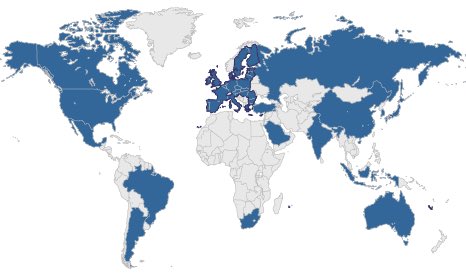
economic-freedom-index-world-2010_mapThe common law, based on individual liberty, enforcement of property rights, freedom of contract, separation of legislature and judiciary, and protection of the individual from the arbitrary caprices of state and government, is arguably our greatest-ever export. That the Anglosphere countries whose legal systems are based on it have consistently formed some of the freest and most prosperous societies on the planet isn’t an accident, but a discernible consequence of it.

Continental countries, in contrast, have to a much greater extent opted for an entirely different legal tradition of codified law, more often originating in the rarified air of abstract political philosophy, rather than grounded in the gritty, often untidy, reality of peoples’ actual lives, interactions and contracts.

The Continental legal tradition reflects a vision of law, liberty, personal rights, and crucially the relationship between state and individual, that is elementally inimical to our common-law and liberty-based tradition: a conflict summed up in the most frequently observed distinction that in the English tradition you may generally do anything which is not specifically prohibited, as opposed to the Continental tradition, where you may generally do nothing that is not specifically permitted.

Yet it’s that Continental tradition that informs the legal systems of the vast majority of EU member-states and which the EU’s corpus juris will overwhelmingly reflect. That shouldn’t be surprising: the EU is, after all, nothing if not a deliberately statist, top-down, technocratic, democracy-circumventing project, and for its legal system not also to conform to that philosophy would be an astonishing inconsistency.

Scales of Justice EnglishBut it’s into that illiberal tradition that a vote to Remain in the EU will consign us. Or, more likely, condemn us. In prospect are the subsumption of some the most cherished institutions and protections of our English common-law liberty – habeas corpus: the right to know the charges arraigned against you: the right to expeditious justice: the right to face your accusers in public court: the right to be tried by a jury of your peers, not by state-appointed judges – into the Continental legal tradition where these are either absent, muted, or susceptible to being set aside on the grounds of State expediency.

The law of the jurisdiction of England and Wales, whether common law or statute, doesn’t belong to MPs, much less to Ministers or Government. It belongs to us, the people. When we send MPs to Westminster, we don’t transfer ownership or possession of our law to them: we merely delegate them temporary custody of it and political responsibilty for its administration – nothing more. The law of England and Wales is not the exclusive property of transient Government or MPs to jettison, abandon or give away to another polity, without our specific consent.

Anglosphere 1We aren’t “European”. Our core values, beliefs & legal traditions give us far more in common with our Anglosphere first cousins. The Continental tradition of codified law & centralised statism is fundamentally inimical to Anglosphere ideas of freedom & liberty. Throughout our history, we’ve chosen different solutions to these fundamental questions than have our European neighbours: solutions developed ground-up, rooted in individual liberty & lived experience, not derived from abstract theory of political philosophy.

It’s that rich heritage that we still have a couple of hours to retrieve and re-energise.

Thoroughly agree with this article? Vehemently disagree with it?

Scroll down to leave a comment

Follow A Libertarian Rebel on Twitter

Delicious Save this on Delicious

I Wasn’t Wrong. I Just Underestimated.

In my March 2015 prediction of the tenor and conduct of the EU Referendum, if anything, I underestimated just how dirty it would be.

Back in March 2015, I wrote an article for fellow-Brexiteer Ben Kelly over at The Sceptic Isle, on how the EU Referendum, whenever it came, would play out. (Ben has archived it, so I can’t link to it, but fortunately I kept a Word copy of it).

The first part of the piece was a prediction of how the referendum would be conducted. Here it is:

“Whenever it comes, the EU Referendum campaign will undoubtedly be the dirtiest and most deceitful plebiscite ever seen in Britain. For the EU-enthusiasts disproportionately represented in opinion-influencing circles, there is simply too much at stake for it not to be.

For them, an OUT vote means a popular re-affirmation of the democratic, sovereign nation-statehood they have spent almost their entire adult lives repudiating. It means a national rejection of the centre-leftish, universalist, democracy-bypassing supranationalism of unelected elites, which they believe is the necessary civilising antidote to the unpredictable caprices of robust, accountable one-country pluralism.

The overwhelmingly EU-phile politico-media establishment, including the three main legacy parties, will exaggerate the supposed benefits and advantages of EU membership, and simultaneously downplay or suppress its drawbacks. There will be massive scaremongering to overstate, in wildly dramatic fashion, the alleged risks of exit, whether to UK jobs, economic growth, ease of travel, or even our much-vaunted but much less evident “influence”.

Even in the 2014 EU Parliament elections, we saw the readiness of the EU-phile movement to retail the risible “3m jobs at risk” meme, and the media’s willingness to boost it, despite its evident falsehood. The personal smearing of advocates for withdrawal will be constant, and vicious. It will be a media negative-propaganda campaign such as we have never before seen.

Hand-in-glove with the media will be what will be trailed as “the voice of business” – more accurately, the voice of big business and its representative organisations like the CBI, which benefits most from the crony-corporatism that the EU exemplifies. Big business values the EU for the competitive advantage it brings: large firms have sufficient size and economies of scale to absorb the mountains of EU regulation and attendant compliance costs that both deter new entrants and cripple their smaller, nimbler competitors. They will do everything to maintain that advantage.

Meanwhile, pro-EU campaign groups and third-sector “charities” and quangos will be vocal in support of EU membership and its alleged benefits as never before. Our emotions will be assaulted by heart-rending warnings of hardship and unfairness to recipients of charity if EU regulations cease to apply on exit.

The anti-exit movement will be backed by massive financial support, not least from the EU itself. For the EU, the stakes in a UK exit referendum being held at all are huge – remember, the entire European super-state project is predicated philosophically on the historical inevitability of ever-closer union – but the risks to the EU from that referendum delivering a UK exit are incalculable.

Britain would be the first major country, and economy, to resile from the project. Not only would it take its contributions with it, but it would almost certainly tempt others to follow. The possibility of it being the thin edge of the wedge, and the first step in the breakup of the entire edifice, could not be discounted.

The extent of EU funding which has been funnelled to the BBC and the CBI is well-known.

BBC CBI comp

But the EU has also been quietly suborning civic society, and even local government, with EU funding, for many years. The recipients cannot be expected to do other than campaign vociferously for its continuation. The EU will pour money into the pro-EU, anti-exit campaign – because its own very survival could be at stake.

History shows, too, that the status quo exerts a strong voter pull in referenda, and that voting intention in favour of the status quo actually hardens as polling date approaches. Dangling before the electorate the idea that the intended change represents a risky leap into the unknown unfortunately works.”

The purpose behind this quick post isn’t to gloat, or to say “See, I told you so!” I’d much rather I’d been completely wrong, and that after a robust but more-or-less civilised campaign on the substantive issues, Britain was now irreversibly on course for a Brexit vote.

It’s just to record ruefully, not that I was right, but that I underestimated the depths to which the Government, the mainstream political parties (albeit with some honourable exceptions within them) and the Remain Campaign would sink – or perhaps that should be dive.

But the cynical, shameless exploitation, by all, of the MP Jo Cox’s murder, culminating in what Conservative Woman‘s Laura Perrins rightly calls something that should go down in the political handbook of infamy, plumbs depths of ethical depravity and turpitude even I could not have imagined.

That Britain now seems about to commit what will arguably the greatest act of national self-destruction of the Modern Era is bad enough. That it should do so as a result of being susceptible to baseness of this magnitude is profoundly depressing.

Thoroughly agree with this article? Vehemently disagree with it?

Scroll down to leave a comment

Follow A Libertarian Rebel on Twitter

 Delicious Save this on Delicious

Stronger IN …. Specious Misrepresentation

Analysis of just one tweet from the Stronger IN campaign shows both its cavalier disregard for factual accuracy and the dishonesty of its overall message

Even with two months of an acrimonious EU Referendum contest still to go, the scaremongering of Stronger IN, the Remain Campaign’s principal vehicle, has already acquired semi-legendary status. Except not, possibly, in the way it anticipated and intended.

Because, with its campaign blatantly mirroring closely the EU-phile Cameroon Government’s Project Fear, every instance of Stronger IN disingenuousness, selective interpretation and outright misrepresentation is rightly attracting immediate and widespread challenge and derision, followed almost every time by a swift and effective rebuttal.

Today has been no exception: but it’s perhaps worth deconstructing one such instance in detail, to show the extent of the deception which is, increasingly, the Remain campaign’s principal (if not its only) tactic.

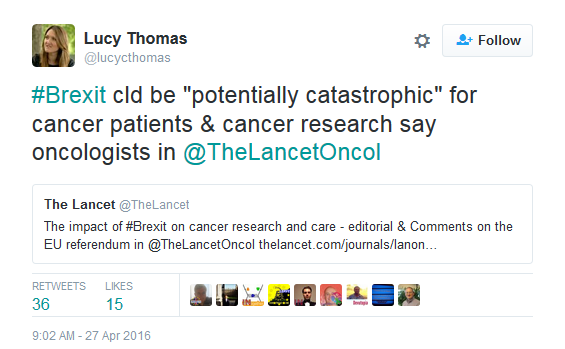
At 0920 this morning, Lucy Thomas (@lucycthomas ) Stronger IN’s Deputy Director, tweeted thus:

2016.04.27 Cancer ThomasThe implication that Thomas’ tweet clearly intends to convey – that the UK’s specifically leaving the EU would adversely affect, “potentially catastrophically”, not only individual cancer patients’ survival chances but even the future of cancer research itself, instantly looks suspicious. Because, as most people with more than a passing interest in UK current affairs know, the UK’s cancer survival rates, compared to those of other advanced countries, aren’t actually particularly good, even while we’re in the EU.

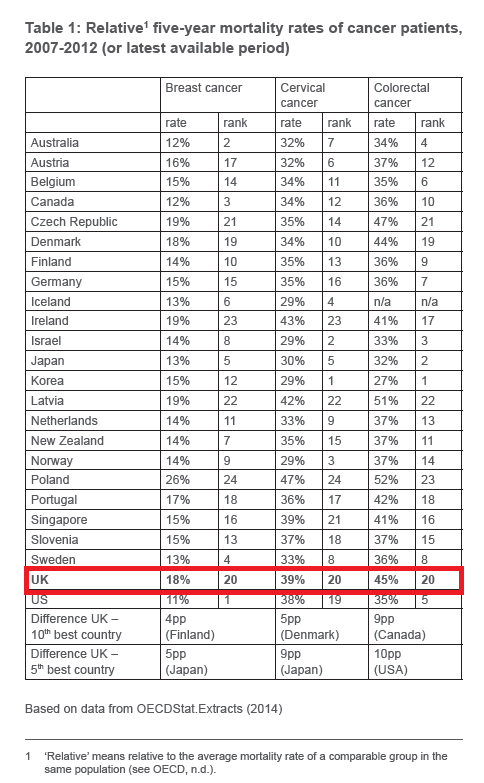
As the chart below shows, in a grouping of 24 countries, we rate pretty badly – 20th overall, in fact. On relative 5-year mortality rates for cancer patients, over the five-year period 2007-2012, not only are we much, much worse than our Anglosphere cousins the USA, Australia, Canada and New Zealand: significantly, we’re also worse than European, but non-EU, Norway and Iceland.

UK Cancer Survival RatesNHS 5-year cancer survival rate OECD

At a more detailed, and solely European level, the same outcomes continue. For, as the chart on the right shows, just compared with Germany and The Netherlands, our 5-year survival rates, over the period 2007-2012 for breast, cervical and colorectal cancer were the worst of all three.

A quick Google search then establishes (in The Guardian, no less) that UK cancer survival rates trail 10 years behind other European countries. It’s worth quoting a two or three sentences in full:

“Five other European countries (Finland, Germany, Italy, the Netherlands and Norway) also recorded better survival rates for lung cancer in the 1990s than Britain in the 2000s.”

“For colon cancer six European countries (Finland, France, Italy, the Netherlands, Norway and Sweden) had better survival rates in the 1990s than Britain achieved 10 years later.”

“In the 2000s 19% of British patients diagnosed with stomach cancer survived. Better survival rates were recorded a decade earlier in Austria, Germany, Italy, Norway and Sweden.”

Norway again. Better cancer survival rates than the UK, and 10 years before. Evidently, not being in the EU isn’t a factor holding back Norway’s progress in tackling the scourge of cancer.

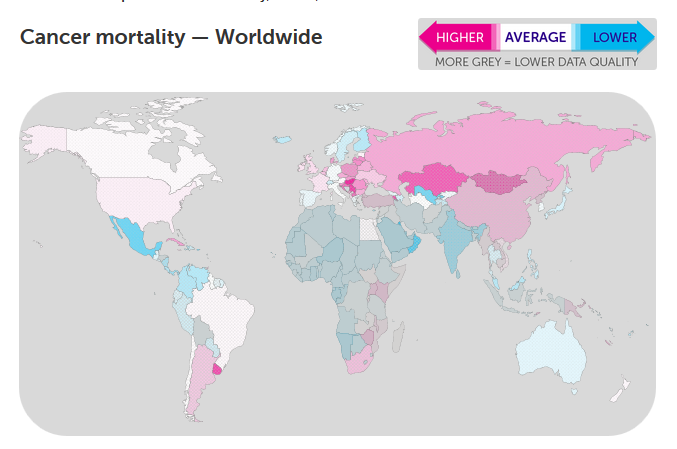
A further quick search yields Cancer Research’s data on worldwide cancer mortality rates, and the chart below:             

Cancer mortality worldwide 2012

It’s immediately obvious that non-EU Switzerland, non-EU Iceland, and non-EU Norway all have lower cancer mortality rates than the UK. In fact, non-EU Switzerland and non-EU Iceland have lower mortality rates than all the rest of the EU, bar Sweden and Finland. Clearly, cancer survival prospects seem, if anything, to be inversely-correlated with EU membership, rather than the opposite.

The empirical data therefore directly contradicts the impression Thomas’ tweet  seems to want to convey.

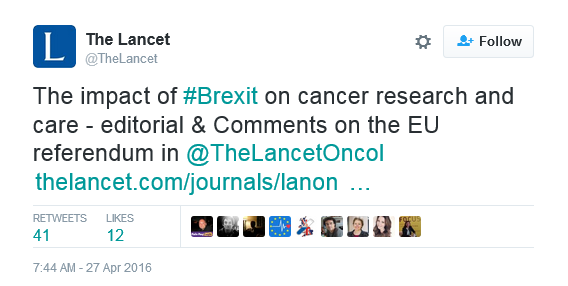
Next, the content of that link in the actual The Lancet tweet, of which Thomas’ is a Retweet-With-Comment, bears closer examination.

2016.04.27 Cancer Lancet

Perhaps by now unsurprisingly, the article turns out to be inherently speculative, tentative, non-specific, certainly non-medical, and primarily an expression of political viewpoint. Again, it’s worth quoting one or two sentences:

“Part of the inherent difficulty with this debate is that the repercussions of leaving can only be speculated on”

“These unknowns mean that points of argument are often semantic, and emotionally led.”

The article attempts to make two main points. First, it implies that the specific act of withdrawing from membership of the EU political union would be the determinant of worse prognoses and outcomes for UK cancer patients. But, as we’ve seen above, from the better survival rates achieved in non-EU countries, even in Europe, that’s a viewpoint which seems wholly unsupportable.

Second, it argues that ceasing to be in the EU’s political structures presages a diminished level of medical-science co-operation. But, apart from offering no convincing argument why this should be so – why do we need to be in political union with, eg Canada, to co-operate mutually on medical science? – the assumption on which The Lancet’s assertion is based itself appears to be at variance with reality.

The chart below, taken from the UK Medical Research Council’s 2014/15 report, shows the policy influence on UK medical science by originating location:    

UK medical science policy sources

In fact, a mere 7% of policy influence on UK medical science originates from within the EU. The equivalent UK figure is 56%: and it’s evident, moreover, that the residual 37% far outstrips the EU’s contribution of 7% to UK medical science policy origination.

Quite how Brexit would therefore so “potentially catastrophically” affect both UK cancer patient outcomes and UK cancer research is, to say the least, unclear.

This micro-checking exercise on just one tweet from the Stronger In campaign probably took no more than 10-15 minutes, including the time spent tweeting the findings as they became apparent. But what it reveals is a reality totally at variance with the impression its Deputy Director is disingenuously trying to impart.

Lucy Thomas’ narrative is factually inaccurate, specious and dishonest – a perfect metaphor, perhaps, for an entire Remain campaign that’s Stronger In misrepresentation than it is in anything else.   

Thoroughly agree with this article? Vehemently disagree with it?

Scroll down to leave a comment

Follow A Libertarian Rebel on Twitter

  Delicious Save this on Delicious

Your Advice Is Not Required, Mr President

An open letter to President Obama on British sovereignty, democracy, and the EU Referendum

Dear Mr President

Welcome to the United Kingdom: we hope you enjoy your last official visit to our shores as Head of State. But we also strongly recommend that, while renewing your acquaintance with our own Head of State, you reflect on the immeasurable historical importance, to both our countries, of independent nation-state sovereign democracy: and then conclude that for you to intervene politically in our forthcoming EU Referendum would traduce both our countries’ past histories, not to mention our own current hospitality, and in a way we find entirely unacceptable.

Questions for Obama on Europe

You’re going to try and browbeat us, Mr President, into voting to remain in the EU: in a democratically deficient, supranational political union that you would never even dare recommend to your own fellow-Americans as a political institution into which they should subjugate themselves.

We’ll return to the specifics of that particular piece of hypocrisy later: but you also evidently propose to compound the hypocrisy by pretending that your intervention has our own best interests at heart.

We’re not fooled. We’re well aware that, in governmental, political and diplomatic circles, the so-called Special Relationship is often a platitude thrown by the unscrupulous to the masses to conceal that the United States resolutely and sometimes ruthlessly acts in what it perceives as its own interests, even to the detriment of its own allies’.

We accept that, however, as being no less than how a major power should defend what it sees as its interests – but what we do not and will not accept is your pretence that a grossly-disadvantageous political arrangement for us is somehow in our interest, because it primarily serves your own.

We have a long institutional memory, Mr President. We know how, in the aftermath of World War II, America took advantage of our precarious financial state to insist on the return to convertibility of sterling, thus allowing the dollar to supplant it as the primary currency in large parts of the world.

We know how, to help promote your predecessors’ then already-incipient preference for a pan-European political union, US Marshall Plan funds were lavished on the fascist and collaborationist states whom we had sacrificed so much blood and treasure to help defeat, while we in Britain struggled to rebuild our own infrastructure and society via loans extended by America on unfavourable terms.

We know how the US threatened to destroy sterling by selling all its sterling reserves during the Suez Crisis of 1956, in order to supplant British influence in the Middle East with its own via a strategy of supporting Arab nationalism.

We know how the 1960s débacle over the aborted Skybolt nuclear weapons delivery system revealed your State Department’s making it an arm of US foreign policy that Britain must be in the (then) EEC, whatever the cost to it economically or democratically, because that was key to US interests.

More recently, Mr President, we’re well aware you have been, not merely the most Britain-unfriendly POTUS in modern history, but also arguably one of those most antipathetic to wider Western interests.

Obama Fawning SaudisWe know you have near-humiliated yourself and your country in making obsequious obeisance to the autocratic Wahhabist-Salafist rulers of a Saudi Arabia that funds Jihadism, executes apostates and jails dissenters. Indeed, you arrive in Britain fresh from abasing yourself to a Saudi Arabia that now threatens to inflict enormous damage on your economy if currently classified material exposing its complicity in 9/11 is revealed.  

We know you have sanctioned a path to the development of nuclear weapons by an Iran that makes no attempt to conceal what it sees as its theocratically-mandated destiny to eliminate a democratic nation-state from the face of the earth and extirpate its people, while in the interim hanging young men from cranes in public for being gay.        

Obama dances the tando while Europe Brussels burnsWe’re also aware that, as recently as last month, even as people fought for their lives and Brussels reeled in shock from violent terrorism  – perpetrated by the supremacist religio-totalitarian Islamist ideology that you apparently cannot even bring yourself to name – you were tango-ing the night away in Buenos Aires, canoodling up to an Argentinian regime that still maintains its egregiously-tenuous claim to a British sovereign territory, over 90% of whose British inhabitants declare, via self-determination referendum, their overwhelming wish to remain British. The satirical cartoons captured it so perfectly, didn’t they?

Reasons Brits believe why Obama opposes BrexitSo please don’t insult our intelligence, Mr President, by pretending your impending “advice”, that it’s essential for Britain’s interests for it to remain in the EU, is merely the counsel of a friend who has only our own best interests at heart. We know full well that that is not the case: only 4% of us think it even might be, as opposed to 51% who are under no illusions that US wishes, not British interests, are uppermost in your motivations. You are, in short, no friend of Britain.       

Now consider the European Union you are assuring us that it would disastrous for us to leave, were it to be translated into the American sphere.

Are you prepared to tell Americans they’d have a safer and more secure future, if only they’d agree to give up their independence, sovereignty and representative democracy to submerge themselves in a new supranational political union including Mexico, Nicaragua, Venezuela, Guatemala and Paraguay, which was determined to arrogate ever-increasing powers to itself from the democratically-elected national governments of its component nation-states, as an inexorable process of creating one single pan-American superstate?

Are you prepared to tell Americans they’d be far better off in such a pan-American political union whose highest judicial authority was a court in Bolivia, consisting mainly of academic lawyers unfamiliar with American common-law traditions, but which would nevertheless be superior to, and override, your own Supreme Court?

Are you prepared to tell Americans it would be much more to their advantage to immerse themselves in a political union of which one of the cornerstones was the totally free movement of people between the 30+ states from Alaska to Tierra del Fuego, with entitlements to generous welfare in their destination country, despite massive economic disparities between them?

Are you prepared to tell Americans it would be so much better for them, in such a political union, for 70% of their laws to be made by an unelected, bureaucratic, corrupt, unaccountable, viscerally anti-democratic Pan-American Commission in Bogota, whose commissioners they weren’t allowed to elect and certainly not vote out, but to which they nonetheless had to send $80 million a day for the privilege?

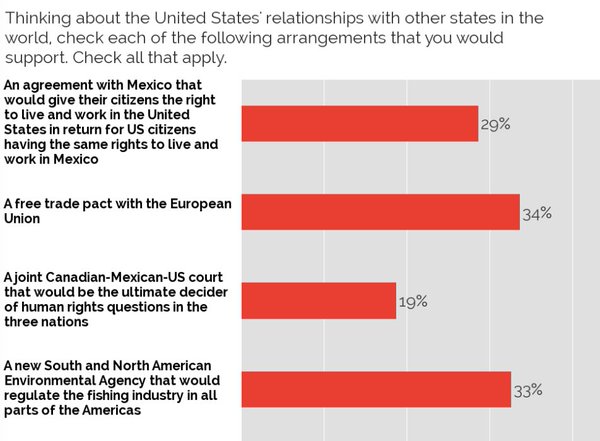
Obama asks us to stay in what Americans wld never tolerateActually, Mr President, we already know the answer to these questions: you would never suggest to Americans any such thing, because they have already indicated that no more than a third, at most, would support anything remotely like the political settlement to which you  insist disingenuously it is in our own best interests to remain shackled. So until you are prepared to recommend Americans to give up their sovereign democracy to the kind of polity you wish to see continued to be imposed on us, we respectfully suggest that you butt out of our Referendum. Interestingly, over 100 of our own elected lawmakers seem to agree.

At the core of our EU Referendum, standing way above all issues of economics, trade or migration, is one very simple principle, but one whose incontestable, absolute necessity for government by democratic consent it is impossible to over-state: that the laws governing the citizens of a discrete-demos polity can legitimately be those, and only those, made by, and only by, the representatives directly elected by the citizens of that polity, and whom they can remove from office via the ballot-box at the next election.  

The founding fathers of the great nation whose elected leader you, Mr President, will thankfully soon no longer be, considered these principles to be of such paramount importance that they and thousands of their fellow-patriots in the Thirteen Colonies were prepared to sacrifice their own lives to secure them for themselves and their future descendants. So much so that, in a few weeks’ time, on the Fourth Of July, you will celebrate the 240th anniversary of their final success in gaining their independence from a distant imperial power determined to keep its subjects in subjugation.

That you now come to us, to seek for your own interests to persuade us not to take this opportunity to recover self-government on these immutable principles for ourselves, from the 21st century equivalent of that distant imperial power determined to keep its subjects in subjugation, we find nothing short of grotesque.        

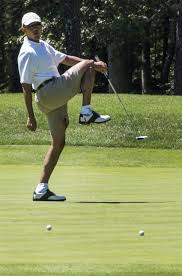
Obama GolfWe respectfully suggest, Mr President, that you abandon your plans to intervene in our democratic referendum. Perhaps you could profitably use the time to make a second and final visit to your new apparently ideological near-soulmate Fidel Castro, before the old tyrant is summoned to account by the Grim Reaper.  Or possibly to work on your golf technique, which looks as though it could use some improvement.

Your advice on our vote to decide our future EU destiny is not needed.


Thoroughly agree with this article? Vehemently disagree with it?

Scroll down to leave a comment

Follow A Libertarian Rebel on Twitter

Delicious Save this on Delicious

The Incredible Shrinking Chancellor

Formerly seen – not least by himself – as a master strategist and astute political operator, George Osborne’s authority is eroding before our eyes

“Events, dear boy, events”, former Prime Minister Harold Macmillan is reputed to have replied when asked to predict the factor most likely to derail his political plans. He meant “the unexpected”: in modern political parlance, the “unknown unknowns” that can, and almost always do, erupt, unforeseen, seemingly out of nowhere, to blow the most carefully-crafted plans off course.

Chancellor of the Exchequer George Osborne could be forgiven for spending more time than usual ruefully recalling Macmillan’s remarks at the moment. Because, since the start of 2016, his plans for his own political advancement have been derailed spectacularly, to an extent which, on 1st January, he can surely scarcely have imagined. Yes, partly by some of those unknown unknowns: but, ironically, also by his own blunders. His stature and authority are crumbling astonishingly, virtually on a daily basis.
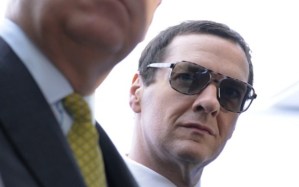
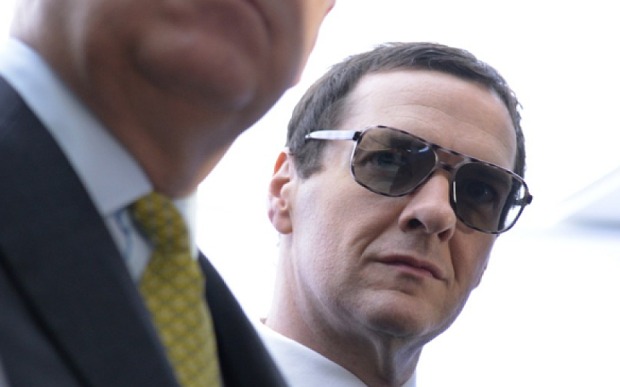
Osborne with shadesYet, contemplated from Osborne’s New Year’s Day breakfast table, 2016 must have looked satisfyingly promising. First, Budget Day on 16 March would give him the opportunity to continue the centre-leftwards tack started in his 2015 Autumn Statement, designed to capitalise politically on Corbynite Labour’s charge towards hard-Leftism, by hoovering up disaffected Blairites and Labour moderates into the Cameroon social-democracy-leaning Big Tent.

Second, David Cameron would round off his tour of European capitals pressing for EU reforms at the Brussels EU Heads of Government Summit over the weekend of 19-21 February. True, he’d return with only trifling and essentially cosmetic reforms. But, accompanied by some lurid Brexit-alarmism, a Cabinet united in campaigning for Remain, and a “helpful” media narrative, they should be just enough to persuade a risk-averse British electorate to vote to stay in the EU. Clearing the way for Cameron to resign in triumph as Prime Minister and Party Leader some time in 2017 or 2018, and leaving Osborne in pole position to see off any  challenge and ascend to No 10.

Except it hasn’t quite worked out like that. In fact, it’s rapidly going pear-shaped. “Events, dear boy, events”.

Take the EU “re-negotiation”. Yes, Cameron did indeed return from Brussels with a “reform” deal: but one of such abject and transparent paucity, ineffectiveness and unenforceability, that it had unravelled, and been both rightly exposed and excoriated for it, within 72 hours. And to such an extent that the Government’s official Remain campaign strategy adopted, almost from Day 1, what had been hoped would be the back-up strategy of Project Fear. Any plausible pretence that there is a “reformed” EU at all has been dropped. Brexit-scaremongering Project Fear, to all intents and purposes, is the  Remain campaign.            
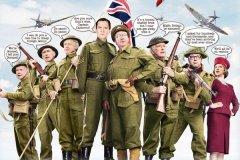
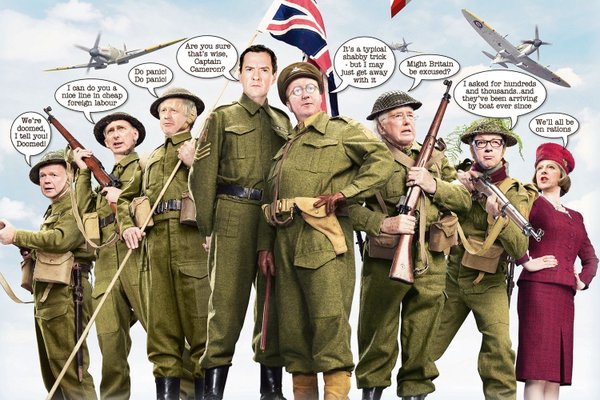
Conservatives - Careers before countryThen, from Osborne’s point of view, came the bombshell. He must surely have reckoned that both Boris Johnson and Michael Gove would be reliably on side, fully signed up to the Government’s official position, as fellow-advocates for Britain staying in even the risibly non-“reformed” EU that was on offer: Boris because of his general pro-EU and internationalist outlook, including a desire to see Turkey in the EU, and Gove because of his personal loyalty to Cameron. Before the Brussels summit of 19-21 February, even this political cartoon was circulating: the Party heavy-hitters, including Boris and Gove, lined up, Dad’s Army style, in Captain Camwaring’s pro-EU Home Guard platoon.

Not any more. Because in fact, the opposite happened. Boris, after much public and private agonising, declared for Leave, and Gove, with what must be one of the finest personal statements to grace British politics for a very long time, did the same.

Those two “defections”, I suspect, rocked Osborne back on his heels: not just on account of their unexpectedness, but also because of their implications, both for the EU Referendum itself, and consequentially, for Osborne’s own political future. On the Leave campaign, to Boris’ public appeal is added Gove’s principled integrity and intellectual heft. They make the outcome of the Referendum far closer and far less predictable: that the Government and Remain could actually lose it, and that Leave could triumph in a vote for Brexit, really isn’t beyond the bounds of possibility.

If that happens, despite his bluster, Cameron would, politically, be Dead Man Walking: and given that their political ideologies and fortunes have been so inextricably linked for 25 years, that means Osborne would too. Even with a wafer-thin Remain win, Cameron’s credibility, and thus Osborne’s, will be seriously damaged: the latter’s, possibly fatally, with intra-Party talk already being that the next leader will almost certainly have to come from the Party’s pro-Brexit wing.

osborne looking grimNo wonder Osborne has suddenly seemed such diminished figure, thrown off balance, ever since. His prospects of following his planned and mapped-out route of a smooth ascent to No 10 in the wake of a benignly-departing David Cameron have suffered a severe blow: they may even be receding, a victim of Boris’ burgeoning popularity with Party members and activists since his ostentatious and publicity-maximising conversion to the Brexit cause.

And it gets worse. Because, intriguingly, in only the barely three weeks that have elapsed since the denouement of these events, a gaffe-prone Osborne has been either been caught out and had to retract hubristic claims, or forced to execute a sharp policy U-turn in an humiliating climb-down, or experienced an open challenge to his authority and rebellion from his own backbenchers, on no fewer than seven separate issues.

First, the Google tax deal. A clearly pleased-with-himself Osborne made extravagant claims for the £130 million agreement he had reached with Google, presumably on the calculation of reaping political capital from the vocal lobby opposed to any (entirely legal) tax-avoidance by multinationals. That soon unravelled, however, with the revelation that it covered a full 10 years of back taxes and amounted to an effective tax rate of only 3%, against the UK standard corporation tax rate of 20%. It concluded with scathing criticism of Osborne from his own backbenchers, both the Commons Public Accounts and Treasury Committees launching separate inquiries, and both Google and HMRC being asked to re-appear before themGoogle, meanwhile, are reportedly furious with Osborne for making self-aggrandising claims which have given them additional poor publicity.

Second, the claims of extra tax revenue from the lower top rate. Osborne boasted  that an additional £8 billion in tax revenue had been generated from the reduction in the top rate of tax from 50% to 45%, attributing the entire amount to the rate change. Unfortunately for him, that was quickly challenged as “precarious” by none other than the Institute for Fiscal Studies, on the grounds that it ignored any deferment factor and was more a one-off gain than a systemically-permanent windfall. We have heard no more about it.

Third, the planned tax-raid on pensions. Osborne had been planning a very Gordon-Brownian stealth-tax: to abolish higher-rate tax relief on pensions, and lower the threshold at which money invested in a pension pot starts to attract high, almost penal, rates of tax. The entirely predictable backbench uproar duly ensued, with Osborne’s plans being rightly denounced as simultaneously both economically-incompetent – disincentivizing prudent retirement saving – and politically-inept – targeting a natural Tory electoral constituency. They have been dropped.

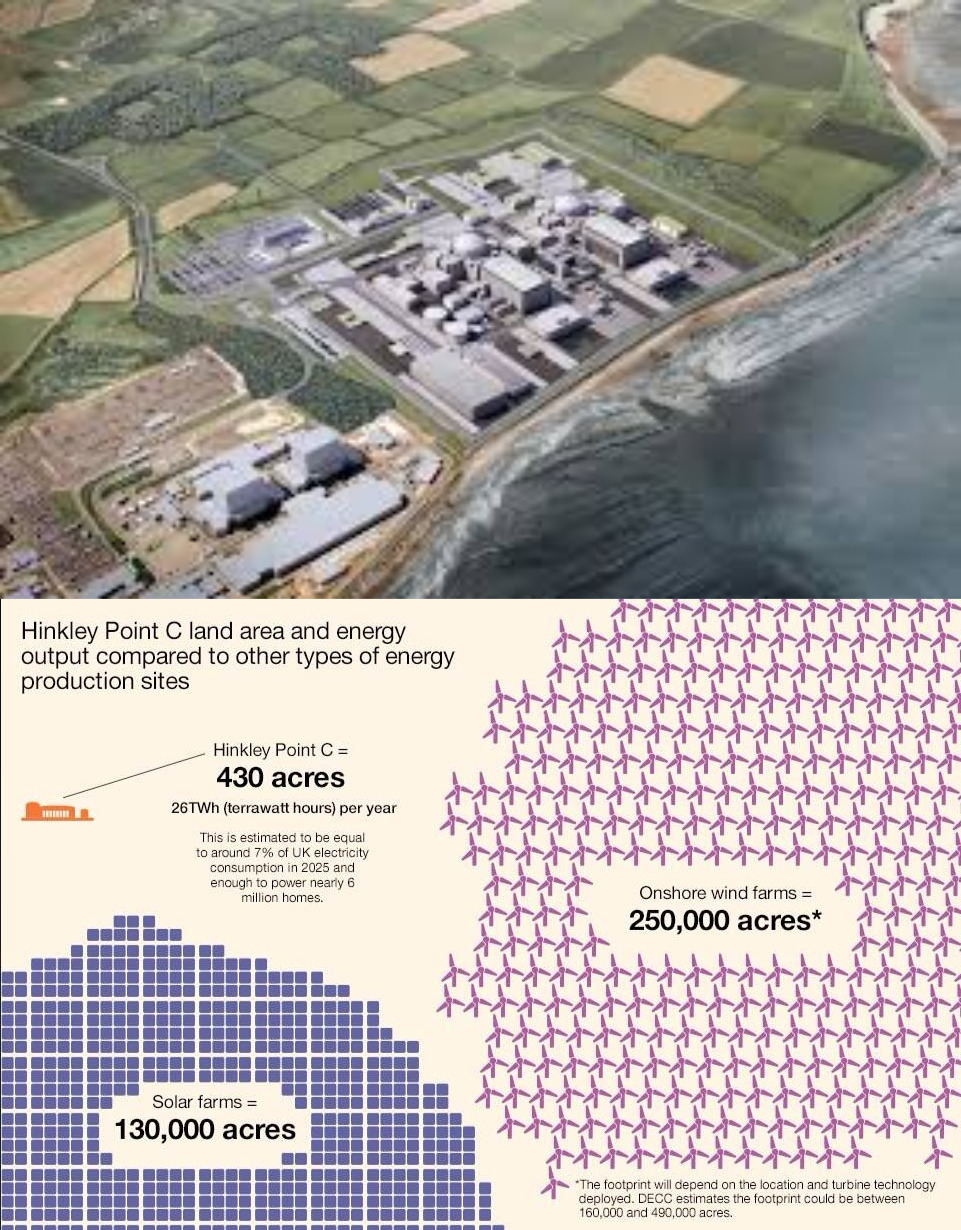
hinkley Point comp 2Fourth, Hinkley Point Nuclear Power Station. This was announced with much fanfare by Osborne on his September 2015 trade visit to China. The deal, was, though, subject to a £2 billion taxpayer guarantee to EDF, without which they would have struggled to secure project finance, and immediately attracted informed criticism because of its capital intensiveness and cost per MWh of output. It’s now emerged that the building cost has roughly trebled, the strike-price per MWh for its output has doubled, and the start date has been put back 8 years: all within 6 months. The calls for it to be scrapped as an expensive and uneconomic white elephant are growing.
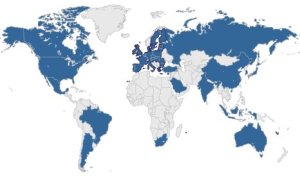
G20 vs EU How Do They Cope via Julia H-BFifth, the G20 warning against Brexit. At Osborne’s initiative, the plan was for the G20 group of advanced economies to warn Britain against exit from the EU. That quickly collapsed, to widespread derision, when commentators pointed out the inconvenient fact that 16 of the 20 G20 countries are actually outside the EU, yet self-evidently still manage to be in the top 20 economies globally. Prompting the question: how could they then credibly warn Britain, the 5th largest, that it must be inside the EU to ensure its very survival? Silence.

Sixth, this week’s Sunday Trading liberalisation débacle. Despite being warned of the likelihood of both the SNP yet again ignoring their pledge not to vote in Westminster on what are devolved matters in Scotland, and an incipient Tory backbench rebellion, Osborne nevertheless determined to push the Bill through the Commons. When it became apparent that the SNP and Osborne’s own backbenchers would indeed carry out their threats, there was a ham-fisted attempt to water down the Bill’s provisions, culminating in an humiliating rebuff from the Speaker who refused to accept a related Motion.  SNP MPs duly supported Labour, the Tory rebels duly rebelled, and an embarrassing defeat for the Government, plus the loss of the liberalisation measures, was the outcome.

Seventh, another Tory backbench revolt, against another Osborne tax rise, this time on motor fuel duty. Despite 74% of the pump cost of a litre of diesel or petrol now comprising tax, Osborne, it appears, had planned to use next Wednesday’s Budget to increase the duty even further. Cue the now normal resistance movement, by up to 150 MPs, and the plans for a hike in the duty are reportedly being shelved.

These kinds of setbacks aren’t unprecedented: Osborne has had wobbles before. Think of the Pasty Tax in the 2012 Omnishambles Budget: a previous attempt to raise fuel duty with effect from January 2013 which similarly had to be abandoned on backbench pressure: and the tax-credits imbroglio of 2015, when an Osborne converted, we were told, to “listening mode” was equally forced into an embarrassing retreat.
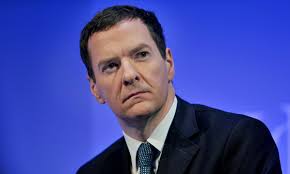
osborne looking grim 2But Osborne’s present troubles look and feel different, quantitatively and qualitatively. Quantitatively, because they’ve been coming thick and fast – no fewer than seven, and in just three weeks, which, I’d venture to suggest, is unprecedented. Qualitatively, because they contain an element which hasn’t been present in earlier iterations – a ready willingness, particularly among Tory backbenchers, not merely to voice misgivings, but vocally and robustly to resist, rebel, criticise and take to the media to denounce the Chancellor’s proposals in no uncertain terms, both as economically-disadvantageous and politically-inept.

The latter charge being especially ironic, and wounding. Because Osborne is, above all else, a Political Chancellor, far too prone to seeing virtually every aspect of economic and fiscal stewardship through the prism of partisan political triangulation. The shameless stealing of Blairite clothing in the form of a National Living Wage (aka, arbitrarily raising the floor price of labour to employers by State diktat) is but the latest example.

Osborne has long been lauded – not least by himself – as a political master-strategist. But, in truth, his excessive concentration on it, to the detriment of his economic and fiscal stewardship, has had decidedly mixed results. He’s been allowed to get away with increasing the National Debt by more in five years than even that preposterous antithesis of fiscal rectitude, Gordon Brown, managed in thirteen, largely because, when only 6% of the population know the difference between deficit and debt, few votes were risked by it.

Yet being master-strategist for two elections, 2010’s not won, even against Brown, and 2015’s, not expected to be won, but won mainly out of voters’ fear of a Labour-SNP government, tell a different story. As does the prevalence of the “austerity” narrative, despite the lamentable pace of deficit reduction. During the 2010-2015 Coalition, the overall rate of public spending reduction was a miserable 0.4% pa in real terms: supposed political master-strategist Osborne, however, succeeded in being portrayed as the heartless architect of Victorian-workhouse austerity, for the macro-fiscal equivalent of reducing a weekly £200 shopping bill by 80p.

So the last month’s acceleration in the decline of Osborne’s standing is partly an overdue reckoning: but its litany of serial hubris, politico-economic miscalculation, U-turn and climb-down, in just 20-odd days since the shock of Boris’ & Gove’s defection to the Brexit cause, have notably exacerbated its visibility. The wider appreciation of his Brown-like inveterate political-meddling and fiscal neo-Keynesianism, stealth-taxes and all, mean that the “Osbrowneomics” and “Osbrowne” memes are gaining wider currency.
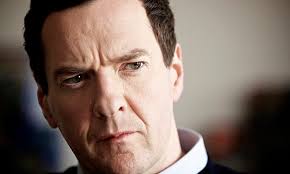
osborne looking hauntedAs each successive Tory backbench anti-Osborne rebellion yields results, his critics are becoming more emboldened. They’re getting a taste for it, scenting blood. Osborne suddenly looks at bay, haunted, error-prone, wan, vulnerable, yesterday’s future, a fast-diminishing figure, in a way few can have predicted on 1st January.

He really is The Incredible Shrinking Chancellor, his stature and authority crumbling daily before our eyes.

Thoroughly agree with this article? Vehemently disagree with it?

Scroll down to leave a comment

Follow A Libertarian Rebel on Twitter

Delicious Save this on Delicious

Does Democracy End At Dover?

To support English Votes For English Laws, yet argue that the UK should stay in the EU, isn’t merely politically inconsistent, but intellectually incoherent

Conservative Party MPs, coming as they do overwhelmingly from English constituencies, have discovered a new enthusiasm for more representative democracy in the current Westminster Parliament. Whether this is solely out of high-minded philosophical principle, or from rather grubbier psephological considerations, one cannot say: but that the election to Westminster, at the May 2015 General Election, of 56 Scottish National Party MPs has re-awakened awareness among English MPs of the iniquities of the West Lothian Question is an indisputable fact.

SNP MPs HoC May 15To their credit, they’re right to be concerned. Despite the SNP’s pre-election pledges that its MPs wouldn’t use their votes in Westminster on issues affecting England which are devolved matters in Scotland, it wasn’t long before those promises were being broken. Scottish MPs have been inventive – some might say speciously so – in deploying a tortuously-constructed argument, that policies intended to apply only in England can somehow also have unexpected and (conveniently unspecified) adverse knock-on effects in Scotland, as a rationale for resiling from their prior commitment.

And so the issue of an exclusively English Parliament, or English Votes for English Laws, has come back into prominence. Irrespective of the precise method that will eventually be chosen to implement EVEL, English MPs are rightly re-asserting a fundamental principle: that the laws governing the citizens of a polity can legitimately be those, and only those, made by, and only by, the representatives directly elected by the citizens of that polity, and whom they can remove from office via the ballot-box at the next election.

So far, so democratically-exemplary. But after this point, things start to get more tricky. Because many of those English MPs have also declared that they will both campaign, and vote, for the UK to remain a member of the European Union. And the EU, as a polity, is a very, very long way from being democratically-exemplary.

To understand why, we have to consider the very concept itself of the demos. The collection of people, almost always most-definable territorially, whose citizens – even when not mutually-acquainted, or ethnically-homogeneous, or religiously-affiliated – nevertheless feel that they do share enough of a common identity, set of values, and sense of being (even distant) co-partners in a joint enterprise, that they will accept one legislature, and one body of laws, as being legitimate to govern them all.

There’s undoubtedly a strong English, and even a strong British demos. Superficially, I might not appear to have much in common with someone of a different ethnicity in Birmingham, or a different religious-affiliation in Bradford: but the point is, I do feel sufficiently like them, and sufficiently part of the same collective political enterprise with them, that I’m prepared to live politically-alongside them, under a democratically-elected government chosen by us all, and a body of laws, made only by that government or its similarly-elected predecessors, applying equally to us all. Even to the extent of consenting to part of my income or wealth being abstracted by a government which we have together elected, and redistributed to them if they’re in need. That’s what the demos means.

But there’s no EU-wide equivalent of this. I don’t feel remotely xenophobic or hostile towards someone in, say, Bialystok, or Bologna, or Bilbao: but, crucially, I also don’t feel anything remotely approaching such a sufficient degree of affinity, or sense of co-partnership with them in a common “European” political enterprise, that I want or am prepared to consent to be part of the same pan-European political space, under the same pan-European government, and the same pan-European body of laws.

There is little evidence of such unwillingness being anything other than strongly reciprocated, among hundreds of millions of people, all over Europe. That does not, as the EU likes to pretend, equate to “xenophobia”, or “nationalism”. It means merely that the criteria which must be fulfilled for a democratically-legitimate polity encompassing all 28 EU member-states to emerge and subsist aren’t capable of fulfilment by popular consent.

The ineluctable conclusion, therefore, is that, as history has so often proved but the EU is philosophically-resolved to ignore, the territorially-defined sovereign nation-state, governed exclusively by its own legislature that is democratically-elected by universal suffrage, is the largest political entity in which the pre-conditions required for a politically-legitimate demos can be fulfilled. To emphasise, there is no “European” demos.

So, I contend, the European Union is democratically-illegitimate as a concept at the fundamental level of political theory, even before we confront the physical democratic deficit of the European Parliament as its purported legislature.

Interior EU Parliament

To start with, even the basic numerical comparisons are strikingly unfavourable. The entire aggregate UK electorate elects a full 100% of Westminster MPs: but no more than a mere 9.7% of MEPs. The average number of electors represented by a Westminster MP is c.68,000: but for each of the UK’s 73 MEPs, that figure is c.840,000. (Intriguingly, the equivalent Luxembourg figure is c.77,000). How any UK MEP can properly represent and address the EU-relevant concerns of nearly 840,000 constituents is a moot point. But an irrelevant one: because even their theoretical ability to do so is so severely constrained by the democratic deficit of the Parliament itself.

EU Parl processMembers of the European Parliament, despite being elected, must be among the most politically-emasculated and impotent legislators in the democratic world.  MEPs, whether individually or collectively, can neither initiate, propose, reject outright, or repeal EU legislation. Those are all rights reserved exclusively to the unelected, and therefore both lacking-in-mandate and democratically-unaccountable, members of the EU Commission.

In the European Parliament, it’s the appointed, not elected, members of the European Commission, meeting in private, who have the sole right to propose, repeal or amend the corpus of EU laws, directives and regulation that constitute up to 70% of the new legislation having application in the United Kingdom. As the graphic shows, the Parliament’s role is barely even consultative: its legislative influence, I’d suggest, is, in practice, negligible.

Contrast that with the Westminster Parliament, where any MP may introduce a Private Member’s Bill, and moreover, via one of no fewer than three different methods available. Two of the greatest social reforms of the last 50 years – the decriminalisation and legalisation of both homosexuality and abortion – were both the outcome of Private Members’ Bills.

To pretend that this sham legislature somehow equates to, or confers on the EU, any democratic legitimacy whatsoever, is little short of a linguistic travesty. It is truly a Potemkin Parliament, rendering the European Union democratically-illegitimate in practice.

Paradoxically, one of the greatest, yet most perverse and least-deserved achievements of the EU is somehow to have convinced so many citizens of its member-states that, while, yes, there may be an element of democratic deficit about it, this is:

  • just an accidental by-product of the EU fulfilling its main aims of friendship and trade via economic co-operation; and/or-
  • regrettably necessary anyway to ensure the smooth functioning of the trading bloc.

To propagate this myth is a grotesque lie, and is cynically to stand both history and truth on their heads. For, as anyone with knowledge of the EU’s founding and history knows, not only was the EU primarily a political-integration project right from the start, with trade and economic convergence being merely its ostensible purpose to conceal that: but it was also deliberately conceived, designed and constituted specifically to be, not just undemocratic, but anti-democratic.

The EU’s founding fathers, particularly Monnet and Spinelli, were profoundly distrustful of voters, and viscerally antithetical to nation-state democracy. Building on original semi-utopian pan-European ideas circulating in the 1920s and 30s, they drew from the two World Wars the wrong conclusion: that it was the mere existence of nation-states in themselves, rather than the emergence within some of them (and only some of them, remember – when did Switzerland, Luxembourg or Norway last launch an aggressive war?) of fundamentally bad ideas like aggressive Communism, Prussian-Militarism, or Fascism, that inevitably led to war. It is this same self-delusion and deception that today leads the EU to claim implausibly that it, rather than NATO, has been and is the guarantor of a Europe at peace.

Monnet on subterfuge 2They set out, therefore, to promote the creation of a supra-national political entity in which the decisions and preferences of the citizens of sovereign democratic nation-states, expressed through the ballot-box, would be bypassed, ignored and ultimately superfluous, enabling rule by an appointed class of technocrats-bureaucrats, immune to the caprices of voters and the need to obtain their consent.

That ethos still prevails in the EU of today. It isn’t even particularly concealed or denied. It was expressed perfectly by the former President of the European Commission, the Maoist Jose-Manuel Barroso when insisting only a few years ago that “democracy is dangerous”. The EU’s democratic deficit is neither accidental, nor incidental. It is deliberate and fundamental to it, and was designed-in from the start.

This, then, is the gimcrack-polity, demos-lacking, democratically-flawed in both concept and practice, artificially constructed and imposed top-down by successive cadres of an unelected, unaccountable, largely self-selecting, pluralism-contemptuous, voter-consent-averse, bureaucratic-technocratic elite, and maintaining a near-powerless Potemkin Parliament as a sham legislature to provide a wholly unconvincing facade of democratic legitimacy, inside which so many of those English MPs who enthusiastically support EVEL – ostensibly in the name of representative democracy, remember –  nevertheless fully intend to vote to keep the United Kingdom locked..

F Scott Fitzgerald speculated that the ability to hold two contradictory opinions at the same time and still function was the mark of a first-rate intelligence: Leon Festinger suggested, on the other hand, that it was a strong indicator of cognitive dissonance. As far as those English MPs simultaneously supporting both EVEL and the UK’s continued membership of the EU are concerned, my inclination is to regard Festinger’s explanation as the more likely. Because their stance isn’t merely politically inconsistent: it’s also manifestly intellectually incoherent.

Thoroughly agree with this article? Vehemently disagree with it?

Scroll down to leave a comment

Follow A Libertarian Rebel on Twitter

Delicious Save this on Delicious