The Paddington Bear of UK Politics

Pity a Labour politician who, like Paddington, has been abandoned, unwanted, on the station platform as the Socialism Train departs 

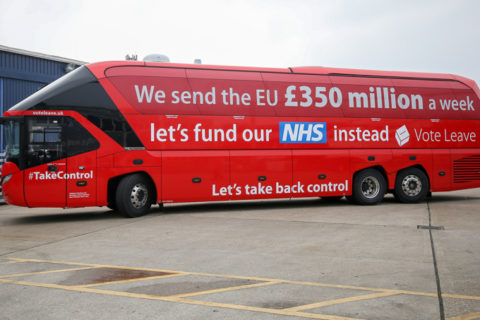
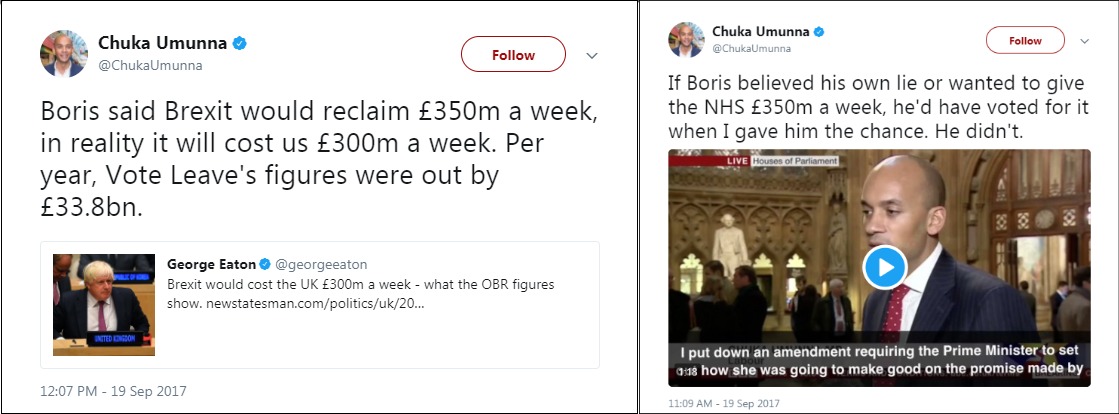
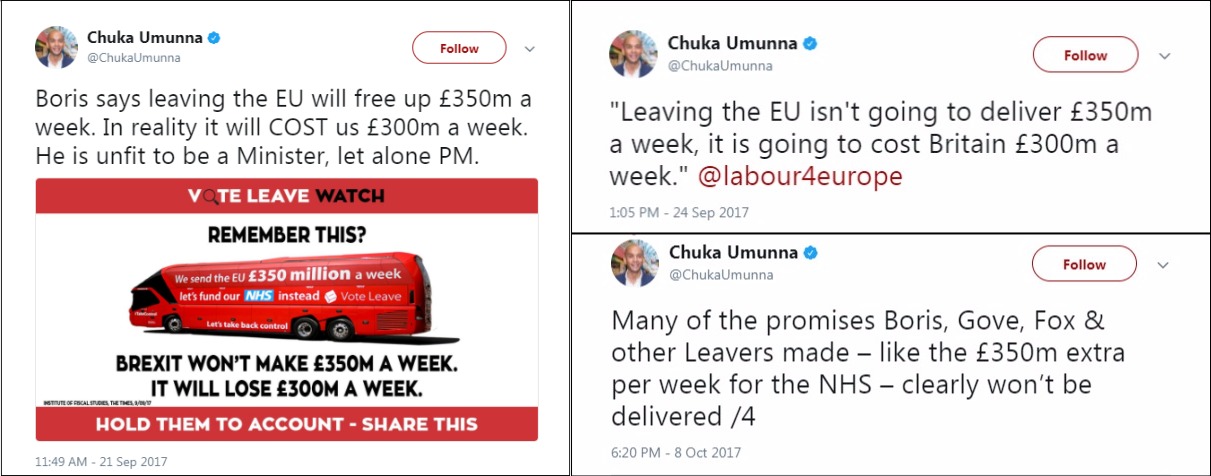
Blairite-Labour Champagne-Socialist smoothie Chuka Umunna appears to have a bit of an obsession. He seems to have convinced himself that the Vote Leave campaign’s battle-bus during the 2016 EU Referendum, with its “Take Back Control” message, was a binding promise to spend an additional £350 million on the NHS in the event of a Leave vote, and he can’t let it go.

Boris Johnson and the Vote Leave bus

It’s a meme he returns to time and time again on his own Twitter feed, like a dog worrying a bone long since chewed beyond nutrition. A quick look through his recent timeline shows tweets about it on 19th September (twice), 20th September (twice)….

…then again on 21st September, 24th September, and 8th October…..   

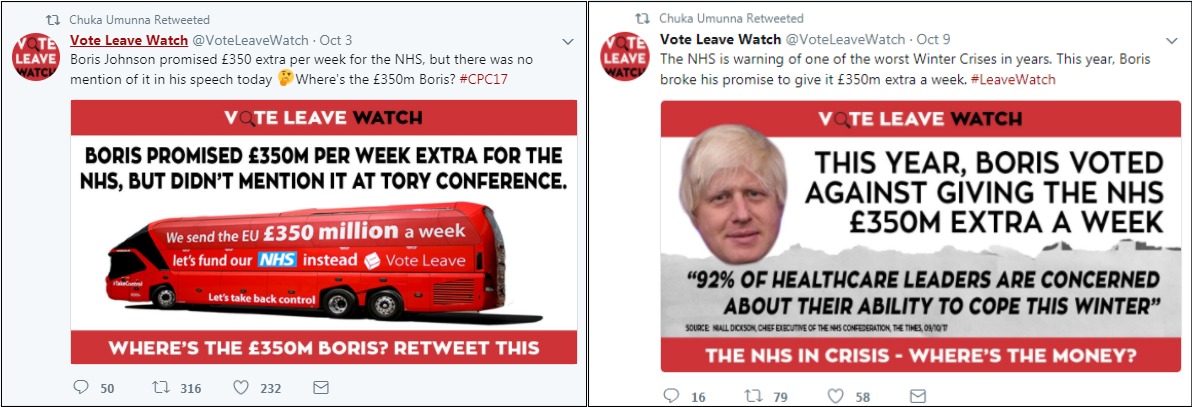
…or in the intervening periods, and just for a change, via re-tweets on 3rd October and 9th October off Vote Leave Watch, which is very much a Chuka creation.

In vain have people tried to explain to Chuka (and I even tried myself once or twice on Twitter) that:

  1. it clearly wasn’t remotely a promise, but a campaigning proposition;
  2. it could hardly have been a promise when made by what was a cross-party campaign group in a binary-question referendum;
  3. the only organisation which was in a position to make any such kind of “promise” (but didn’t) was the Government, which was, er, pro-Remain, 

but all to no avail.

There’s a plausible possible explanation for this. In the era of Hard-Left Corbynite-Labour, Chuka has an acute irrelevance problem.

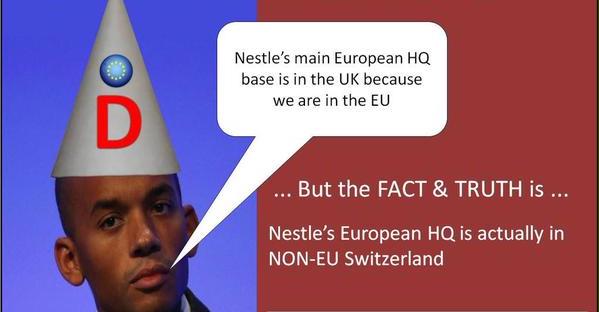
Once touted – not least by himself – as the Blairite Leader-in-Waiting, despite a mysterious and flattering “UK’s Barack Obama” update to his Wikipedia page from a computer in his own law firm’s office, an, ahem, unfortunate slip-up about EU geography, a £20,000 donation from a gambling tycoon despite campaigning against betting shops in his own constituency, and superciliously describing London as “full of trash” and lacking suitably-exclusive hangouts for cool dudes like himself, until Labour’s 2015 General Election defeat, Chuka was considered a serious future contender for the leadership. 

The advent of Corbyn changed all that. Remember, Chuka stood for the leadership, and was even at one time the bookies’ favourite: but then suddenly withdrew from the contest just 3 days later, in circumstances which have never been satisfactorily fully explained, citing “the level of pressure and scrutiny that comes with being a candidate”.

On Corbyn’s election, he was one of those who declined to serve in Corbyn’s Shadow Cabinet, and was replaced as Shadow Business Secretary on Corbyn’s first appointments.

Since then, the growth of a new aggressively left-wing membership, plus the consolidation of hard-Left Momentum’s control of the Party, have left him, politically, in the wilderness. His brand of metropolitan-centrist left-liberal Blairism is totally out of tune, and out of favour, in a party turning to full-blown socialism.

Chuka Umunna is the Paddington Bear of UK politics. As the hard-Left Labour train departs the station on its Journey Of Destiny to True-Socialist Utopia, he’s been left behind on the station platform, clutching his suitcase (probably a Gucci one – champagne-socialists like Chuka don’t settle for anything less) with a label stuck on it.

Only in his case, and unlike Paddington’s, this label says “NOT WANTED ON VOYAGE”.


Thoroughly agree with this article? Vehemently disagree with it?

Scroll down to leave a comment

And follow A Libertarian Rebel on Twitter

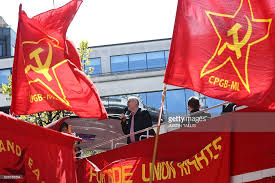
The Academics and Socialism

Indoctrination of the university student and graduate population with the predominantly left-wing political attitudes prevailing in higher education has a growing effect on British elections

Note: this is the longer version of an article first published at The Conservative Woman on 2nd October 2017.

Why”, asked Laura Perrins, Co-Editor of The Conservative Woman on 22 August, “should you risk sending your children to university for a full three years of left-wing propaganda?

For the parents of any young adult raised in a household even moderately inclined towards social conservatism, EU-withdrawal, a smaller state, lower taxes and free-market economics, this is an increasingly pertinent, even worrying, question.

Because, as Laura pointed out, after three years at an educational establishment which institutionally not merely disagrees with your views, but positively hates them and thinks they (and consequently you) are evil, your children will more than likely emerge from it thoroughly marinaded in left-wing thinking (and hating you in their turn).

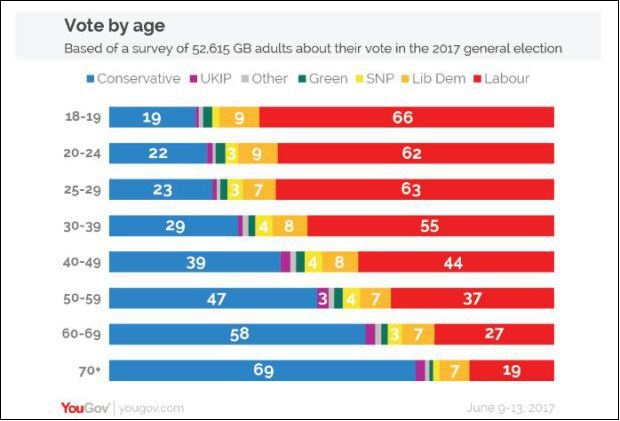
The young’s voting patterns in recent election results certainly seem to bear this out. The YouGov analysis of voting by age group in the 2017 General Election shows that, in all three age-groups spanning the ages from 18 to 29, the Labour vote was over 60%.

Higher Education and Academe as a bastion of left-wing indoctrination is an impression that’s widely held. But to what extent is it true?

Fortunately, we have some empirical data from within the last two years. The chart below shows the results of a poll taken shortly before the 2015 General Election, asking for the voting intentions of UK University academics.

The responses leave little room for doubt. In no discipline did the intention to vote Labour drop below 40%, while you have to go as low as 20% in every academic discipline before encountering a voting intention other than Labour or Green.

Overall, the academics’ voting intention went 83% to the four main parties of the Left (Labour, LibDems, SNP and Green), while in the General Election proper, their vote share was only 47%. In other words, university-tenured academics inclined towards parties of the Left at a frequency nearly double that of the electorate as a whole.

A similar poll of UK academics’ voting intentions was conducted in the run-up to the 2016 EU Referendum, by The Times Higher Education Supplement. Here, the results were even starker.

In no discipline was the intention to vote Remain below 80%, while in only one discipline, Engineering and Technology, did the intention to vote Leave break through the 15% threshold. As everyone now knows, the result was 52%-48% for Leave. Once again the academics leaned Remain-wards at a rate more than 1½ times that of the voting population.

So, on the face of it at least, the perception of the University experience as being an academic indoctrination process in Europhilia and Leftism has some evidential support. If you have the impression that your child has emerged from University brainwashed into an ardently-Europhile Leftist who hates you and everything you stand for, you’re probably right.

But what seems explored much more rarely is: why this should be so? Why should the supposedly academic and intellectual elite overwhelmingly incline towards leftist and statist parties and policies that concentrate decision-making power in bureaucracy rather than democracy, and reject those which favour liberal-individualism and free-market competition? And do so, moreover, at a incidence nearly double that found in the adult population as a whole?

Well, the first thing to remember is that this phenomenon isn’t new. Hayek analysed and excoriated it decades ago in his “The Intellectuals and Socialism”, famously referring to “the professional second-hand dealers in ideas”.

Politically, the Academic and Intellectual Elite has an aversion to capitalism and free-market competition because, being a system based on voluntary exchange reflecting consumer preferences, it doesn’t confer on them either the superior societal status or the monetary rewards to which they consider themselves entitled because of their (assumed) far superior intellect.

Arguably, Robert Nozick put it even better in his 1998 essay Why Do Intellectuals Oppose Capitalism?

“Intellectuals feel they are the most valuable people, the ones with the highest merit, and that society should reward people in accordance with their value and merit.”

This is especially marked when they compare themselves with people successful in what, to them, is the rather grubby business of designing, producing and marketing products that people will voluntarily part with their hard-earned, post-tax cash to own. Think, for example, how much more popular in the public mind James Dyson is than A C Grayling. The old disdain for “trade” has crossed over from the Aristocratic Landed Elite to the Intellectual Academic Elite.

Consequently, the academics and intellectuals incline, politically, away from free-markets democracy towards the more collectivist politics of markets-averse, leftist-statist bureaucracy. Not only does it value them more than competitive free-market capitalism does: but it can also use the coercive power of the State, manifested via the taxation system, to enforce on wider society at least a financial recognition of their assumed superior intellect and desired superior status.

This also explains their near-homogeneous support for remaining in the European Union. Yes, academics and intellectuals do favour the EU as an additional source of funding. But because the EU is an essentially socialistic, authoritarian, top-down bureaucracy, they also view it as a means to impose on the UK the kind of Leftist policies which they themselves are attracted to, and without the necessity and inconvenience of obtaining popular democratic consent. Remember, as we saw in the aftermath of the EU Referendum, their opinion of the demos borders on contempt.

This leads to the next question. For how long do the academics’ and intellectuals’ pro-Left, pro-EU biases continue to influence their recipients’ voting behaviours after inculcation?

Conventional psephology held that most had grown out of their youthful flirtation with socialism by about 30, by which time advancing careers, along with marriage, family and mortgage responsibilities, had altered their perspective. Indeed, as late as April this year, a YouGov poll suggested that the Left-Right crossover point comes roughly at age 34.

However, the results of the 2017 General Election have forced a re-evaluation of that hypothesis. It seems that the Labour/Left voting tendency now persists for at least a decade beyond that. As the Ipsos MORI chart below shows, the phenomenon now extends well into the 40s, and that it’s only after 45 that a Conservative-leaning tendency starts to prevail.  

This seems to bear out what Iain Martin has recently written on “the widespread assumption among those aged below 45 that Tories or pro-market people are an inherently bad bunch with motives that are inherently evil”.

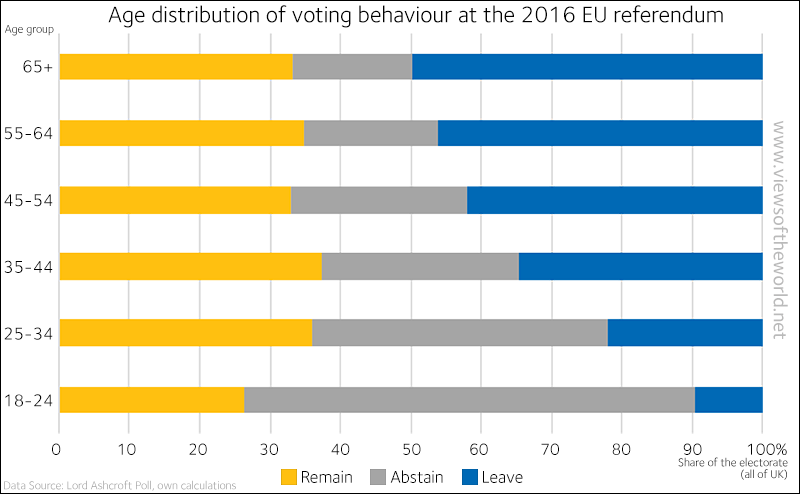
Perhaps, though, it could have been better predicted. Because the age distribution of voting patterns in the 2016 EU Referendum shows a similar pattern. Once again, it’s only at the 45-54 age group does Leave start to prevail over Remain.

Neither does this look to be a temporary aberration, attributable to the more fractious political atmosphere before, during and since the EU Referendum. The pattern seems to be persisting, and hardening. The Remain=Labour and Leave=Conservative assumptions are by definition somewhat crude proxies, but it does appear that an overall shift in age-related voting patterns may be taking root for the short-to-medium term at least.

As far as countering it is concerned, the first thing to remember is that this may not, after all, be so historically unprecedented, and so in the end be so permanent, as excitable media comment suggests.

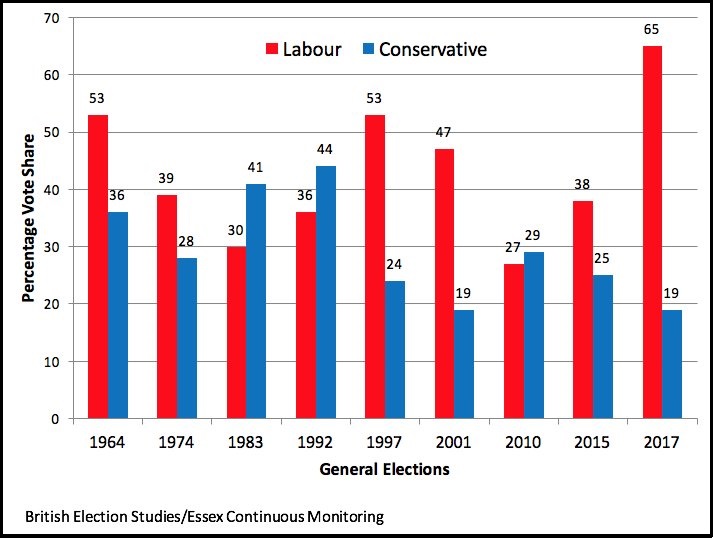
Albeit not of the same magnitude, there have been similar trends observed before, as the chart below of under-30s percentage voting patterns in General Elections since 1964 shows. The under-30s Labour vote almost halved between 1964 and 1983, and again between 1997 and 2010.       

Under 30s support Lab & Con since 1964

However, that might be where the optimism ends, at least for the time being.

In 1983, the Conservative Party, though faced with a Labour opposition similar to Corbyn’s in its socialist programme, was itself ideologically committed to a smaller state, free markets and capitalism, and unafraid to take on its opponents publicly in the battle of ideas. In 2010, it benefited from a widespread disillusionment with the dysfunctional Brown government after 13 years of increasingly tawdry New Labour.

Today’s circumstances, however, are nowhere near so propitious. First, no-one under 50 has much, if any, memory of what life in Britain was like under the last real even semi-socialist government: and given the prevalence of left-wing attitudes in higher education, they may well not have been taught an accurate history of it. To under 50s who lean Left-wards, therefore, Corbynism, however flawed, can seem fresh and exciting. 

Far worse, though, is that, as has been so starkly shown this past week, the Conservative Party is mired in intellectual atrophy, apparently completely incapable of unashamedly making the case against state-socialism and for a lower-taxed, less-regulated and more entrepreneurial economy, capitalism and free markets. So ideologically-sapped, and so devoid of confidence, does it appear, that it is reduced to offering, almost apologetically, diluted versions of previous flagship Labour policies.

Unless the Conservative Party is jolted from its torpor by the prospect of impending ejection from office and replacement by the most disastrously socialist government since the Labour Party’s formation, then the left-wing ideological indoctrination of the young via higher education – and Laura was surely right in her original 22nd August article to suggest that one of Blair’s motives in greatly expanding university access was to expose more to it – will yield results, with dire consequences, not least for those welcoming it.

Thoroughly agree with this article? Vehemently disagree with it?

Scroll down to leave a comment

Follow A Libertarian Rebel on Twitter

The Tories Don’t Deserve To Win – Labour Deserves To Lose

Neither the Tories, with their statist, triangulating Manifesto, nor Labour, with its destructive socialist vision, deserve victory in this General Election

In a few hours, this General Election will be all over bar the results and their consequences.  Yet the usual anticipation of Election Night is muted by an almost palpable sense of relief at the approaching end of a campaign offering such a lacklustre, uninspiring choice.

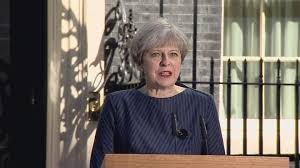
For Theresa May and the Tories  it was supposed to be the Brexit Election: where, wanting both a bigger Parliamentary majority and her own popular mandate to implement it, she would offer a vision of a Britain mitigating the risks but also exploiting the advantages from recovering political and economic sovereignty.

Both, paradoxically, dictate some loosening of State and regulatory shackles on the economy, a facilitation of innovation and entrepreneurship: especially as the economy inevitably goes through a period of uncertainty and flux as powers are repatriated and trading relationships either reset or forged from new. But that isn’t what we’ve got.

The first intimations were reasonably heartening, But then came the Manifesto.

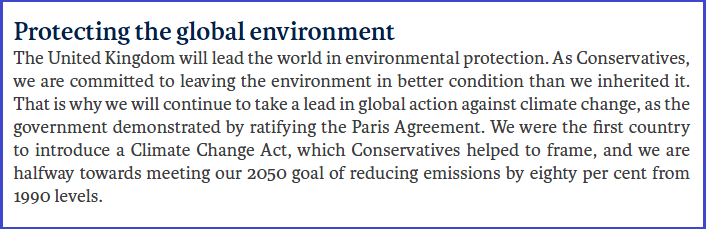
2017 Manifesto on Core Beliefs

Disparaging talk of “untrammeled free markets”, belief in “the good that government can do”, and abhorrence of “inequality”. The context leaves little room for doubt that the offer to voters is one of an interventionist State, concerned not so much with opportunities, but with outcomes.  

Further on, we are promised an Industrial Policy, a National Productivity Investment Fund, worker representation on boards, and a commitment to continue spending 0.7% of GDP on virtue-signalling foreign aid.

Finally, we get to this Greenery-gullible horror. Yet it accompanies a pledge to give British voters “the lowest energy costs in Europe”, notwithstanding that those two aims are mutually incompatible.

Worse still, it’s to be achieved, not by slashing Green taxes and encouraging more competition among energy providers via supply-side measures, but by capping prices: the same policy that, as recently as 2015, the Tories rightly damned as economically-illiterate when included in Labour’s election manifesto by Green-Left Red Ed Miliband.

So, in aggregate, a largely social-democratic policy programme, advocating a version of active-state Rhenish corporatism that would not look out of place in the manifesto of any milquetoast European Christian-Democratic party.

One can speculate endlessly on the reasons why. Possibly they lie in the fact that May is an instinctive paternalist (should that be “maternalist”, I wonder?) technocrat who’s unconvinced of, as Martin Durkin puts it, the potential of free markets to liberate and enrich.

Perhaps, because Labour has gone so far Left, she was persuaded that a Clinton-Blair style triangulation, with the Tories parking their tanks on “moderate” Labour’s lawn, would work electorally. Maybe she was afraid of frightening off the 2 or 3 million Labour voters who voted for Brexit and want to see it happen, and also the One-Nation tendency in her own party still looking for any excuse to derail Brexit. Who knows?

Then there’s been the campaign itself. May  – and it has been almost exclusively May, from battle-bus, through campaign literature, to media, and all points in between – has come across as by turns either robotically evasive, or uncomfortable and unconvincing when pressed on detail.

The forced U-turn on Social Care brought her campaigning deficiencies into sharp focus, but combine that with her natural somewhat leaden, flat-footed demeanour, plus a requirement to face an inquisitorial public & press far more often than she’s ever had to do before, and the result has been, not failure, but certainly sub-par performance.

Both she and her Party, have emerged from the campaign diminished, and not just in opinion-poll ratings, either. “Strong and Stable” has become something of a stick to beat her with. The whole thing has been rather insipid, disappointing, and very far from enthusing.

Consideration of Corbynite-Labour’s hard-Left manifesto need not take us as long. “Insipid” isn’t a description that could remotely be applied to it: “terrifying” or “economically-catastrophic” hardly begins to cover it, such is the red-in-tooth-and-claw programme that unrepentant socialist Jeremy Corbyn has in mind for the country.

The appalling consequences of a Corbyn-led Labour government have comprehensively dissected, with this by Andrew Lilico being merely one of the latest.   

As Lilico points out, fiscally and economically Labour would impose on Britain the highest level of taxation since World War II: the nationalisation, almost certainly without compensation, of the most important industries: a return to widespread (and excess) unionisation: deliberately punitive taxes on financial services designed specifically to deter private capital: and the effective collectivisation of private business property through imposing public interest duties inimical to both private property rights and commercial interest.

Moving from the general to the particular, just one example can suffice to show hard-Left Corbynism’s economic wrong-headedness. Despite favouring continued uncontrolled mass immigration, Labour proposes to deal with the housing shortage by a price-cap on new houses.  

All that that is likely to achieve is a shortage of new houses. If Labour really wanted to boost the supply of low-cost new houses, it would pledge to ease planning restrictions, not threaten to impose State price and even purchaser – priority to State employees, naturally – controls on builders. 

Non-economically, a Corbyn-led Labour government would see restrictions on the police, the reduction of the Army to a notional force only, and the withdrawal of Britain from its role in international security.

And this before even considering the implications of Corbyn’s 30+-year record of not only sympathy but vocal backing for all manner of anti-British, anti-Western groups, including those engaged in active terrorism, even on British soil.

And thus we come to the end of a singularly uninspiring campaign on what should have been the most important election in Britain for decades. The great issue for which it was ostensibly called to reinforce has been barely discussed beyond trite soundbites and banal generalities.

Hard-Left Labour certainly deserves to lose this election, and lose it heavily: but the Conservatives, on their manifesto and especially on their stuttering and lacklustre campaign, really don’t deserve to win it, either.

Thoroughly agree with this article? Vehemently disagree with it?

Scroll down to leave a comment

Follow A Libertarian Rebel on Twitter

Delicious Save this on Delicious

From Shoe-In to Toss-Up

Via the ineptitude of its candidate, and hostility from its residual Farageistes, UKIP has managed to convert the Stoke Central by-election from a virtual one-way shoe-in into an uncertain three-way toss-up.

On the face of it, UKIP’s choice of candidate to contest the Stoke-on-Trent Central by-election caused by the resignation of Labour’s Tristram Hunt should have been obvious, and uncomplicated.

Here was a constituency where, on the best available estimate, the Leave vote in the EU Referendum was a massive 69.4%: where the voters hadn’t returned a Conservative MP in decades: where there was widespread disaffection with a Labour Party dominated by London-centric Metropolitan New-Leftism rather than traditional working-class empathy: and where UKIP put up a very creditable showing at the 2015 General Election.

stoke-ge-2015-results-pcsIt’s worth examining that latter result in more detail. UKIP came from 5th in 2010 on a measly 1.1%, to 2nd in 2015 on 22.7% with an 18.3 swing to it. In a General Election where the Conservatives achieved among their highest-ever number of seat gains, they didn’t even manage to come 2nd in Stoke Central, being pipped by UKIP into 3rd place.

This surely should have suggested UKIP re-selecting its 2015 candidate, Mick Harold, to contest the seat. As a Stoke Councillor, Chairman of UKIP’s Stoke branch, and Deputy Chairman of its Staffordshire County Committee, he appeared to have experience plus an established public profile, in both local government and local party, strong enough to stand a real chance of taking the seat from Labour.

And a real chance, moreover, not only on his own merits. Because Labour had selected, to try and retain its Stoke Central seat, the execrably foul-mouthed, mendacious, misogynistic Gareth Snell, most notable, among a string of other gaffes, for describing Brexit as “a pile of shit” to his own Brexit-voting constituency, and arguably the most repellent Labour candidate that even seasoned commentators can remember.

snell-stoke-tweet-gaffes-compEnter, however, UKIP’s recently-elected new Leader, Paul Nuttall. Already an elected UKIP MEP in the European Parliament, it’s an intriguing, albeit ultimately futile, exercise to speculate on what Nuttall’s real motives were.

Perhaps he genuinely felt the party leader belonged in Westminster, not in Brussels/Strasbourg. Perhaps he wanted to show that, within only months of being elected, he could do what Nigel Farage never managed to do in all his years as Leader, namely, win a House of Commons seat. Perhaps he saw a Westminster seat as a convenient replacement for his Brussels/Strasbourg one when the UK exits the EU before the next European Parliament elections in 2019. Who knows?

Whatever the reason, though, Nuttall decided to seek UKIP’s candidature, and was duly selected. Whether Harold was “persuaded” to stand aside, or did so entirely voluntarily, as his statement on it insists, is perhaps another intriguing subject for speculation.

Nuttall, though, is a clown. It didn’t take long for the first evidence to surface, in the shape of the now-infamous Hillsborough imbroglio, when Nuttall claimed to have lost “close personal friends” in the disaster. 

nuttall-hillsborough-website

Had the final paragraph merely read “…when 96 Liverpool fans lost their lives.”, his statement would still have been – and rightly so – a searing condemnation of the Government’s obfuscation of key facts relevant to determining blame. It did not lack power. It did not need the addition of the “including close personal friends of mine” to give it extra force. So whatever persuaded him to add such an unnecessary, self-serving, and easily-verifiable-as-untruthful embellishment? As so often, over-egging the pudding merely leaves the chef with egg on his face.

Following that, we had the “new address” fiasco. Even if, as claimed, Nuttall’s original move to Stoke was delayed because of a vacancy / chain issue, why was the necessity for a Stoke address not resolved the minute Nuttall indicated an interest in the constituency? Is it such a rental hotspot? And how inept is it to allow one’s self to be photographed quite clearly camping out in a hastily newly-acquired “home”? No journalist worth their salt, however un-biased, could fail to run with a “carpetbagging” narrative in those circumstances.

nuttall-bolton-2017Then there’s the missing weekend. Despite it being the last weekend of campaigning before the Thursday 23rd February polling day, Nuttall was apparently AWOL from Stoke for most of it, attending the UKIP Spring Conference in Bolton, where he made a somewhat bizarre “They will not break me”-themed speech.

Was his attendance in person really necessary, Party Leader or not, on the last weekend before a crucial by-election? Could a speech to Spring Conference via video-link not have been arranged? Or was it vital, despite the risk to the by-election campaign, to prevent Farage in effect taking over the Conference? 

To be fair, it hasn’t all been of Nuttall’s own making. Most of the so-called “independent” Press has been its usual homogeneously ‘liberal’-left biased, pro-EU self, determined to report in a bad light any policies, or parties, outside what’s deemed to be the acceptable Overton Window of British politics. But it’s also inescapable that the inept, bumbling Nuttall has given it a cornucopia of material to work with.

There is, however an additional factor. The friendly-fire, the blue-on-blue incoming from the Farageiste Falange.

2017-02-22-banks-hillsborough-compThe “Hillsborough” furore had largely died down by last week, the narrative having run its course and the last drop of press mileage having been squeezed out of it: until, that is, Arron Banks, major UKIP funder but also, I’d suggest, eminence grise of the Farageistes, tweeted a reference to Hillsborough having been an “accident”.

Whatever Hillsborough was or wasn’t, it certainly wasn’t an accident: and though subsequent Banks tweets have correctly referred to it as a disaster, that has been enough to revive the entire controversy to Nuttall’s detriment: as have the allusions to Banks being “sick of hearing about it”. Given Nuttall’s Merseyside origins, it’s difficult to believe the choice of the word “accident” was itself accidental.

Hard on the heels of that, at UKIP’s Bolton Spring Conference, came Farage’s “helpful” intervention that “Nuttall must win Stoke”, and that a win in the by-election there is “fundamental to the party’s future”. You might think this is a bit rich coming from an ex-Leader who serially failed to get elected as an MP, but we’ll let that pass.

What it does, of course, is to make Nuttall’s position as Leader hostage to electoral fortune, and imply that, should he fail, his leadership is inimical to UKIP’s future electoral prospects. Or, put another way: all other candidates having now been eliminated, Farage fancies yet another crack?

So what has been the cumulative effect of all this? As of early evening Wednesday 22 February, and per Ladbrokes, Labour are back as 4/7 favourites, despite having been seemingly been behind for much of the campaign: UKIP have drifted out to 2/1, having previously been favourites: and the Conservatives have come from nowhere to be at 7/1 and talking up their own chances of pulling off a surprise . Yes, in Stoke.

stoke-odds-1838-wed-23feb17Quite how UKIP has managed to achieve this, after starting out from a position of apparently unassailable advantage, almost beggars belief. In the space of a few short weeks, and having been initially blessed with what were, for it, virtually the most favourable circumstances imaginable, it’s converted what should have been a foregone conclusion into a very close-run thing.

That Labour could pull it off, with a victory for by far the foulest candidate, standing for by far the least-deserving party, is an appalling prospect. But if so, UKIP will have no-one to blame but itself.

Thoroughly agree with this article? Vehemently disagree with it?

Scroll down to leave a comment

Follow A Libertarian Rebel on Twitter    

Delicious Save this on Delicious

The People-In-Parliament

Unreconciled pro-Remain MPs cynically exploiting an interpretation of Parliamentary Sovereignty to try and negate the EU Referendum result have highlighted the urgency of radical post-Brexit Parliamentary reform
uk-supreme-courtThe Supreme Court decision in Miller – that the Government’s powers under Crown Prerogative did not include the power, despite the unequivocal popular mandate given it by the result of the EU Referendum, to issue notification under Article 50 of the Lisbon Treaty of Britain’s withdrawal from the European Union, so that a specific Act of Parliament was required – has re-activated the question of what Parliamentary Sovereignty actually means.

I was brought up to believe, and was in fact taught, that what the doctrine of Parliamentary Sovereignty expresses is the supremacy of Parliament over the Crown – that the Crown cannot arbitrarily compel the passing of laws or the raising of taxes without the consent of Parliament, but by extension also, therefore, without the consent of the people whom Parliament merely represents.

In other words, that Parliament is sovereign over the Crown, but not sovereign over the people, comprising as it does merely their temporarily-elected representatives.

Admittedly, the question is disputed by constitutional writers. Burgess suggests that this is indeed the case, and argues that, by asserting or assuming sovereignty over the people, successive Parliaments have exceeded their powers. Loughlin, on the other hand, suggests that Parliament is indeed supreme over the people, and infers that this is legitimised by freely-held, non-coercive elections under our system of representative, rather than direct, democracy.

I’ve always been uneasy with this latter interpretation: to me, it seems far too conducive to an elective dictatorship, able to act with impunity in defiance of the people’s expressed wishes. When we send MPs to Westminster, we are not relinquishing or transferring ownership of our democratic powers to them: we are merely lending them, and delegating temporary custody of them, to MPs until the next election – and nothing more. 

This has even more resonance when Parliament, without our approval, agrees to transfer power or jurisdiction over domestic policy matters to unelected, unaccountable supra-national bodies like the EU. Because our democratic powers as a people are only lent, not relinquished, to MPs, they do not become the property of a transient Government or those MPs to dilute or even cede to another polity, without our specific consent.

The Supreme Court’s ruling in Miller, however, making implementation of the clear popular mandate given the Government by the EU Referendum in effect subject to approval by Parliament, appeared to reinforce the interpretation that Parliament is supreme, not only over the Crown, but over the people also.

Crucially, however, that is certainly the way it has been gratefully interpreted over the past three days by very many anti-Brexit MPs in the current Parliament’s inbuilt near two-thirds to one-third pro-EU, pro-Remain majority: a pro-EU majority that stood in stark contrast to the UK electorate’s 52% to 48% vote to leave the EU, and which, translated into Parliamentary seats, has been calculated would produce a pro-Leave landslide.
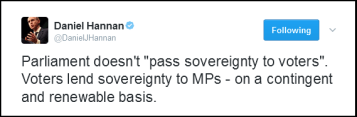
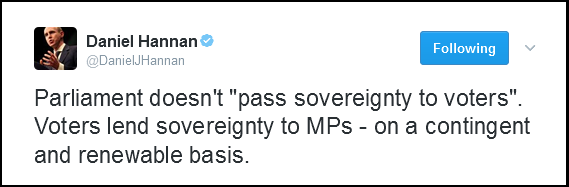
2017-02-07-hannan-on-parliamentary-sovereigntyWhen Parliament voted, by a factor of no less than 6:1, to hold the EU Referendum, what it did was to hand back to the British people, in relation to the specific issue of remaining in or leaving the EU, the powers that the British people had, once again, temporarily lent to it, via the 2015 General Election. Dan Hannan’s tweet above perhaps clarifies how.
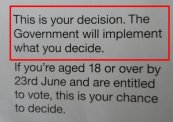
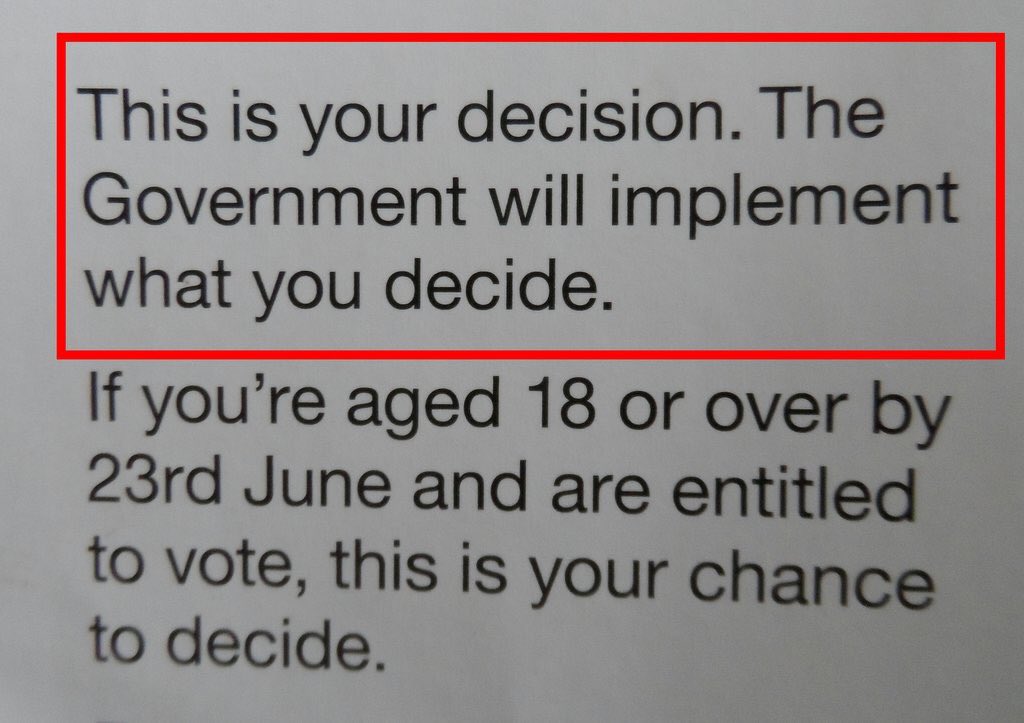
ref-leaflet-contract-with-the-votersFor this particular issue of Britain’s EU membership, Parliament gave back to the people the sovereignty which we temporarily lend it. It said, in effect: “this is for you to decide, not us on your behalf”. It even emphasised as much – “The Government will implement what you decide” – on its information leaflet.

And the decision of the British people, and its implied, consequent instruction to its elected Government, was clear and unmistakeable.

To have, therefore, seen diehard-Remain MPs trying over the past three days to confect and exploit a cynical, self-serving  misinterpretation and distortion of Parliamentary Sovereignty to mean Parliament supreme over the people, to further their own nakedly anti-Brexit aims in defiance of the democratic decision of the UK electorate which they voted by over 6:1 to confer on it, has been utterly nauseating.

We’ve seen unashamedly pro-EU MPs, who for years accepted torrents of EU legislation into the corpus of UK law with near-zero scrutiny, suddenly converted to the apparent necessity of line-by-line scrutiny of Brexit aims and negotiating strategy.
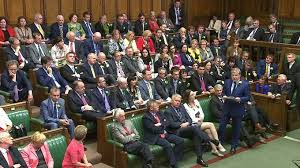
snp-mps-hoc-may-15We’ve seen Labour, LibDem and SNP MPs, supported by unreconciled Tory Remainers, proposing amendments to the Article 50 Bill which were blatant attempts to slow the Brexit process to a standstill: and making it clear that many want either not to leave the EU at all, or else remain in it in all but name.

We’ve seen the vast majority of Labour, LibDem and SNP MPs, again with support from unreconciled Tory-Remainers, making it abundantly plain that their wish to “scrutinise” the Government’s Brexit negotiating strategy is only to expose & weaken the Brexit negotiators’ hand, before negotiations start.

We’ve seen pro-EU MPs, who for years were so eager to give UK voters’ democratic powers away, now fighting hard to stop them coming back. Many of their disingenuous amendments clearly were mere devices to negate implementing the decision which Parliament gave to the electorate to make, and some of those pro-EU MPs could barely be bothered to conceal it.

We seen unreconciled pro-Remain MPs, one after the other, indulging in competitive hand-wringing over the post-Brexit plight of EU nationals currently in the UK. Their cynicism has been quite breathtaking: it’s easily ascertained that approximately 84% of EU nationals residing legally in the UK would not be affected one iota.
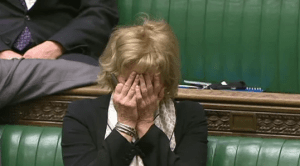
soubry-distraught-hoc-wed-07-feb-2017Their speeches were in effect re-fighting the EU Referendum itself, and re-running the combined Remain campaign’s Project Fear. They left no doubt that, for them, being pro-EU means being anti-democracy, and that the prospect of leaving the anti-democratic EU horrifies them.

It’s difficult to deny that, when Leave-ers voted on 23rd June 2016 to recover Parliamentary Sovereignty, what they meant was leaving the EU altogether – so that, in a Britain once more an independent, self-governing country from being outside the European Union, their laws & taxes would in future be decided by, and only by, the MPs they elected to Parliament, and by no-one else.
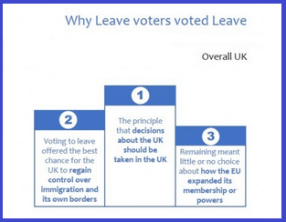
why-people-voted-leave-2In other words, that Parliament would be sovereign over any foreign legislature in the determining the laws they have to obey and the taxes they have to pay. Remember, both the Government and Remain campaigns to stay in the EU had been totally unequivocal in warning that a Leave vote meant exactly that – leave completely.

I suspect what they did not mean by recovering Parliamentary Sovereignty was Remainer MPs interpreting it instead as Parliament in effect deciding whether the UK is to leave the EU at all. Yet it’s been obvious from the last three days’ Article 50 Bill debates that that’s how the Diehard-Remainers see it, and have tried to interpret it. Their conduct has been nothing short of pro-EU anti-democracy chicanery.

So what implications does this have for the future of Parliament, and our democratic politics, once Brexit has been achieved?

One consequential necessity above all, I’d contend, has long been pre-eminent: that, having succeeded in retrieving and repatriating our democratic sovereignty, we cannot risk merely entrusting it once again to the same body of MPs who for 40 years eagerly and arguably illegitimately gave it away without our consent in the first place: at least not without imposing some very robust limits on their powers in that respect.

They have shown that, quite simply, they cannot be trusted. The reaction of too many to the, for them, unwelcome Referendum result has betrayed their disdainful attitude towards their electorate.

Many remain unreconstructed advocates of the EU Project: it’s been clear that, for so many, the prime attraction of EU membership is that it enables them to fulfil a visceral desire to put as much policy-making as possible beyond the reach of what they see as the capricious domestic democratic process and an electorate whose views they by-and-large do not share or even find repugnant.

We cannot assume that a future Parliament, especially a left-leaning, residually pro-EU one, would not surreptitiously resume the powers-ceding process of the last 40 years all over again. Their hands, in short, need to be tied.

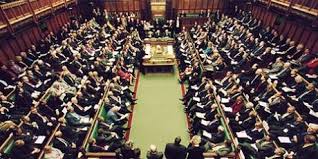
commons-chamber-normalSo we must strengthen the post Brexit Parliament’s democratic accountability to the electorate. To more of a People’s Democracy that makes legislature and executive work, not in the interests of the Establishment cartel, but in the interests of the people.

We need, and urgently, a proper Recall Procedure, in the hands of voters. The Bill presented in the last Parliament to allow a minimum percentage of constituents to recall an errant MP to face re-election was voted down: instead, Members decreed that only a committee of MPs was fit to decide whether one of their fellow-MPs had misbehaved sufficiently to have to account to his electorate – his constituents, impliedly, were not . So much for “trust the people”. Real voter Recall is a cause going by default.

We need Open Primaries for candidate selection. We may no longer be in the days of the Cameroon Cuties’ A-List, and Labour’s infamous all-women shortlists seem to have fallen out of favour: but with the occasional exception, none of the main parties seems at all keen to open up the candidacy process and make it more accessible, less subject to capture or manipulation by party hierarchies, and more transparent. The case for Open Primaries is strong, but not being robustly made.
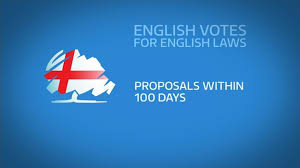
evelA fairer constitutional settlement for England, shamefully neglected in the rush to confer domestic powers on the devolved assemblies, is long overdue: but the issue of an exclusively English Parliament, or English Votes for English Laws, has retreated towards the back burner.

Yet by re-advancing it, English MPs would rightly be re-asserting domestically the fundamental principle on which the EU Referendum itself was fought and won: that the laws governing the citizens of a discrete polity can legitimately be those, and only those, made by, and only by, the representatives directly elected by the citizens of that polity, and whom they can remove from office via the ballot-box at the next election.

For national-level democratic participation, we have to rely on a once-in-5-years cross-marking exercise, based on manifesto commitments which few expect their parties to honour, once the inconvenience of an election is out of the way. But – in an age when we can book a holiday with a few mouse-clicks, or apply for a university course with a screen-touch, why should this be?
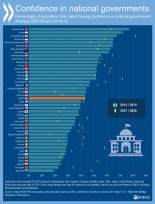
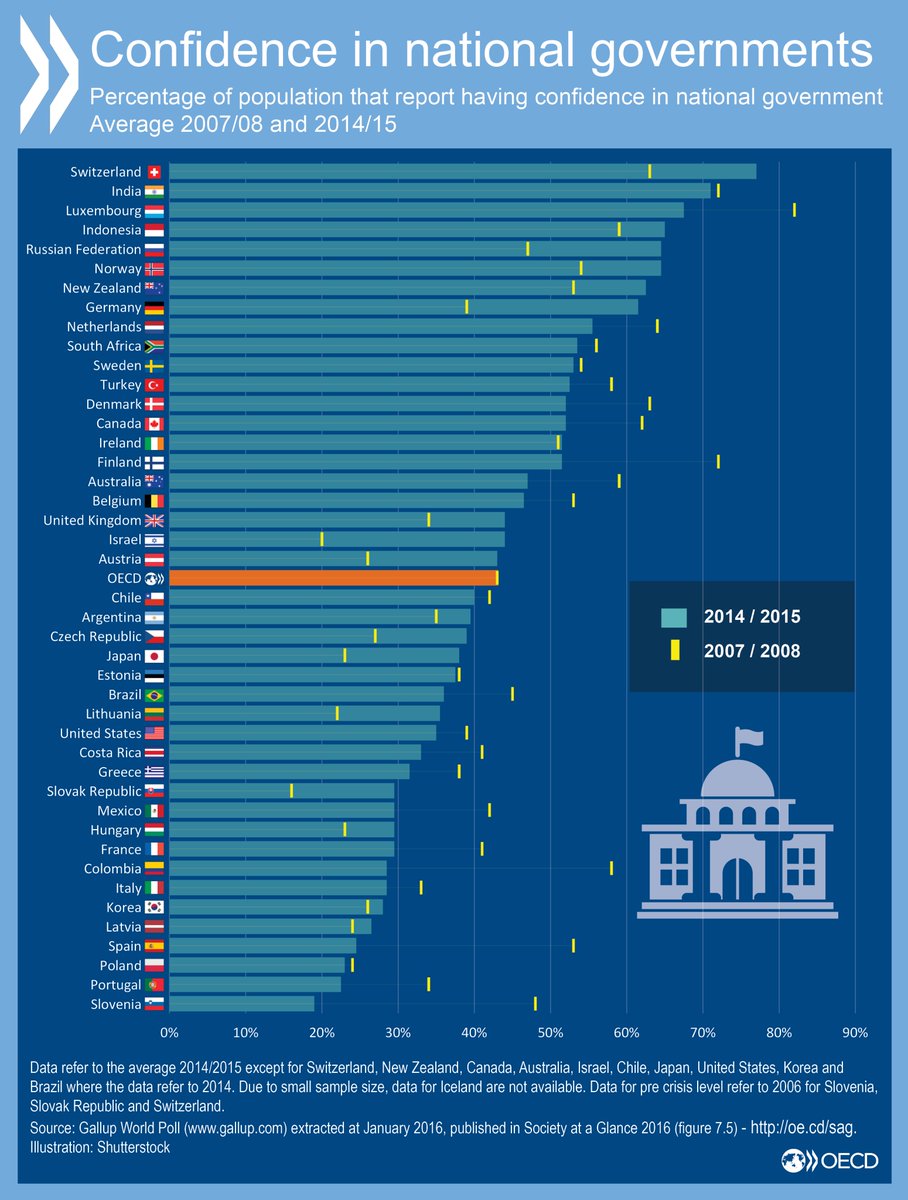
confidence-in-govt-switz-topThe Swiss manage successfully to hold referendums on issues other than major constitutional questions like their voting system or EU membership. It’s no coincidence, to my mind, that the Swiss, who have the most direct say in their government, via localisation & frequent referendums, express the highest confidence in their government and regularly show highest public-engagement in politics. We can achieve the same. We need more referendums, not fewer.

The political-class, of course, hates them. They’re “divisive”, they’re unpredictable, they take control of campaign messaging away from party machines, and, worst of all from their point of view, referendums let voters take control of a single issue outside the 4/5-year election sequence when an entire manifesto is voted on.

There can be few better reasons for having more referendums than a demonstrably unrepresentative, voter-averse, political class being opposed to them. If we were more accustomed to using them as an instrument of democratic consent, they’d be far less “divisive”.      

Whatever method of future democratic engagement we adopt, we need, too, to eliminate the loopholes, if not downright electoral fraud, made possible from now rampant abuse of the postal (or virtually proxy) voting system. There have been too many instances reported of, as just one example, multiple postal votes per household, to continue leaving glaring abuses unchecked. A return to the previous very tight criteria for postal voting eligibility, plus a requirement for photographic ID at polling booths, is necessary if the democratic process is not to be further subverted.         

We need, also, enshrined in law, an absolute bar on the transfer away to any other body, whether domestic or international, of any part of the democratic sovereignty temporarily and conditionally vested in Parliament by the electorate. Remember, it’s not just to overseas or supranational unelected, unaccountable institutions that our democratic powers have been transferred – think how much policy-making has been put beyond the reach of democratic disapproval or change over the years by being delegated to quangos or semi-autonomous government agencies insulated from the democratic process.

The Coalition purported to remedy this with its 2011 European Union Act, essentially requiring a plebiscite on any further significant transfer of powers from Westminster to Brussels. Crucially, though, it largely left to Cabinet discretion what actually constituted a significant transfer of powers which would trigger a referendum. It was basically a sham, designed principally to head off demands from a growing-Eurosceptic Conservative Party and public for an EU Referendum while in coalition with the fanatically pro-EU, referendum-averse LibDems. We need a new law which is far more prescriptive.

The EU Referendum and its aftermath – especially the disconnect it revealed between, on the one hand, an electorate the majority of which is opposed to both EU membership and continuing uncontrolled mass immigration, and on the other, a Parliament largely in favour of both – has dramatically exposed how the traditional model of representative democracy is no longer working, in that, patently, it increasingly fails to represent. And as representative democracy’s disconnect between the views of rulers and ruled grows more and more apparent to more and more people, dissatisfaction with it will only grow.

The current anti-politicians (but NB not anti-politics) sentiment isn’t a mere passing phase. It augurs a permanent change in the relationship between rulers and ruled, to one where the balance between representative and direct democracy shifts more towards the latter.

That’s why, after Brexit, radical Parliamentary reform is needed to make MPs more accountable to their electorates, and ensure they can never again give away democratic powers which, because they are merely custodians of them our our behalf, are not theirs to give.

Thoroughly agree with this article? Vehemently disagree with it?

Scroll down to leave a comment

Follow A Libertarian Rebel on Twitter

Delicious Save this on Delicious

Bearding Branson For Bucks

Branson was dead keen to play for Remain. To pay for Remain, though, not quite so much….

Recall how, during the EU Referendum, one of the Remain campaign’s most prominent and vocal celebrity supporters for keeping Britain in the EU was Richard Branson?

Despite laying himself open to charges of rank hypocrisy – Branson, remember, is such an ardent advocate of Britain’s EU membership that he bases himself in the (non-EU) Caribbean, and his business interests in (equally non-EU) Switzerland – Beardie was nevertheless adamant about what a sheer, unmitigated catastrophe for Britain a vote for Brexit would be.

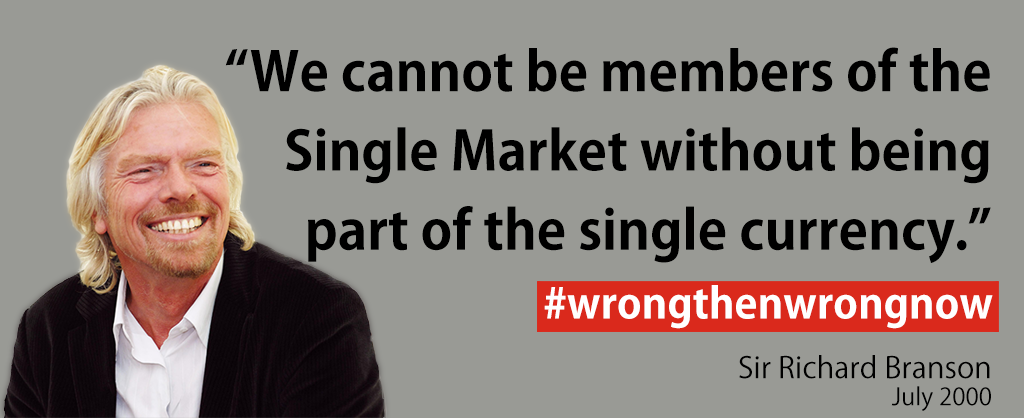
Neither the numerous critics of his arrant hypocrisy, nor the multitude of commentators who pointed out how, er, spectacularly inaccurate a track record he had on the entire issue of the Euro and the Single Market, could deter him.

euro-by-branson-2

Now surely, you might imagine, such a committed pro-European wouldn’t have hesitated to back his unshakeable convictions with a sizeable chunk of his considerable fortune? Via even some kind of significant contribution to such a transparently noble cause?

Alas not.

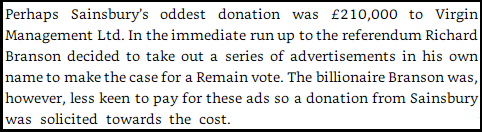
For, as Michael Mossbacher and Oliver Wiseman recount in their book “Brexit Revolt – How The UK Voted To Leave The EU”, Beardie, although keen to be associated prominently with the case for a Remain vote, was, shall we say, rather less keen to stump up all the moolah to pay for it….

mossbacher-wiseman-quote-re-branson

That’s right – the Remain camp had to tap up billionaire pro-Labour, pro-EU donor and peer Lord David Sainsbury to pay, in addition to this other donations to the Remain cause, part of the cost of Billionaire Branson’s Remain-supporting ads.

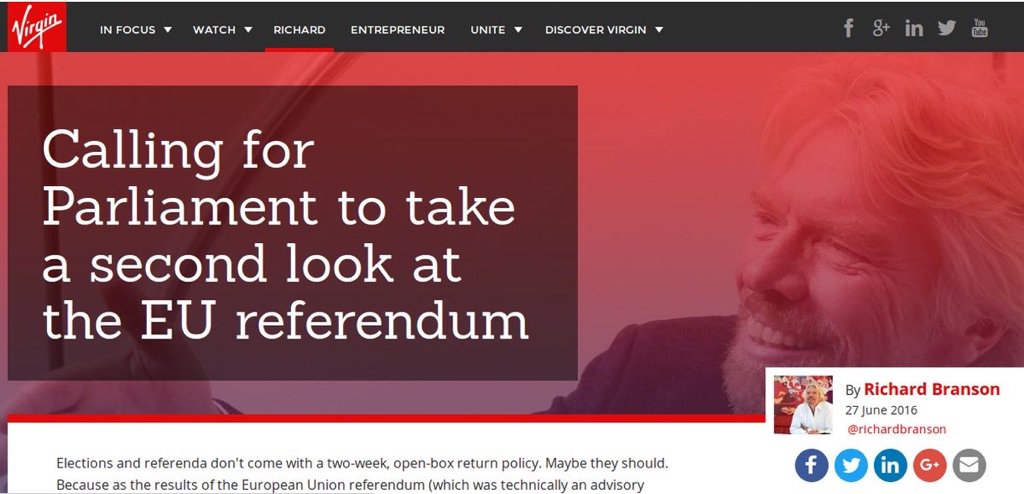
And now, being openly unwilling to accept the democratic verdict of 17.4 million people, Beardie’s also agitating for either a second Referendum, or in effect a Parliamentary blocking of Brexit implementation. 

branson-demand-for-2nd-referendum-poster-05jul2016

Presumably he’d want to play an equally prominent pro-Remain role in any second Referendum. And possibly even a third if a second once again delivers the “wrong” result.

Let’s hope for Sainsbury’s sake that he has a lock on his wallet….

Thoroughly agree with this article? Vehemently disagree with it?

Scroll down to leave a comment

Follow A Libertarian Rebel on Twitter

Delicious Save this on Delicious

The LibDems Can’t Half Pick ‘Em

The LibDem candidate for tomorrow’s Richmond Park by-election is an unconvincing combination of contradictions. She deserves to be defeated.

We’re used to the LibDems occasionally picking slightly iffy parliamentary candidates to contest either General Election or by-election seats.

The case of one Ibrahim Taguri, the alleged “fund-raiser” forced to resign as candidate in Brent Central after a “donations-in-return-for-access” scandal, comes to mind: as does the case of George Cunningham (Chair of “Brussels & Europe LibDems”, incidentally), suspended as parliamentary candidate in Thanet North after allegations of impropriety which included bringing in donations from abroad.

In the case of Sarah Olney, candidate in the Richmond Park by-election being held tomorrow, though, the LibDems appear to have picked a candidate whose problem isn’t so much one, as it were, of convictions, as of contradictions.

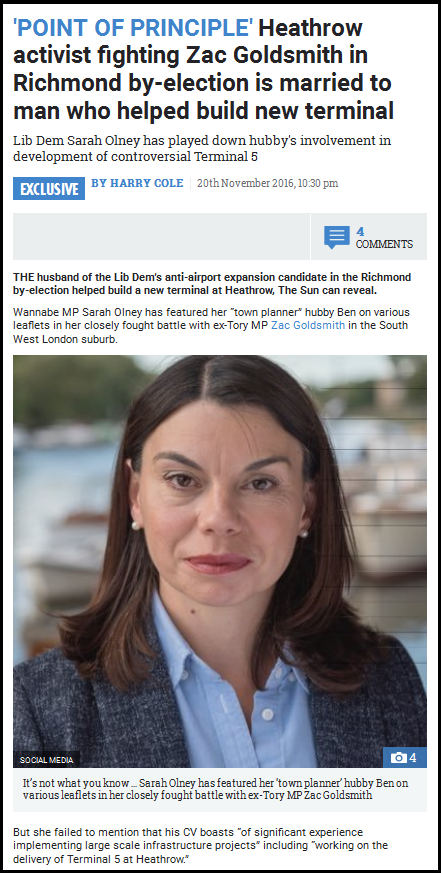
Firstly, on the central issue behind the by-election occurring at all, i.e., former Tory Zac Goldsmith’s resignation as an MP on principle to re-stand as an Independent on his declared opposition to Heathrow runway expansion. Olney, as one would expect, both as a Green-tinged LibDem and, to be fair, on local nuisance grounds, is also opposed to the third runway: but here’s the contradiction – her husband is a town planner who played, it appears, a key role in developing Heathrow’s Terminal 5.

olney-richmond-3 That of itself is perhaps a tad awkward, but probably no more than that if fully disclosed – it’s his profession, after all, and everyone has to live – but the contradiction has been exacerbated by her decision to play down the fact almost to the extent of concealing it.

Her campaign leaflets, we learn, make a point of mentioning his “significant experience in implementing large-scale infrastructure projects”, but, er, omit that one particularly “large-scale infrastructure project” he helped to implement was the last-but-one major project at the facility whose expansion she vehemently opposes.

There’s an interesting potential conflict of interest here. If Olney wins, on an overtly anti Heathrow expansion ticket, she acquires all the pecuniary and status rewards of an MP. On the other hand, the development will probably go ahead anyway, so her husband, with his experience, also stands to gain professionally. Win/win for the Olneys?

If she loses – and bear in mind that the least she’s likely to achieve is a good second, because neither the Conservatives nor UKIP are contesting the seat, and the Labour candidate looks like a no-hoper –  she’s no worse off than she is now, and the Heathrow development probably proceeding anyway still stands to benefit her husband.  No-change/win for the Olneys?

The contradiction between the public position (and it’s without doubt sincerely held) and the limited potential for personal downside is intriguing.

That’s the local factor at issue in the Richmond Park by-election. The national one, of course, is the EU Referendum, Brexit, and the desire of the LibDems either to dilute it to the point of virtual impotence or preferably frustrate and overturn it entirely, whether by parliamentary or judicial manoeuvres. Which is where the second contradiction arises.

As you’d expect, and again as a fairly standard LibDem Europhile, Olney is opposed to Brexit. As their candidate in Richmond Park, where over 70% of votes cast in the EU Referendum were for Remain, she’s also an at least implied backer of the anti-democratic Unreconciled Continuity Remain cabal’s machinations – prominent in which are two of the party’s former leaders and also its current one – to delay, diminish and preferably negate it, whether by Judicial Review, parliamentary vote(s) or even by pressing for a second Referendum.

The contradiction here is this: Olney is on record as previously saying that people must accept the UK’s decision to leave the EU, and that the government should not seek to “re-run” the vote.olney-richmond-2She had even gone as far as calling for Leavers and Remainers to “come together”, and “make a success of Brexit”. But with her party leader Tim Farron already having pledged to make the contest a “Brexit by-election”, the question arose as to how Olney would handle such an embarrassing contradiction.

Very much in the same way, it turns out, as she handled the Heathrow contradiction: by concealing it. On the afternoon of 26 October, apparently, she deleted her personal website and its call for the democratic verdict of the British people to be respected. She now suggests that Theresa May should commit to a second Referendum on our EU-exit terms “to buy herself time and negotiating capacity”. That’s quite a U-turn, even for a LibDem…..

When Olney started her campaign, it was mainly, though in fairness not exclusively, a local one. Airport expansion was the key issue, she claimed, and a vote for the LibDems would “make a stand against Heathrow”.

Whether the third contradiction – the switch of primary focus from the local to the national issue – has come about from anti-Brexit conviction or from embarrassment at family connections with Heathrow expansion is a moot point, but come about it most certainly has.

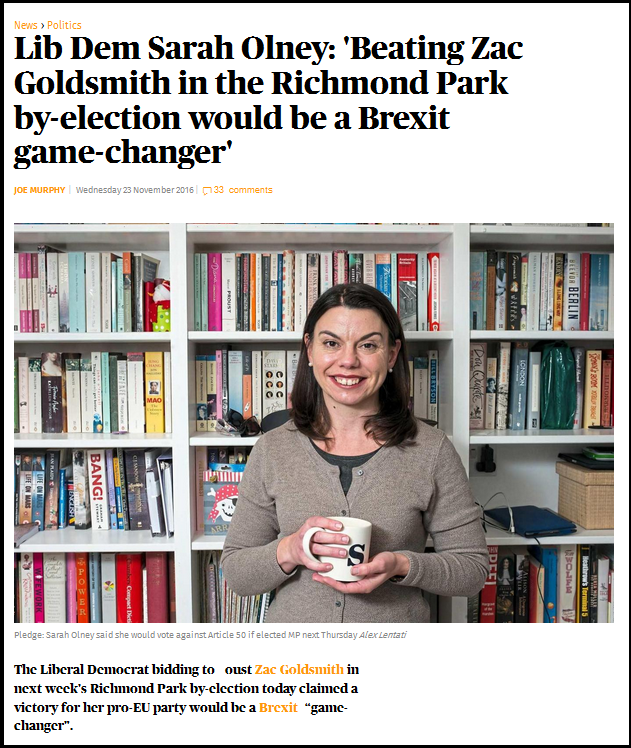
olney-richmond-4Far from being a “stand against Heathrow”, a LibDem victory would now be nothing less than a “Brexit game-changer”, seemingly. [Notwithstanding the fact that it would bring the number of LibDem MPs up from only 8 to only 9, presumably, and hopefully thereby make not one whit of difference to the Government’s proceeding to implement the democratic Referendum result.]

olney-letter-richmond-parkThat was on 23 November. In the space of a mere week, however, it has mutated into something even more momentous. No longer a mere “Brexit game-changer”, the Richmond Park by-election tomorrow is now, we are told, “the most powerful vote you ever cast”. 

Wrong, Sarah. The most powerful vote any of us alive have ever and will ever cast was the vote of 23 June 2016, when no fewer that 17,410,742 of us voted to defy the imprecations and exhortations of the globalist-utopian political, economic, financial and cultural ‘liberal’-elite, and recover our political and economic sovereignty to our own shores and our own ballot-boxes, to be determined democratically by us and us alone.

For that reason above all, it’s important that the LibDems don’t win this by-election.

I’m frankly ambivalent about Zac Goldsmith. His Mayoral campaign was abysmal: his languid environmentalism is a turn-off: his susceptibility to, and collaboration with, Exaro’s rightly now-disgraced “Westminster Paedo Ring” campaign was misguided or worse: and I believe his opposition to Heathrow expansion is strategically wrong.

But I admire his principled decision to abide by his commitment to his constituents over Heathrow, even at political risk to himself: his advocacy of more direct democracy via a proper MPs’ Recall Mechanism: and above all, his unswerving devotion to the Brexit cause. For those reasons alone, I hope he wins.

But there is another. If Goldsmith does manage to win, it will mean that the Europhile, anti-Brexit LibDems, for this by-election allied with the Greens instead of competing with them for the same voter demographic, and in possibly one of the most LibDem-friendly, Remain-supporting, anti-Brexit constituencies in the country, will have failed.

That would send a powerful message to the egregious Farron, Clegg, Ashdown and all their motley crew of embittered, anti-democratic Remainer plotters, intent on ignoring or overturning the expressed will of the people.

And that will be a very fine contradiction indeed.

Thoroughly agree with this article? Vehemently disagree with it?

Scroll down to leave a comment

Follow A Libertarian Rebel on Twitter

Delicious Save this on Delicious

Oikophobia Unleashed

Brexit then Trump has caused hitherto-muted ‘Liberal’ contempt for the masses to erupt unconstrained

A week may be a long time in politics: but the 4½-month period between late-June and mid-November seems to have gone by in a flash.

Because, between the aftermaths of the two political earthquakes represented by the UK electorate’s vote for Brexit on 23rd June and the US electorate’s vote for Trump on 8th November, the chorus of Left-‘Liberal’ anger, objection, complaint and condemnation has been both continuous in frequency and unchanging in content.

A word on semantics. I habitually use “Left-‘Liberal'” for two reasons: the “Left” to distinguish it from the Classical-Liberalism to which it now bears hardly any relation, and the quotes around ‘Liberal’ to convey that its truly ‘liberal’ components are harder to detect. In US, and increasingly now in UK, usage, ‘Liberal’ actually means Left-‘Liberal’: so the remainder of this piece will use it as such.

‘Liberal’ opinion would always have been anti-Brexit. It prefers unaccountable, democracy-bypassing supranational institutions to the democratic sovereign nation-state: it favours unfettered immigration rather than even mildly-controlled borders: it supports elites-benefiting crony-corporatism over genuinely competitive markets: and it would rather single-regulatory-area trading blocs than free trade.

times-frontpage-wed-15jun16-osborne-threats-brexit‘Liberal’-elite received-opinion, anti nation-state and globalist, overwhelmingly informed the anti-Brexit argument. It was all-pervasive, from Government through the plethora of acronymed organisations to the Remain campaign itself, and all echoed faithfully by their largely equally-‘Liberal’ media amen-corner. So its palpably-traumatic shock when 52% of Referendum voters ignored or rejected its pro-EU exhortations, scaremongering and pressure, and voted instead to Leave, was at least predictable.

Less predictable, however – although, as we’ll see, perhaps not entirely – was the volume and tenor of the vilification heaped on the 52% who had shown the temerity to ignore the instructions of their self-assumed intellectual and cultural superiors, and vote instead for economic and political self-determination.

They were not merely wrong, ran the ‘Liberal’ narrative, disseminated via innumerable furious and vitriolic denunciations in the visual, print and online media. They, especially the swathes of working and middle-class voters outside the M25 who voted Leave in droves, had voted the way they had because they were perverse, racist (pick any “-ist” you like, really), ignorant, xenophobic, and – favourite of all – “uneducated”. The Referendum, they argued, should be ignored, and the question re-put

Moving from the particular to the general, democracy itself was soon identified and duly arraigned as the alternative culprit. The Referendum wasn’t even about EU membership at all, it was claimed, but about something else entirely. So Cameron, went this theme, had been wrong to concede something so unpredictable as a referendum at all: the arguments were too complex for the great majority of the voting public to understand, let alone decide on: why, perhaps even mass democracy itself was a flawed concept, seeing that at least half of the voters were plainly cerebrally-challenged, and manifestly too ill-equipped intellectually to participate in it.

b-oneill-rage-of-the-elitist-campMany were surprised by the unabashedly-articulated virulence. But not all – more astute commentators noted that the reaction was more a case of the mask slipping. The reflex was new, not in substance, but only in the extent to which ‘Liberal’ opinion no longer felt any constraint or reluctance about expressing it so clearly and openly.

Among the affluent, mainly-metropolitan, upper-middle-class, educated, intellectual and cultural Left, a faux-solicitude for the masses going hand-in-hand with a visceral revulsion for them has a long and unattractive history. One could perhaps cite as examples the early Fabians, or that epitome of Bloomsbury disdain Virginia Woolf: but suffice it to refer to that George Orwell quote from The Lion And The Unicorn with which so many are so familiar:

“In intention, at any rate, the English intelligentsia are Europeanised. 
They take their cookery from Paris and their opinions from Moscow. In the 
general patriotism of the country they form a sort of island of dissident 
thought. England is perhaps the only great country whose intellectuals 
are ashamed of their own nationality. In left-wing circles it is always 
felt that there is something slightly disgraceful in being an Englishman 
and that it is a duty to snigger at every English institution, from horse 
racing to suet puddings. It is a strange fact, but it is unquestionably 
true that almost any English intellectual would feel more ashamed of 
standing to attention during ‘God save the King’ than of stealing from a 
poor box. All through the critical years many left-wingers were chipping 
away at English morale, trying to spread an outlook that was sometimes 
squashily pacifist, sometimes violently pro-Russian, but always 
anti-British.”

scruton-on-oikophobiaThe philosopher Roger Scruton deploys what I still consider by far the most descriptive term for the phenomenon of mainly metropolitan ‘Liberals’ consumed by contempt for the nation & its white working and middle classes. He calls it Oikophobia, from the Greek oikos, meaning home: a repudiation and irrational fear of, even hatred of, one’s own nation, heritage, traditional culture and people.  

He went on to amplify it in his magisterial speech entitled “Immigration, Multiculturalism and the Need to Defend the Nation-State”, delivered – with a prescience that in retrospect one can only marvel at – on 23rd June 2006, exactly 10 years to the day before our own Referendum Day. This is the passage that stands out:

scruton-on-oikophobia-2

That rampant ‘Liberal’ oikophobia, aimed at the Brexit-voting classes, whatever their socio-economic status and irrespective of their reasons, has scarcely diminished since its post-23/6 eruption.

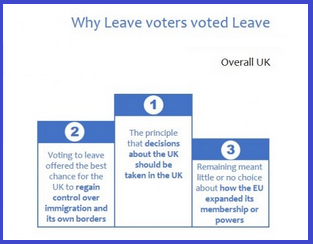
why-people-voted-leave-2In vain do its targets point out that, far from being a vote by the allegedly prejudiced, hatred-filled, “xenophobic”, “uneducated” mob, 53% of those voting Leave gave as their reasons the fundamental issue of sovereignty and democracy: the principle – clearly anathema to sophisticated ‘Liberals’ – that decisions about the UK should be taken by, and in, the UK.

As a usually very non-political friend put it to me: “I voted Leave because I want my kids to grow up and live in a society where the taxes they have to pay, and the laws they have to obey, are decided by, and only by, politicians who they can elect and throw out, and by no-one else“.

It’s hard to better this as a simple summary of the Brexit case, and I’ve unashamedly borrowed it: but apparently it establishes beyond doubt millions’ racism, xenophobia, hatred, lack of sophistication, stupidity, and every other conceivable moral failing sufficient to consign them in ‘Liberal’ opinion to beyond the Pale of respectable society.

Then, just one week ago, a second cruise missile tore into the ‘Liberal’ citadel and detonated. Confounding the instructions, predictions (and, let’s face it, the heartfelt desires) of virtually every TV outlet, pollster, psephologist, media-pundit and cultural-commentariat apparatchik in the USA and beyond, the American voting system spurned the robotic, compromised, shop-soiled doyenne of the politically-corrrect, globalist ‘Liberal’ Establishment in favour of its ultimate ogre, Donald Trump. ‘Liberal’ opinion reeled in shock, denial, anger, and then exploded in incandescent almost hysterical, fury.

mount-st-helens-eruptionTo borrow a metaphor from volcanology: if Brexit 23/6 was the 20 March 1980 earthquake that created the bulge of sub-surface magma, visibly growing daily, on the north side of Washington State’s Mount St Helens, then Trump 8/11 was the 18 May 1980 rapid-succession earthquake, landslide and lateral blast that blew it apart and triggered the volcano’s eruption. The ensuing pyroclastic flow of ‘Liberal’ rage, frustration, hatred, bile, vituperation and contempt for the voters who delivered the dual earthquakes has both intensified and continued ever since, and it shows no sign of abating.

Just as in its post-Brexit phase, disparagement, firstly of the electorate and then secondly of democracy itself, are ‘Liberal’ opinion’s both default reactions and predominant responses.

Voters went for Trump, ‘Liberals’ insist, because they share his alleged misogyny (overlooking that 53% of white women voters and 43% of all women voters voted for him, and that among women without a college degree, he was 20% ahead).

The vote for Trump was an outpouring of latent white racism and xenophobia, they declare (ignoring that Trump garnered only 1% more of the white vote, but 2% more of the Hispanic vote, than Romney in 2012: that he attracted more Afro-American votes than Romney in 2012: and that whites voted for Obama in record numbers in both 2008 and 2012). 

The traditionally Democratic-voting working class in the battleground Rustbelt states broke for Trump, ‘Liberals’ informed us, because they were, above all, “low-information” (currently the en-vogue euphemism de choix for “thick”). Whatever happened to ‘Liberal’ concern for the economically-disadvantaged and the mission to improve their educational opportunities?

Trump won because Obama is black, suggested a Professor of African-American Studies at Princeton. Entertaining this proposition requires you to make the prodigious leap of logic to infer that not liking the fact that Obama is a black man made usually-Democratic voters not vote for a white woman. Right……         

61 million Americans voted for Trump, The Guardian’s Jonathan Freedland implied, because they share his complete abrogation of any moral values. That a working-class man in Michigan or Wisconsin, job constantly at risk, no pay raise in 6 years and family home just re-possessed, might not regard transgender bathrooms as a first priority, seems not to have occurred to him. Perhaps it really was about the economy, stupid.      

Predictably, perhaps, in view of his meltdown on BBC Question Time earlier this year, the historian Simon Schama positively dripped with metropolitan-‘Liberal’ condescension & contempt. Those with a different view to his, let us note, are not merely political opponents, but “sweaty agitation”, inclined to “nativist populism”, and, worst of all, are “people who don’t read broadsheets”. The horror.  

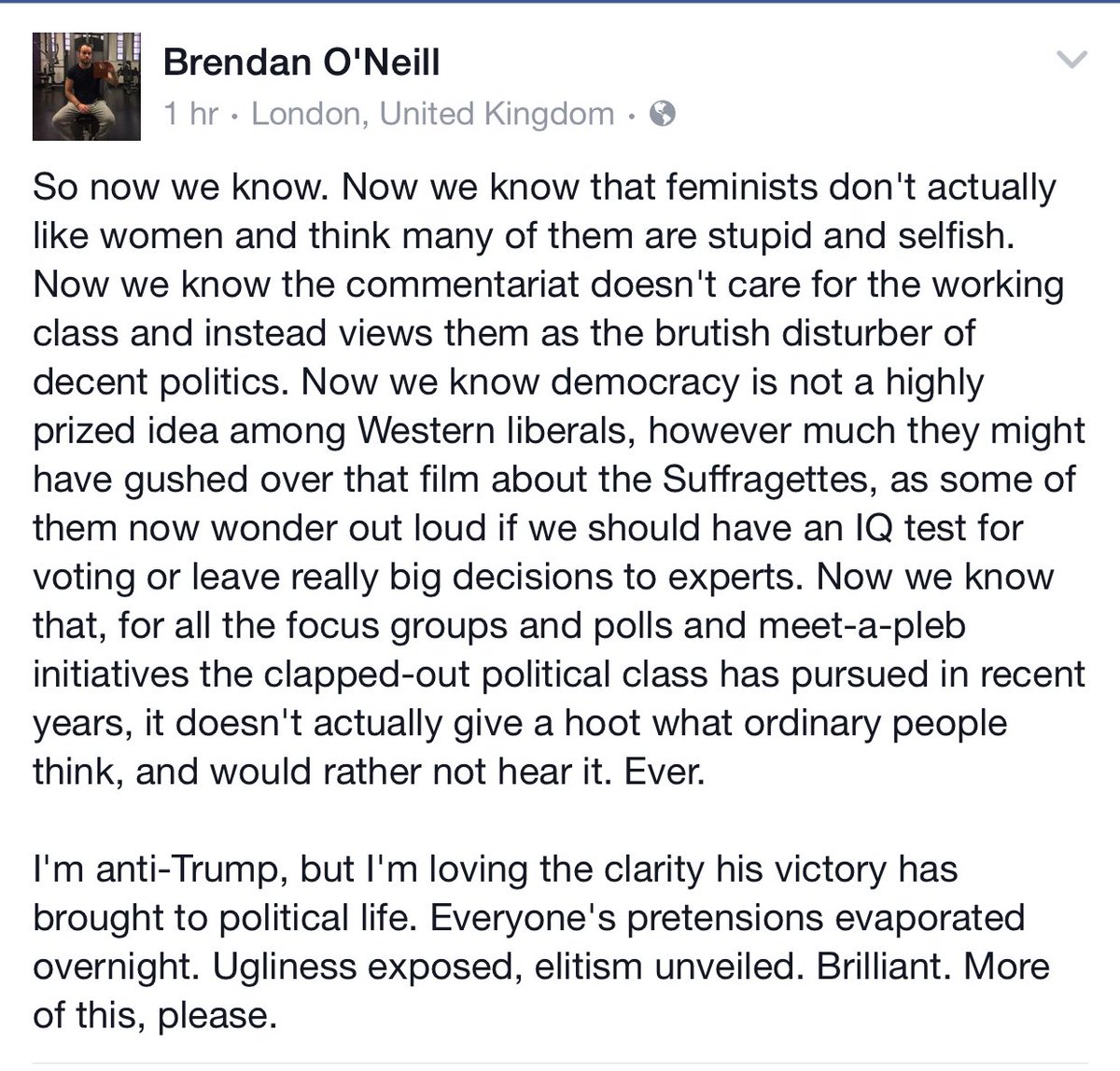
So what conclusions can we draw from this near-visceral outpouring of ‘Liberal’ bile directed at those impudent enough to hold a contrary view? Spiked!’s Brendan O’Neill, again, put it well in a Facebook post yesterday, and the next three paragraphs draw from it. 

brendan-oneill-on-liberals-view-post-trump-15nov16We’ve learned that many ‘Liberal’, Democratic-voting “feminists” actively dislike to the point of vilification any women who hold an opinion different to their own, and think moreover that the 43% of them who voted for Trump must by definition be stupid and selfish, without even bothering to consider what their reasons might be.

We’ve learned that the ‘Liberal’ media-commentariat doesn’t after all have a high regard for the working and middle classes, but instead positively reviles them as backward, unsophisticated, “low-information” disrupters of its own preferred model of an anodyne, “civilised” consensus-politics, deracinated of any substantive ideological difference.

We’ve learned that even democracy itself is something that ‘Liberals’ don’t value highly when it delivers verdicts outside their acceptable range of outcomes: so much so that some are openly discussing the presumed necessity of political-IQ tests for voting, or if not, reserving big decisions exclusively for “experts”.

And finally, as Melanie Phillips put it so aptly in The Times yesterday, we’re seeing the grotesque spectacle of ‘Liberals’ weeping over the supposed demise of democracy from its inherent deficiencies, even as they simultaneously dismiss half the population as too stupid and unfit to participate in it, and speculate on ways of excluding them.

For the ‘Liberal’ globalist order, Trump after Brexit presages an existential crisis. After the Brexit vote, its repudiation by 17.4 million UK voters might have been dismissed as a one-off: but not after Trump. The rebellion against ‘Liberalism’s 30-year hegemony is growing. Next year sees elections in France, Germany and The Netherlands, with parties opposed to the ‘Liberal’ globalist order poised to make substantial gains. ‘Liberals’ therefore have to fight back, and the current deluge of Oikophobia is just the start.        

Where we are with this is quite bad enough: but where we could be headed is chilling. Writing in Foreign Policy magazine, Jason Brennan, author of “Against Democracy”, condemns the assumed inseparability of mass democracy and voter ignorance. There is, he says, “no real solution to the problem of political ignorance, unless we are willing to break with democratic politics”, arguing instead for an epistocracy, a kind of “aristocracy of the wise”, where experts can determine political policy for those of us who are too “low-information” to have a say in them ourselves.

This too, like Oikophobia itself, has an unlovely provenance: taking us back, by inference, towards the eugenics whose possibilities fascinated Wells, Shaw, the Webbs, and the early Fabians, concerned to address the adverse societal implications of “feeble-minded” people, but this time transferred from the restricted area of welfare-entitlement to nothing less than the political-participatory process itself.

‘Liberal’ Oikophobia in isolation is unpleasant, and illiberal, but rarely more. Unleashed, and combined with a resentment at the outcomes of mass democracy whose perceived solution is mass democracy’s delegitimisation, however, it constitutes a far greater threat than does any consequence of a Trump presidency or an EU-exiting Britain. It has to be countered.        

Thoroughly agree with this article? Vehemently disagree with it?

Scroll down to leave a comment

Follow A Libertarian Rebel on Twitter

Delicious Save this on Delicious

A Matter of Law and Liberty

The EU Referendum debate has not paid enough attention to the risk to our liberty-based legal traditions implicit in a Remain vote

Post-Brexit trade deals of varying merit. Immigration. The effect of a Brexit on the UK economy. These are the matters that have dominated the EU Referendum debate.

But the list contains one glaring omission. Almost nowhere has there been discussed the risk that a Remain vote, and its near-certain consequence of deeper integration into the EU, poses to the individual-liberty based English legal tradition.

EU legal gavelBecause part of the EU’s overall aim is explicitly to create a specifically EU corpus juris  and what it openly calls a “common legal space”: an expanding both geographical jurisdiction and body of law applicable within it, made by, and administered by, the EU at supranational level.

As ever with the democracy-averse EU, though, the project proceeds both by increments and by stealth, with its ultimate objective not disclosed, because it knows that, were it to be openly proposed in one fell swoop, the voters of member-states would reject it out of hand. But its aim is nothing less than a body of pan-EU law will eventually supplant that of nation-states.

This poses an especially enormous problem for the UK, because of our fundamentally hugely-different legal tradition. Our common law grew from the ground up: it developed through individual judges adjudicating on the individual real-life cases brought before them, weighing the facts on the ground, and making decisions which became precedents over time. Indeed, much of our statute law enacted via the legislature, rather than by judicial decision, has traceable common-law roots.

economic-freedom-index-world-2010_mapThe common law, based on individual liberty, enforcement of property rights, freedom of contract, separation of legislature and judiciary, and protection of the individual from the arbitrary caprices of state and government, is arguably our greatest-ever export. That the Anglosphere countries whose legal systems are based on it have consistently formed some of the freest and most prosperous societies on the planet isn’t an accident, but a discernible consequence of it.
Continental countries, in contrast, have to a much greater extent opted for an entirely different legal tradition of codified law, more often originating in the rarified air of abstract political philosophy, rather than grounded in the gritty, often untidy, reality of peoples’ actual lives, interactions and contracts.

The Continental legal tradition reflects a vision of law, liberty, personal rights, and crucially the relationship between state and individual, that is elementally inimical to our common-law and liberty-based tradition: a conflict summed up in the most frequently observed distinction that in the English tradition you may generally do anything which is not specifically prohibited, as opposed to the Continental tradition, where you may generally do nothing that is not specifically permitted.

Yet it’s that Continental tradition that informs the legal systems of the vast majority of EU member-states and which the EU’s corpus juris will overwhelmingly reflect. That shouldn’t be surprising: the EU is, after all, nothing if not a deliberately statist, top-down, technocratic, democracy-circumventing project, and for its legal system not also to conform to that philosophy would be an astonishing inconsistency.

Scales of Justice EnglishBut it’s into that illiberal tradition that a vote to Remain in the EU will consign us. Or, more likely, condemn us. In prospect are the subsumption of some the most cherished institutions and protections of our English common-law liberty – habeas corpus: the right to know the charges arraigned against you: the right to expeditious justice: the right to face your accusers in public court: the right to be tried by a jury of your peers, not by state-appointed judges – into the Continental legal tradition where these are either absent, muted, or susceptible to being set aside on the grounds of State expediency.

The law of the jurisdiction of England and Wales, whether common law or statute, doesn’t belong to MPs, much less to Ministers or Government. It belongs to us, the people. When we send MPs to Westminster, we don’t transfer ownership or possession of our law to them: we merely delegate them temporary custody of it and political responsibilty for its administration – nothing more. The law of England and Wales is not the exclusive property of transient Government or MPs to jettison, abandon or give away to another polity, without our specific consent.

Anglosphere 1We aren’t “European”. Our core values, beliefs & legal traditions give us far more in common with our Anglosphere first cousins. The Continental tradition of codified law & centralised statism is fundamentally inimical to Anglosphere ideas of freedom & liberty. Throughout our history, we’ve chosen different solutions to these fundamental questions than have our European neighbours: solutions developed ground-up, rooted in individual liberty & lived experience, not derived from abstract theory of political philosophy.

It’s that rich heritage that we still have a couple of hours to retrieve and re-energise.

Thoroughly agree with this article? Vehemently disagree with it?

Scroll down to leave a comment

Follow A Libertarian Rebel on Twitter

Delicious Save this on Delicious

I Wasn’t Wrong. I Just Underestimated.

In my March 2015 prediction of the tenor and conduct of the EU Referendum, if anything, I underestimated just how dirty it would be.

Back in March 2015, I wrote an article for fellow-Brexiteer Ben Kelly over at The Sceptic Isle, on how the EU Referendum, whenever it came, would play out. (Ben has archived it, so I can’t link to it, but fortunately I kept a Word copy of it).

The first part of the piece was a prediction of how the referendum would be conducted. Here it is:

“Whenever it comes, the EU Referendum campaign will undoubtedly be the dirtiest and most deceitful plebiscite ever seen in Britain. For the EU-enthusiasts disproportionately represented in opinion-influencing circles, there is simply too much at stake for it not to be.

For them, an OUT vote means a popular re-affirmation of the democratic, sovereign nation-statehood they have spent almost their entire adult lives repudiating. It means a national rejection of the centre-leftish, universalist, democracy-bypassing supranationalism of unelected elites, which they believe is the necessary civilising antidote to the unpredictable caprices of robust, accountable one-country pluralism.

The overwhelmingly EU-phile politico-media establishment, including the three main legacy parties, will exaggerate the supposed benefits and advantages of EU membership, and simultaneously downplay or suppress its drawbacks. There will be massive scaremongering to overstate, in wildly dramatic fashion, the alleged risks of exit, whether to UK jobs, economic growth, ease of travel, or even our much-vaunted but much less evident “influence”.

Even in the 2014 EU Parliament elections, we saw the readiness of the EU-phile movement to retail the risible “3m jobs at risk” meme, and the media’s willingness to boost it, despite its evident falsehood. The personal smearing of advocates for withdrawal will be constant, and vicious. It will be a media negative-propaganda campaign such as we have never before seen.

Hand-in-glove with the media will be what will be trailed as “the voice of business” – more accurately, the voice of big business and its representative organisations like the CBI, which benefits most from the crony-corporatism that the EU exemplifies. Big business values the EU for the competitive advantage it brings: large firms have sufficient size and economies of scale to absorb the mountains of EU regulation and attendant compliance costs that both deter new entrants and cripple their smaller, nimbler competitors. They will do everything to maintain that advantage.

Meanwhile, pro-EU campaign groups and third-sector “charities” and quangos will be vocal in support of EU membership and its alleged benefits as never before. Our emotions will be assaulted by heart-rending warnings of hardship and unfairness to recipients of charity if EU regulations cease to apply on exit.

The anti-exit movement will be backed by massive financial support, not least from the EU itself. For the EU, the stakes in a UK exit referendum being held at all are huge – remember, the entire European super-state project is predicated philosophically on the historical inevitability of ever-closer union – but the risks to the EU from that referendum delivering a UK exit are incalculable.

Britain would be the first major country, and economy, to resile from the project. Not only would it take its contributions with it, but it would almost certainly tempt others to follow. The possibility of it being the thin edge of the wedge, and the first step in the breakup of the entire edifice, could not be discounted.

The extent of EU funding which has been funnelled to the BBC and the CBI is well-known.

BBC CBI comp

But the EU has also been quietly suborning civic society, and even local government, with EU funding, for many years. The recipients cannot be expected to do other than campaign vociferously for its continuation. The EU will pour money into the pro-EU, anti-exit campaign – because its own very survival could be at stake.

History shows, too, that the status quo exerts a strong voter pull in referenda, and that voting intention in favour of the status quo actually hardens as polling date approaches. Dangling before the electorate the idea that the intended change represents a risky leap into the unknown unfortunately works.”

The purpose behind this quick post isn’t to gloat, or to say “See, I told you so!” I’d much rather I’d been completely wrong, and that after a robust but more-or-less civilised campaign on the substantive issues, Britain was now irreversibly on course for a Brexit vote.

It’s just to record ruefully, not that I was right, but that I underestimated the depths to which the Government, the mainstream political parties (albeit with some honourable exceptions within them) and the Remain Campaign would sink – or perhaps that should be dive.

But the cynical, shameless exploitation, by all, of the MP Jo Cox’s murder, culminating in what Conservative Woman‘s Laura Perrins rightly calls something that should go down in the political handbook of infamy, plumbs depths of ethical depravity and turpitude even I could not have imagined.

That Britain now seems about to commit what will arguably the greatest act of national self-destruction of the Modern Era is bad enough. That it should do so as a result of being susceptible to baseness of this magnitude is profoundly depressing.

Thoroughly agree with this article? Vehemently disagree with it?

Scroll down to leave a comment

Follow A Libertarian Rebel on Twitter

 Delicious Save this on Delicious