Category: UK-Politics

Bring on a General Election: and yes, even a hard-Left, Corbyn-led Government

A General Election would provide the opportunity, both for the Conservative defeat needed for it to lance the boil of its own Left-‘Liberalism’, and for the experience of a hard-Left, Corbyn-led Government necessary to lance the boil of Socialism.

Note: this is the long (and updated) version of the article first published at The Conservative Woman on Friday 22 June 2018. 

That Theresa May, on Wednesday 20 June 2018, survived that afternoon’s vote on Tory arch-Remainer Dominic Grieve’s amendment to the EU Withdrawal Bill, which sought to give the House of Commons power in effect to halt Brexit in the event of no deal being agreed with the EU, was no victory, but yet another fudge, kicking the can down the road.

It was preceded by a Prime Minister’s Questions of quite staggering awfulness, not only from her, but from almost the entire House, with both sides first fawning over an Imam whose public utterances at the very least imply he wants any criticism of Islam banned, then competing furiously to virtue-signal their achingly politically-correct Left-’Liberal’ credentials at every possible opportunity.

That, plus the long-evident reluctance of most of its overwhelmingly pro-Remain membership to accept and implement the EU Referendum result, finally convinced me. The present Chamber is moribund, even rotten, led by a Prime Minister who is Dead May Walking, and another election is needed.

Why am I so keen on a General Election now? Or, if not keen, nevertheless reluctantly convinced of the necessity for one, despite the potential baleful adverse consequences? For three reasons.

Firstly, with both political attention-span and memory being relatively brief among the vast majority of the public who wisely don’t pay much day-to-day attention to politics, by the time 2022 comes round, many people will have largely forgotten the 2017-18 attempted, if not actual, betrayal of the 2016 EU Referendum result.

Not to mention, also, being bleakly realistic, that some of those now most angry about that betrayal and thirsting for the chance to wreak electoral revenge may, by then, no longer be around to vent that anger at the ballot-box. An early election would mean that voter frustration with both parties has an outlet before it subsides.

Next, the current Vichy-‘Conservative’ Party needs to suffer a heavy defeat, along the lines of the 1906, 1945, and 1997 landslides, to bring about either a split with, or a purge of, its Cameroon-Blairite Left-‘Liberal’ wing, whose current ascendancy is driving the Party Left-wards, both economically and culturally, with dire results.

Remember, in the last year alone, Theresa May has proposed having the State fix the price at which energy suppliers can sell their product: signalled an intent to intervene in the price/demand side of the housing market instead of liberalising planning controls to incentivise supply: threatened to crack down more on ‘hate-crime’ and ‘Islamophobia’, aka free speech: promised to control and police the internet: approved lifestyle and behaviour-nudging taxes: resiled from tackling mass uncontrolled immigration: and proposed throwing another £20 billion at an unreformed NHS while praising it fulsomely in ever more reverential terms.

And that’s before we consider the Miliband-Lite Tories’ eager appeasement of the Green Climate-Change lobby, the racial and religious grievance industries, an increasingly corrupt and partisan United Nations, and, above all, a vengeful and intransigent European Union over Brexit.

This resolute Leftwards march is no temporary expedient, but merely the latest phase in a process which has been going on for years, even decades. The great failings of the ‘Conservative’ party since the end of World War II, with the exception of the 1980s which sadly must now be viewed as an aberration, have been its reluctance to counter the Left intellectually, and its consequent willingness to accept the Left’s policies, especially when attractively packaged, for the sake of occupying office.

Indeed, the writer Peter Hitchens recounts remarks by YouGov’s Peter Kellner, man of Labour and the soft-Left through and through, to the effect that from time to time a Conservative government must be allowed to occupy office, so as to maintain for the electorate an illusion of pluralism and choice, but provided that it does nothing to unravel previous Labour administrations’ policies. Wittingly or unwittingly, the ‘Conservative’ Party has been happy to comply.

The Party therefore needs an unequivocal electoral defeat and period in opposition, to force it to re-think from first principles what it stands for, then devise a portfolio of policies that aren’t merely politically-promising, but intellectually-consistent, in order to be able to capitalise on it when the Corbynite-Labour bubble bursts.

Finally, the boil of Socialism now seemingly infecting so much of the electorate needs to be lanced. But with the increasingly soft Left-‘Liberal’ ‘Conservative’ Party having totally abandoned making a robust case for low-tax, small-State, civil-libertarian, free-market conservatism as the engine of prosperity, freedom and growth, in favour of timidly apeing Socialist-Labour in the vague hope of a few Corbyn-Lite policies enticing voters back, I  cannot see that happening without a new generation of voters experiencing for themselves the malign reality of a hard-Left government.

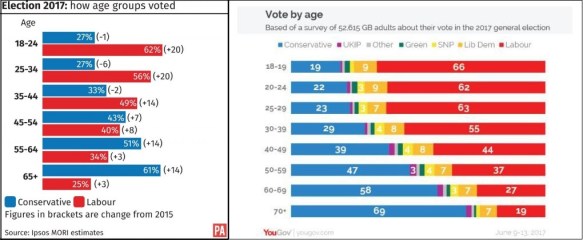
Psephologically, before the 2017 General Election, the Labour-to-Conservative crossover point – the age at which people switch to voting Conservative rather than Labour – was assumed  to be roughly 34. 

Age predictor UK politics

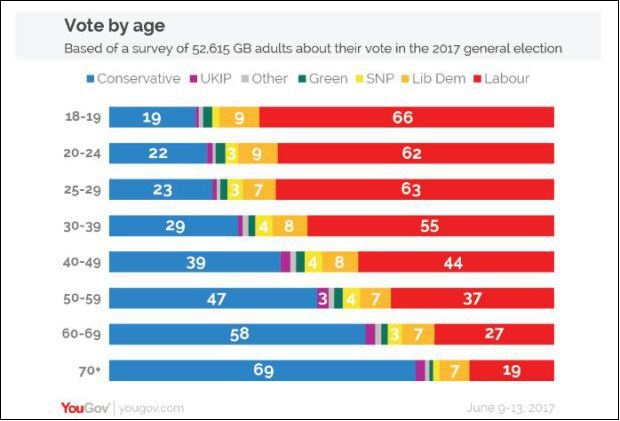
But the 2017 General Election, the first with Corbyn as Labour leader, changed all that. The post-election analyses moved that crossover point back by an entire decade or more, to somewhere between 44 and 49 . . . . . 
UK GE2017 voting by age groups comp

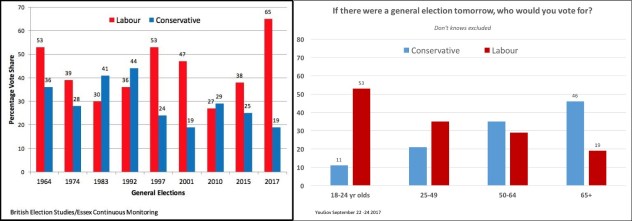
. . . . . and Labour now enjoys majority support in all voter age groups between 18 and 45, including the highest-ever ratings among under-30s since 1964.
Hist under-30s support Labour & Sep 17 vote intent by age comp

This shouldn’t be altogether surprising. It’s now nearly 40 years since Britain last had an economically-Left Labour Government (in contrast to the culturally-Left governments of all parties which we’ve had for about 35 years), so that almost no-one under the age of, possibly, 55 at least, has any memory or experience of actually living under one.

Add to that two more factors: firstly, the predominantly Left-leaning sympathies of the UK mainstream media, which means Corbyn’s socialist policies are seldom subjected to the critical examination and questioning directed towards their smaller-state, lower-taxes, and free-market leaning equivalents: and, secondly, the left-wing bias of the Education profession by which two generations have been indoctrinated . . . . . .
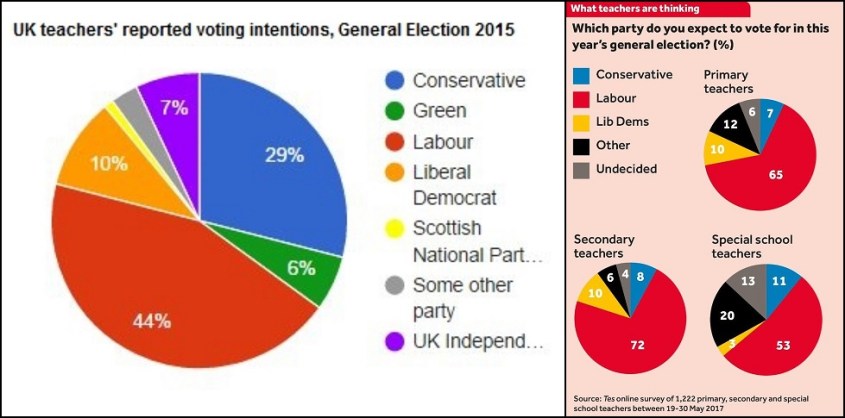
Teachers voting intentions 2015 & 2017 GEs comp. . . . . . . . and it’s arguably astonishing that Corbyn’s socialist prescriptions, superficially so enticing to those who’ve never suffered them in practice, aren’t even more popular. 

This is why reminders of hard-Left Labour’s insalubrious history of either supporting or at least excusing tyrannical Communist dictatorships – even while it simultaneously condemned the West of human rights, free speech and the rule of law as fascist – cut no ice. The past is truly another country.           

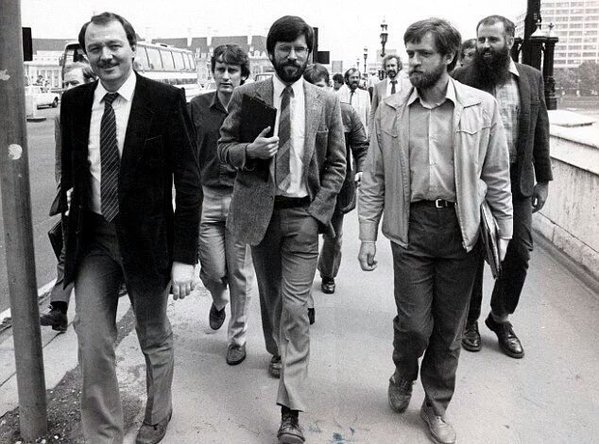
Corbyn does support some bombingThis is why pointing out Corbyn’s uncritical support for the IRA throughout the 1970s and 1980s, even as it was blowing up British women and children on the streets of the United Kingdom, doesn’t resonate. To today’s devotees of the Corbyn Cult, this is ancient history. It’s 30 years since the end of the Cold War, isn’t it? It’s 20 years since the Good Friday Agreement, isn’t it?

This is why warnings of strikes, power-shortages, punitively-high taxes, and fiscal mismanagement from Labour runaway spending and borrowing, have so little political cut-through with voters, from Generation X-ers through Millennials to Generation Z-ers. They’ve never actually seen it in Britain, so they just don’t believe it: and in my view, nothing short of experiencing for themselves the horrors of living under a left-wing Labour government will dispel their illusions.

In short, we’ve arrived at one of those points which seem to occur every 40 years or so, where a major political upheaval is needed to generate political resuscitation and renewal.

Yes, of course there are risks, and very serious ones, from a hard-Left Labour government, and as someone who abhors every manifestation of Leftism, I’m the first to acknowledge them. The Corbyn-McDonnell Terror won’t be pleasant. But capital markets, via demanding higher borrowing rates, and threatened or actual capital flight, via reduced tax receipts, have a habit of curbing the worst excesses of economcally-Left Labour governments.

In any case, is that really so worse than the alternative? Of years of a Continuity-May ‘Conservative’ Party, ever more in thrall to mushy Left-‘Liberalism’, governing hesitantly and ineffectively while the hard-Left poses self-righteously as Salvation Denied?

Just as, to cure a malignant cancer, painful chemotherapy has to be endured, so rejuvenating conservatism and defeating Socialism may require some temporary hurt. But the sooner the treatment starts, the less painful it is, and the sooner comes the cure.

Fortune favours the brave. Bring on that election.

Thoroughly agree with this article? Vehemently disagree with it?

Scroll down to leave a comment

And follow A Libertarian Rebel on Twitter
 

Faux-“Feminism” On The March

The Women’s movements protesting Trump’s London visit aren’t about genuine feminism, but about left-wing faux-minism 

The London protests of Friday 13th July against Trump’s visit to the UK have given a chance to see in action, more visibly than hitherto, a phenomenon until recently largely confined to America. 

Springing to media prominence in the aftermath of Trump’s November 2016 election and January 2017 Inauguration, the Women’s March Movement got known principally for marching around in pussy-hats or dressed as vaginas, not to protest the oppression of women regardless of perpetrators or victims, but chiefly to protest, from the Left, the outcome of democratic elections which it disliked. 

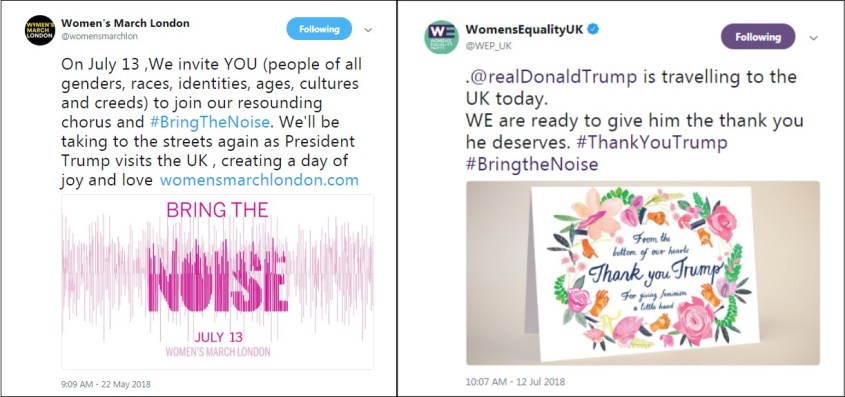
For their UK counterparts / equivalents / imitators, the opportunity presented by Trump’s visit was irresistible. To give a flavour. . . . 

Womens March Womens Equality notifys re Trump visit

. . .although the “day of joy and love” and “the thank-you he deserves” were perhaps not what most of us would have interpreted from those innocuous phrases.

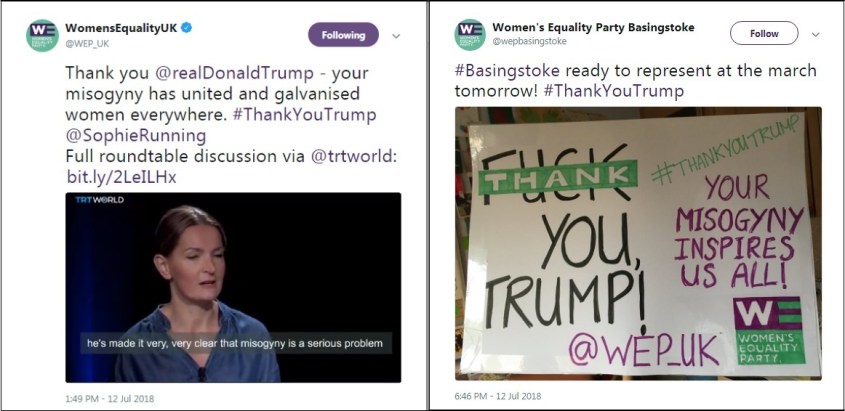
Both the WML and WEP vociferously condemn Trump’s alleged misogyny and white-supremacist racism, indisputably evidenced by the shockingly-egregious appointments, made entirely on merit, of Indian-Sikh heritage Nikki Haley, née Nimrata Randhawa, as UN Ambassador, and Betsy De Vos, a former donor to his rivals, as Education Secretary.

Curiously, however they seem reluctant to condemn, except by a no-doubt heartfelt and eloquent silence: Female Genital Mutilation, which despite being statutorily illegal in the UK for almost two decades, has resulted in few, if any, convictions: Marital Rape: Religio-cultural so-called “honour”-based violence against women: the genocide, murder, rape and sexual enslavement of thousands of Yezidi women and girls by ISIS: and the systematic grooming, rape and trafficking of untold thousands of young or even under-age, vulnerable white working-class girls, predominantly by organised gangs of Pakistani-Muslim men. 

But let no-one doubt their commitment to calling out misogyny wherever they see it, even if they’re, ahem, somewhat selective about where they choose to see it. Or not.

WEP Trump misogyny compAt this point, it might be instructive to examine the so-called “Women’s Equality” Party and its co-founder, Sophie Walker, a bit more closely. Psephologically, the electoral potential of a party whose very name could by implication be read as specifically excluding half the electorate is debatable, but ignore that.

Walker has an undistinguished electoral record. In London’s 2016 mayoral election, she received just 0.6% more of the vote than the odious George Galloway. Then, in the 2017 General Election, she decided to contest the Shipley, Yorkshire, seat of Tory MP Philip Davies.

Now you might think that the natural Yorkshire seat for a “Women’s Equality” Party Leader to contest would be Rotherham, where some 1400, mainly under-age, vulnerable, disadvantaged, white working-class girls were groomed, raped and trafficked by gangs of mostly Pakistani-heritage Muslim menHowever, some women are obviously deemed less deserving of equality than others.

For Walker, Davies’ (far worse) crime was to impede the Parliamentary progress of measures to tackle male domestic violence against women, because they excluded any measures also to tackle female domestic violence against men. His arguing for true, not selective, gender-equality, claimed Walker, was “sexist” and “regressive”. So it was against him, and not for the Rotherham victims, that she stood. She polled 1.9% compared with Davies’ 51.3%

On BBC Sunday Politics London in early December 2017, she asserted, without offering any evidence: “gender-inequality is the main cause of domestic violence”. She continued: “the vast majority of men who experience domestic violence are in gay relationships”. Thus seamlessly blending a belittling of male-victim domestic-abuse with homophobia.

Walker regularly retails the stock Leftist narrative on the alleged gender pay gap. Yet this has been comprehensively debunked by economists who’ve shown that, once you control for factors like type of job, number of hours worked and lifestyle choices, the “gap” virtually disappears, or even favours women.

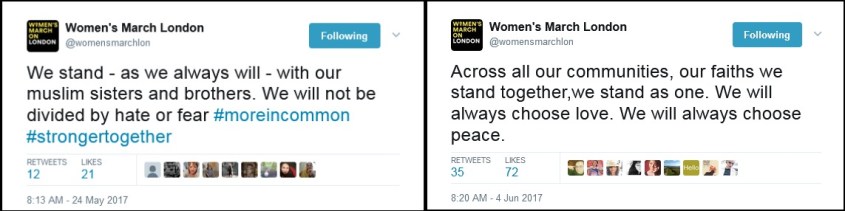
Reverting to the WML, potential clues about its own apparent insouciance about the religio-cultural abuse of young indigenous women aren’t that hard to find. The movement makes no particular secret of its advocacy of uncontrolled mass immigration, and a willingness, even eagerness, to excuse or even indirectly promote radical militant Islam, not least by readily deploying the Left’s specious “hate-crime” narrative to protect it from criticism, even in the immediate aftermath of an Islamism-inspired terrorist atrocity that killed 22 people attending something as clearly “Islamophobic” as an Ariana Grande concert.    

Womens March Islam open borders comp Womens March London Muslims comp

Where, then, does that leave their protests as “feminists” against the Trump whose alleged misogyny towers above all others?

Despite their names, these aren’t political movements about women, and especially not about securing for women even freedom from oppression, never mind true equality. If they were, they wouldn’t be so selectively myopic about the abuse of women from sources, and on motivations, to which they appear content, even keen, to turn a blind eye.

They are instead political movements for women, and specifically for women of a certain political persuasion, striking pretty much the standard package of Left-‘Liberal’, fashionably politically-correct attitudes and shibboleths.

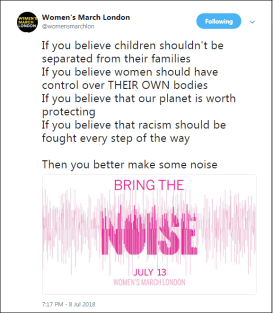
Womens March London invite re Trump

Believe “women should have control over their own bodies”? Except victims of FGM, marital rape, and “honour”-based violence, presumably.

“Believe our planet is worth protecting”? But not the African woman cooking over a dung fire because Green-Left NGOs decree that giving her cheap, reliable energy would cause “catastrophic climate change”?          

“Believe racism should be fought every step of the way”? Victims of religo-cultural anti-white CSA need not apply.

Both movements come across as metropolitan middle-class left-wing movements, principally for metropolitan middle-class left-wing women favouring the aggressive cultural-marxist third-wave iteration of feminism which is viscerally anti-Western generally and anti-American especially.

One might ask, finally, where they were when Erdogan, appeaser of misogynist Islam and jailer of journalists (including women), was in London recently? Or where they were for the visit of Xi Jinping, fan of media censorship, show trials, torture of dissidents and summary executions, (including of women)?

Tumbleweed. Wrong kind of victims. The faux-“feminist” Leftists don’t march for them.

Thoroughly agree with this article? Vehemently disagree with it?

Scroll down to leave a comment

And follow A Libertarian Rebel on Twitter
  

Tory Armageddon or Tory Anti-Climax?

Will today’s House of Commons debate votes on the House of Lords’ wrecking-amendments to the EU Withdrawal Bill prove to be Tory Armageddon or anti-climax?

This article was first published at The Conservative Woman on Tuesday 12 June 2018. 

Theresa May’s default instinct is procrastination. Her entire conduct of the Brexit negotiations has been characterised by deferral and delay, rather than decision. Today, however, comes the confrontation she can duck no longer. The House of Lords wrecking amendments to the EU Withdrawal Bill come back to the House of Commons.

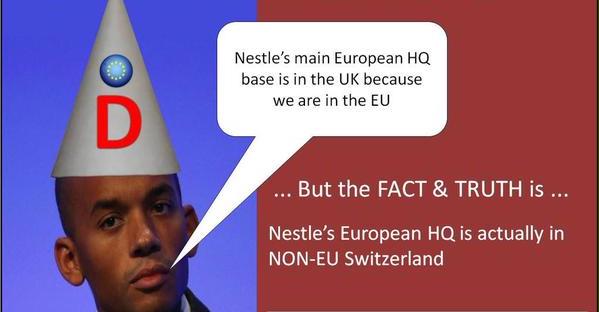
We can, however, totally dismiss the arguments of Unreconciled Remainers like Chukka Umunna and Gina Miller that for the Government to require all 15 Lords’ amendments to be debated and voted on in just 12 hours or so over the next 2 days is somehow an affront to democracy.

It takes either a breathtaking degree of chutzpah, or a staggering lack of self-awareness, for Umunna and Miller to (presumably) believe that their own blatant attempt to overturn the democratic decision of 17.4 million voters and stop Brexit somehow isn’t a far greater affront to democracy, but leave that to one side.

In 1999, the Blair Government, of which Umunna was, and Miller I suspect would have been, an enthusiastic supporter, made the Commons consider no fewer than 820 Lords’ amendments to the Greater London Authority Bill in just 5 hours.  The Remainers’ faux-outrage over 15 amendments in 12 hours or so over 2 days is risible, as well as being nauseatingly hypocritical.

Before her misguided decision to call last year’s election, May probably had the numbers, including the DUP and Labour Leavers committed to respecting the democratic outcome of the EU Referendum rather than Corbynite game-playing, to defeat the amendments and send the Bill back unamended.

Now, however, with May’s majority vanished, the picture looks very different, even with the votes of the DUP and those principled Labour Leavers. The rebellion by unrepentantly pro-EU, anti-Brexit Tory backbenchers – notwithstanding that, under a year ago, every single one of them stood for Parliament on a Party manifesto pledging to implement Brexit and leave both the Customs Union and Single Market – is now well into double figures.

It was boosted by Justine Greening’s refusal to accept a (justified) demotion in May’s Cabinet reshuffle, and by the (also justified) resignation of Amber Rudd as Home Secretary, because both have promptly joined the Soubry and Morgan claque in what is known as Remoaner Corner. Just in the past few days, former Environment Minister Caroline Spelman has thrown in her lot with them.

So attention has now reportedly turned to differentiating the 15 Lords’ amendments into Green, Amber and Red categories, in order of acceptabilty. Fine in theory, but most of the Red Amendments on which the Government might actually be inclined to dig in its heels, like continuing Customs Union and/or Single Market membership, or continued ECJ judicial supremacy, are precisely those on which the pro-EU Left in Parliament and the Tory anti-Brexit rebels intend to inflict a defeat on the Government, because they amount to their aim of a soft-as-mush Brexit-In-Name-Only.

As if that wasn’t enough, as a prelude the past few days have been dominated by David Davis’ (latest) implied threat to resign over the Northern Ireland backstop. At the time of writing, opinion is divided, depending on whom one chooses to believe, on whether Davis has once again backed down on a fudge, or May has capitulated by agreeing to time-limit the backstop, however nebulously.

It’s only a few days ago that comment and analysis was predicated on the forthcoming EU Summit on 28-29 June making the Parliamentary and Cabinet arithmetic difficult afterwards. Intriguingly, and as a reflection of how fast-changing this whole situation is, it’s now at least arguable that this judgment needs to be reversed.

Firstly, if May really has conceded a time-limited Northern Ireland backstop, (and even if she doesn’t resile from her concession in the face of unrelenting pressure from the viscerally pro-Remain mandarins of the FCO and Cabinet Office), it’s almost certain that Barnier and his Brussels colleagues will reject it out of hand at that EU Summit. Their aim is to exploit the UK/EU border in Ireland to stop Brexit.

Secondly, if she goes to that Summit on the back of several Parliamentary defeats brought about essentially by her own disloyal backbenchers, her position will be severely weakened. It’s the Parliamentary arithmetic that will make the EU Summit difficult, not the other way round.

Paradoxically, May’s, and Brexit’s, lifeline could be to refer back to that unnecessary 2017 General Election. It did at least have one advantage, of making the vast majority of her Remain-voting MPs face their constituents and promise to implement the Referendum result. She should have no qualms about reminding the rebels of that, and then make every Amendment vote a Vote of Confidence, in effect threatening them with another election.

But if she won’t, then she must go. For some time the political blogosphere hasn’t been reticent in calling for May to be ousted, not even necessarily to save Brexit, but because of her manifest inadequacies both as a Prime Minister and Party Leader – I myself called for her to go at TCW on 29 January this year –  but now the heavyweight commentators are even joining in, economist and Conservative Andrew Lilico’s devastating indictment of her at Reaction last week being but one example.

But her potential Brexiteer ousters, it appears, lack the courage to back their words with deeds. Like so many of their predecessors, it will be their fate to be remembered, not as Tory statesmen who upheld democracy, but Party hacks who, when it came to the crunch, put party before country. Anti-Climax seems far more likely than Armageddon to be today’s outcome.

Thoroughly agree with this article? Vehemently disagree with it?

Scroll down to leave a comment

And follow A Libertarian Rebel on Twitter

Tory High Command Is Un-Commanding

Theresa May, the leader who can’t lead, must go.

Note: this article was first published at The Conservative Woman on Monday 29 January 2018

“Tory High Command” is a journalistic cliché not much seen or heard these days. With good reason. Scarcely has there been a period in the allegedly-‘Conservative’ Party’s recent political history when command of any kind has been so conspicuously lacking. It’s gone either AWOL, or missing in action.

Where, and even who, is it? It ought to have been axiomatic that the Party’s former Chairman, Patrick McLoughlin, absent to the point of near-invisibility during its disastrous 2017 election campaign, should have resigned in the early hours of Friday 9th June.

But he did not. Nor, apparently, was he asked to: presumably because Theresa May herself, near-fatally weakened by losing her overall majority in an unnecessary election, having fronted a campaign based on the personality of a Leader with no discernible personality, lacked the authority to demand it.

Instead, McLoughlin was allowed to remain in place for another 7 months, until May’s recent, botched, reshuffle. New Chairman Brandon Lewis has in effect been handed a poisoned chalice. The delay has not only diminished the political significance of the Chairman, but also exacerbated the structural and organisational issues he must grapple with before even starting to plan an electoral fightback. No “High Command” there.

Additionally, because May allowed blatantly-manoeuvring former Chief Whip Gavin Williamson to ‘recommend’ himself to replace Michael Fallon at Defence, she has a new Commons Whips’ team. They have to try to enforce the wishes of a Leader bereft of authority from frittering away their overall majority, among a parliamentary cohort including at least 15 resolved to frustrate the Government’s flagship policy. Not much ‘High Command’ there either.

Cabinet and senior MP discipline appears to have broken down almost completely, into open semi-revolt. Just in the last few days alone: – 

One inescapable factor is common to all of these. It is Theresa May’s own near-total lack of ideology, intellectual curiosity, governing-philosophy, vision, direction, commitment, strategy, competence, charisma, and, most of all, leadership ability.

The Hammond self-indulgence, contradicting what at least passes for Cabinet policy, is now her political litmus test. If May takes no further action beyond a timidly-mild rebuke to Hammond for going off-piste at Davos to signal appeasement to  the corporatist oligarchy, that will speak volumes, both for her own lack of Brexit-commitment and for her now terminally-expiring political authority and credibility.

To those of us who had deep misgivings about her on her unelected coronation in 2016, this comes as no surprise. In reality, Theresa May has been found out.

A surprise Cameron pick for Home Secretary in 2010, she flattered to deceive  at the Home Office, where a mediocre Secretary of State can hide behind the confidentiality that surrounds much of its remit. Other than refusing the extradition to the USA of computer hacker Gary McKinnon and finally procuring the deportation of Abu Qatada, her record there was largely one of failure, especially to reduce the level of immigration.

She’s remembered mostly for an instinctive authoritarianism – recall her proposed illiberal Snoopers’ Charter and Extremism Disruption Orders? – and for combining that with a default EU-philia which saw her opt back in to the equally-illiberal European Arrest Warrant, after UK membership of it had expired.

We now know that her fabled taciturn and non-committal demeanour, spun by her aides and supporters as ‘Theresa consults and weighs up both sides of an argument carefully before making up her mind”, was just that – spin. Too many voices for it to be coincidence have now come forward to say that the reason she sits and says nothing is because she has nothing to say – that it takes a while, but eventually they come to realise there just isn’t very much going on in there.

It’s now obvious this was more or less obscured, by her chiefs of staff during her first year in office as Prime Minister until they were forced out after the 2017 election débacle, and more recently by Damian Green in his de facto role of her deputy until his own forced resignation.

It was said of the hapless John Major that as Prime Minister he resembled a squishy cushion, in that he invariably bore, politically, the imprint of the last person who sat on him. The same conclusion on May is unavoidable. She is temperamentally incapable of leadership, essentially a careerist, preternaturally-cautious, indecisive, managerialist. Her government is pathologically timorous and desperate, trapped like a rabbit frozen in the twin headlights of a Brexit it’s anxious to dilute, and Corbyn.

This is no longer merely a question of putting Brexit at risk, much as though diehard-Remainer Tory MPs might welcome it as a consequence of their not moving against May. Continued leadership stagnation will usher in a Corbyn-led government, and the loss of their own seats with it.

May is simply not up to being Prime Minister. It’s an intriguing paradox that someone with such authoritarian instincts should be such an ineffective leader. But command ultimately requires leadership. Where there is no leadership, there is no command. Along with Hammond at least, she must go, soon, whatever the short-term risks.

Thoroughly agree with this article? Vehemently disagree with it?

Scroll down to leave a comment

And follow A Libertarian Rebel on Twitter

The De-Legitimisation of Democracy and the Demos

The reaction of the pro-EU Remain campaign to Leave’s victory in the 2016 EU Referendum has been an attempt to de-legitimise the Demos and even Democracy itself

Note: this is the long (and updated) version of an article first published at The Conservative Woman on Monday 08 January 2018

The EU Referendum was a seminal event in our political history for many reasons. One of them, however, was unique in modern times. In reaction to their defeat, the losing side’s leaders unleashed their inner contempt, not just for the result, but for the mass electorate, and arguably even for democracy itself.

The several distinct strands discernible in the Ultra-Remainers’ interpretation of the Referendum result were, and are, all intended to justify either ignoring, diluting, or overturning, it. That the flaws in them are so self-evident and so easily debunked, however, highlights their desperation.

‘The Leave vote was driven by racism and xenophobia, to stop all immigration’.

This first, knee-jerk, reaction has endured, an enthusiastic adherent being the habitually self-unaware Owen Jones, who in effect repeated it approvingly in a blog criticising the Remain-Elite’s demonisation of Leave voters (yes, really!). But, apart from the logical fallacy that wanting to stop all immigration (a minority view even among Hard-Leavers) is not prima facie evidence of either racism or xenophobia, how the accusation explains the large number of BME and Eastern European origin Leave voters is unclear.

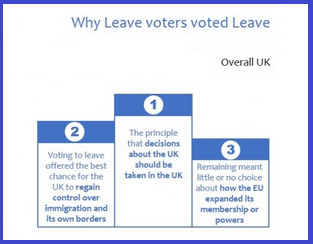
The definitive rebuttal, though, emerged from Lord Ashcroft’s polling which found the majority of Leave voters voted on ‘Sovereignty and Democracy – the principle that decisions about the UK should be taken in the UK’. Even the second choice – ‘for the UK to regain control over immigration and its own borders’ – is about control, not prohibition: the usual Remainer accusation of “to stop all immigration” is therefore exposed as just anti-Leaver prejudice.

‘Leave voters were predominantly un-educated, ‘low-information’ people, who didn’t know what they were voting for’

Even discounting its inherent repugnance – when did a vote’s democratic validity under universal adult franchise suddenly become conditional on educational or knowledge qualifications defined post-facto by the losing side? – this meme’s central tenet, that mere possession of any old university degree makes your opinions and vote valid, but those of your not similarly-endowed fellow-voters invalid, is risibly false. Just to give one example, 55% of graduates, apparently, believe that both poverty and income inequality are increasing, when in fact the exact opposite is true.

‘The Leave vote caused a spike in hate crime’

This imprecation was made possible at all only by the balefully-imprecise definition of ‘hate-crime’, an ‘offence’ requiring neither complaint, victim, evidence nor corroboration to be accepted and recorded. Rightly described by Brendan O’Neill as ‘the most cynical, politically motivated crime panic in memory’, and ‘the invention of a crime epidemic to the cynical, political end of defaming Brexit as hateful and dangerous’, it has now largely subsided, leaving its levellers looking especially malevolent, or foolish, or both.

‘The Leave vote was secured by Russian influence and bots on Twitter’

With this allegation, Remainer desperation descended into fantasy. It was rapidly demolished, not least by academic Matthew Goodwin’s comprehensive dismissal of the so-called ‘evidence’ for it. In summary, approximately 86 per cent of the allegedly Brexit-“influential” tweets, which themselves represented only 15 per cent the total analysed, were actually sent after the polls had closed, and fewer than 1 per cent of voters polled cited Twitter as their preferred information source.

‘They didn’t vote to be poorer, or to leave the Single market and Customs Union’

Actually, they did. The repeated insistence by Cameron and Osborne alone that a Leave vote involved quitting both the EU’s principal economic institutions meant that no-one could be unaware of those consequences of their Leave vote. The prominence given it, plus the findings of the Ashcroft poll, suggests Leave voters recognised there were economic risks in leaving, yet were still prepared to risk a temporary financial downside for themselves to ensure their children’s future in an independent,`self-governing democracy.

Varied as all the above reactions are, they do have one common factor which appears both unprecedented in recent history, and very disturbing. Albeit in different ways, they all seek, not merely to condemn or oppose the Leave vote, but specifically to de-legitimise it, as justification for ignoring, negating or overturning it. As historian Robert Tombs puts it: ‘Never in modern times has there been such an overt and even contemptuous attempt to deny the legitimacy of a popular vote.’

Previous unexpected election outcomes produced shock, as in 1992, or noisy street demonstrations by the losers, as in 2015: but I cannot recall a previous vote in modern UK political history after which the losers have embarked on a blatant campaign to invalidate the votes of the winners, and to such an extent as to challenge even the legitimacy of democracy itself.

Why? Well, those of what we can accurately label the Ultra-Remainer mindset, even carried over into regular general elections, have not been on the losing side in any election for approximately 25 years. After 1992, they got, in succession, Blair, Brown and Cameron: in effect a continuum of Blairite government reflecting their politics, right up until its abrupt repudiation by 17.4 million voters on 23rd June 2016.

For them, losing is a new experience, one which they don’t like, and can’t handle. And the underlying reason is that, as they’ve now shown and continue to show, they actually hold a low opinion of the masses, and, by extension, of mass democracy, especially when it delivers an outcome unwelcome to them.

It’s clear that, for so many, the overriding attraction of EU membership is because it enables as much politics as possible to be made immune from the need for popular consent – to be put beyond the reach of the capricious domestic democratic process and the electorate whose views they not only by-and-large do not share, but for whom they actively feel contempt.

In a way, we should thank them. Their Referendum-denying, insult-hurling, anti-Brexit demonisation and attempted de-legitimisation of 17.4 million people’s votes has revealed starkly the sheer extent to which this country’s elites tolerate mass democracy only for as long as it produces the results they want. When it doesn’t, they’re viscerally eager either to disparage it or suspend it.

And they are still disproportionately both influential and vocal, in politics, government, the media, academia, and big-business. As we go into 2018, Brexit is still not certain, despite being the largest vote for any single policy in British political history. It’s starting to feel as if democracy itself is dangling by a very tenuous thread.

Thoroughly agree with this article? Vehemently disagree with it?

Scroll down to leave a comment

And follow A Libertarian Rebel on Twitter

We Must Re-Create The Brexit Movement

The Brexit Movement, prematurely wound down after the EU Referendum, needs re-creating to continue making the case for it, so as to keep pressure on the Government to deliver it.

Note: this is the long (and updated) version of an article first published at The Conservative Woman on Friday 17th November 2017.

Like many ConWom readers, I suspect, I spent the early dawn hours of Friday 24 June 2016 in a state of ecstatic semi-euphoria that the British people had ignored the pro-EU hectoring of the massed ranks of the New Establishment and their globalist backers, and had voted to leave the EU. It didn’t last very long.

Such was the furious reaction of the Remainer-Elites and their compliant media courtiers to their unexpected defeat that, before the day was out, I’d become convinced that while we had won the Referendum battle, we certainly hadn’t yet won the war, and that the celebrations of some, on the assumption that all that was needed to achieve Brexit had been done, were hubristic and perilously premature.

I even tweeted as much, as this selection from my Twitter timeline between early that Friday morning and late that evening shows (with apologies for the profanities…)

But sadly, this is precisely what happened after the Referendum. The Vote Leave campaign wound down: its principal Conservative politicians dived headlong into the internecine strife within their party from which its Remainers emerged predominant, while its successful CEO, Matthew Elliott, decamped to the Legatum Institute.

On the Leave-EU side of the Brexit movement, an insufferably bombastic and complacent Nigel Farage resigned as leader of UKIP to forge a new career in the media as the man who won the Brexit that hasn’t occurred yet. UKIP meanwhile has collapsed into virtual irrelevance after the two most credible replacements were seen off by the residual Farageistes, is now led by a non-entity, and is near-invisible. 

A couple of pro-Brexit campaign groups persist, but active mainly on social-media only. One of them, connected to the Leave-EU movement, has a website where it’s comparatively rare that the space taken up by the text of a blogpost actually exceeds the space taken up by images accompanying it. 

In effect, the loose coalition that delivered that historic vote by 17.4 million people to retrieve their sovereign nation-state popular democracy from supranational unaccountable-elite technocracy, and the communications infrastructure that made it possible, has all but dissolved.

It’s this article’s contention that this has been a catastrophic error: that developments,  not only since the Referendum generally but specificially more recently, are placing Brexit in ever-greater jeopardy: and that the Brexit movement needs to be re-constituted and go back on to a war footing, to fight for what the British people voted for, and even contest if need be the second referendum which I personally believe to be the Unreconciled Remainers’ end-objective.

Although the Leave coalition subsided, the Remain campaign never ceased. Unlike Vote Leave and Leave-EU, the pro-Remain Open Britain campaign has never wound down, and continues to make the anti-Brexit case.

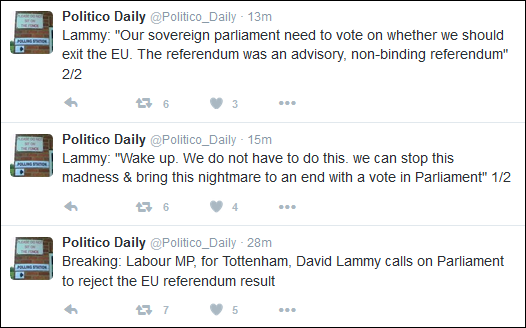
Readers will recall the ugly post-Referendum orgy of anger and hatred directed by ‘liberal’ Remainers and their cheerleaders at Leave voters, the constant attempts by the academic and judicial elite to delegitimise the Referendum result, and the sometimes near-hysterical anti-democratic polemic of, to name only two egregious but typical examples, the philosopher A C Grayling and Labour MP David Lammy, so I need not reiterate them.

It intensified once again during the Gina Miller litigation designed to facilitate a majority pro-Remain House of Commons vetoing the Government’s Article 50 notification. But it lessened somewhat after Parliament voted by 494 votes to 122 to authorise the triggering of Article 50 by 31st March, and matters reached a sort of uneasy equilibrium.

But then came May’s ill-advised, mismanaged General Election. When she and the Conservatives were returned drastically weakened, the Continuity-Remain movement was re-invigorated and its political, civil service, media, academic and judicial channels have visibly stepped up their campaigning by several levels of magnitude. They’re making the running: they look increasingly confident that Brexit really can be stopped and the Referendum reversed, and a majority-Remain Government seems at best half-hearted in response.

Now the fight is intensifying even more with the tortuous passage through Parliament of the EU Withdrawal Bill. The parties of the pro-EU Left have made clear their intention to conduct a guerilla war against it, voting against even the clause setting out its overall purpose, aided by 15 or more Unreconciled-Remainer rebels on the Tory back benches, some with considerably less honourable motivations than others.

In passing, let’s dismiss the disingenuous platitudes so many of these utter about wishing to do no more than “improve” the Bill. In many cases, it’s self-serving cant. They want to keep us in the Single Market and Customs Union, and under the jurisdiction of the European Court of Justice,  not out of genuine concern for our post-Brexit trade prospects or the position of UK-resident EU nationals, but to engineer either a Brexit-in-name-only, or one which is so close to EU membership that re-joining would seem like a logical step.

Many remain unreconstructed supporters of the EU Project and Britain’s submersion in it. It’s long been clear that, for them, the prime attraction of EU membership lies in is its very anti-democracy: it enables them to put as much policy-making and as many decisions as possible beyond the reach of what they see as the capricious domestic democratic process and an electorate whose views they by-and-large do not share and for whom they harbour a visceral contempt.

If some of the amendments being proposed already seem very technical and legalistic, be prepared: worse is yet to come. In this very detailed long-read published on 12th November at Brexit Central, Professor David Campbell of Lancaster University sets out how the legislative process of Brexit could become almost impenetrably bogged down in the morass of a quasi-constitutional conflict over the supremacy of the Judiciary, or Parliament.

It doesn’t look impossible that it could establish the supremacy of the Judiciary over that of Parliament. Just think what that would do to the prospects of Brexit happening at all. That partly explains, in my view why such an ardent anti-Brexiteer as Labour’s Keir Starmer is so keen to maintain the jurisdiction in post-Brexit Britain of the European Court of Justice.

Professor Campbell concludes that we may need an Assertion Of Parliamentary Sovereignty Act to make Brexit tamper-proof from judicial-activist usurpation of the powers of Parliament to implement the express instruction of the electorate.

If the EU Withdrawal Bill is set to have a rocky passage through Parliament, imagine how difficult it would be for a minority Government to push legislation, whose effect would be to prevent the pro-Remain Judiciary from blocking Brexit on constitutional grounds, through a marginally pro-Remain Commons and a majority pro-Remain despite unelected Lords.

Another potential complication emerged on 14th November, with a European Court of Justice ruling that EU citizens who become British do not lose the right to bring a non-EU spouse from a non-EU country to live with them in the UK. The continuing post-Brexit application of ECJ human-rights rulings is figuring strongly in debate on the EU Withdrawal Bill, so this is a further area where continued pro-Brexit advocacy is lacking.

May herself arguably opened a new front in the anti-Brexit campaign with her speech to the Lord Mayor’s Banquet on Monday 13th November. Yes, it is possible to interpret her remarks on Russian interference in Western elections as a desperate ploy to divert attention from her domestic travails: but it’s also possible to interpret it as a fresh attempt to de-legitimise by association the entire Brexit vote, especially the evening before the EU Withdrawal Bill was re-introduced into Parliament, with every prospect of the Unreconciled Remainers on her own back benches determined to vote it down on any pretext?

The signs are ominous. The EU is refusing to move on to talks about a post-Brexit trade relationship unless its exorbitant financial demands are agreed. Each UK concession on these is banked, not reciprocated, and met with merely a request for a larger sum. On 20th November, it even had the temerity to demand in effect an EU veto on UK domestic tax, environmental and business-regulatory policy after Britain has left the EU.    

Its intransigence is being encouraged by a UK media overwhelmingly hostile to Brexit and resolved to paint it in the worst possible light. Sir Humphrey, for whom Britain’s EU membership has been axiomatic for 40 years and thinks Brexit a monumental folly of crude populism-appeasement, is dragging his feet.

The Government is being forced by its weakness and wafer-thin, DUP-dependent, majority into unwanted concessions. It’s conceding votes in Parliament on aspects of Brexit which, with the clear instruction delivered by the Referendum result, should no longer be in play at all. In these circumstances, that it might, to win a crucial vote, concede a second Referendum, either on the terms of our exit, or even on the decision itself to leave, can’t in my view be ruled out.

If that comes about, the Remainers will have achieved what has been their prime objective – and also the EU’s, for it has an unsavoury record of ignoring plebiscites with unwelcome outcomes and requiring electorates to vote again and again until they come up with the “right” answer.

And then what? Unlike Vote Leave and Leave-EU, the pro-Remain Open Britain campaign has never wound down, and continues to make the anti-Brexit case. Continuity-Remain could gear-up for a second EU Referendum comparatively quickly. The money would come flooding in.

It’s victory, though, would be far from a foregone conclusion. Since June 2016, the electorate has seen the EU moving faster towards ever-greater integration and centralisation in ways the Remainers denied were even being contemplated. It’s seen how so many of the scaremongering predictions of Project Fear failed to materialise. A second Referendum could be won with another Leave vote.

But not without a campaign organisation. Even without a second Referendum, Brexit feels in enough danger to justify the reconstitution of the Leave coalition, if only to continue to make the case it made so effectively in the first half of 2016, and hold the Government’s feet to the fire. The Brexit movement needs to be re-created.

Thoroughly agree with this article? Vehemently disagree with it?

Scroll down to leave a comment

And follow A Libertarian Rebel on Twitter

Same BBC Bias, Different BBC Source

Changes to the BBC Question Time format mooted by a former BBC honcho would do little to alleviate the programme’s bias, merely expand its sources 

Note: this is a longer version of an article first published at The Conservative Woman on 3rd November 2017.

Complaints about the sometimes blatant left-‘liberal’, pro-EU, pro-Green bias of BBC Question Time, in the selection of questions, panels and audiences, are perennial. However, they have recently been given significant backing, at least as far as allegations of the programme’s institutional anti-Brexit bias is concerned, by some old-fashioned investigative journalism.

In summary, since the  EU Referendum, Remainer panellists have outnumbered Leaver panellists by nearly 2 to 1, and no fewer than 86% of the panels have been Remainer-dominated.

So it was intriguing to come across this article in The New Statesman by former BBC grandee Roger Mosey, on how the programme format might be changed by its new editor.

In fairness, Mosey was one of the very rare voices at senior level in the BBC, not only to detect its innate metropolitan-‘liberal’ bias but also to go public with admission and criticism of it. It won him plaudits from journalists with no reason to sanitise it.

But his New Statesman article alludes to the bias issue only very obliquely, and the changes it suggests would, in effect, not so much alleviate, much less eliminate, the bias as invite it from a different source, under the guise of improving the quality of the programme’s output.

Briefly, he suggests panels with fewer politicians, largely ignoring those from outside the two main parties, and spending more time on “major topics”: but, significantly, he also favours inviting more experts, academics and scientists “who know their subject inside out”, to explain things more clearly.

There are some glaring flaws with this. Presumably, however, the current BBC – apparently so out of touch with the vast majority of the country that doesn’t inhabit the politico-media bubbles of Westminster, North and West London that it was utterly shocked by the EU Referendum result – would think we non-metropolitan proles would be too dim to notice them.

First, as we’ve had demonstrated to us all too vividly over the past two years especially, but also before that, the so-called “experts” are frequently – and sometimes spectacularly – wrong.

In the early 2000s, the CBI experts harangued us that for the UK not to join the Euro would be a disaster. They were wrong: the true disaster has been near 40% youth unemployment in the Southern Europe’s economies. In 2009, economics expert David Blanchflower predicted 5 million unemployed if UK public spending was cut. He was wrong too

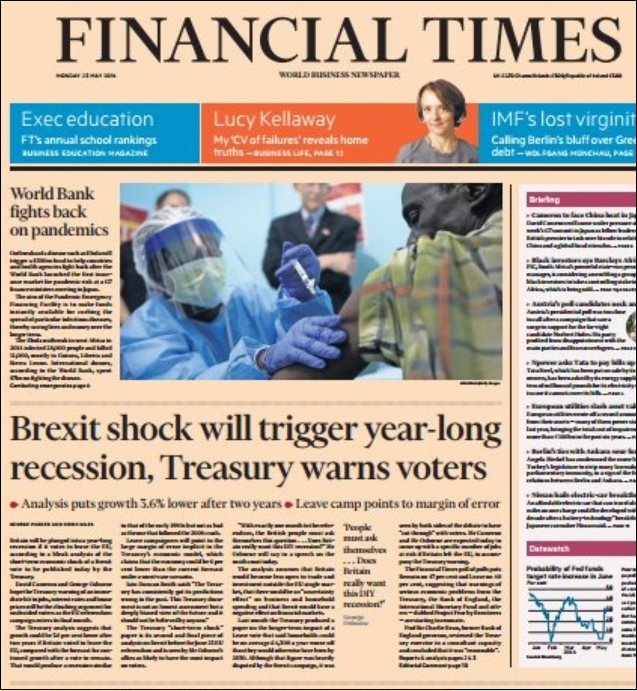
In the EU Referendum, the Treasury experts, echoed by their tame and equally pro-Remain media courtiers, warned us a year-long recession would follow a Leave vote. They were wrong.

Central banking expert and Bank of England Governor Mark Carney assured us of an “immediate and profound economic shock” which would follow even a vote to Leave. One didn’t.

The polling experts told us a defeat for Remain was unthinkable. How did that work out?

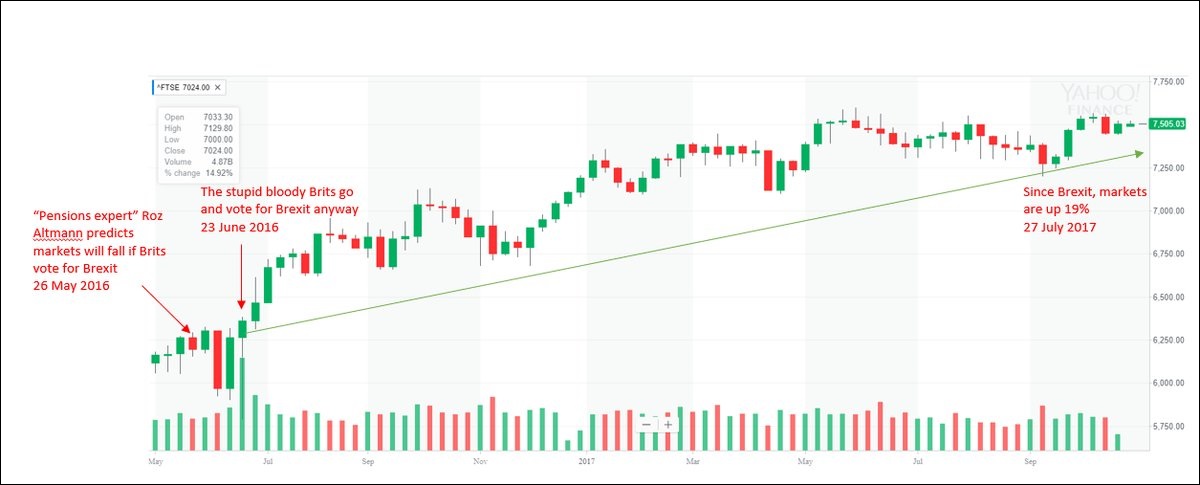
“Pensions expert” Baroness Ros Altmann (still, incidentally, using her peerage in the unelected House of Lords to try and derail Brexit), predicted a fall in equity markets after a Leave vote. They rose instead.

Next, apart from their prediction errors, the experts, academics and scientists are just as prone to biases in their judgements as politicians. I wrote on this site only a month ago of the massive Left-‘Liberal’-Green bias among UK Academia, and particularly of its pro-EU bias.

Couple that with the BBC’s inherent left-‘liberal’ pro-EU bias, and it isn’t hard to guess the direction that most experts, academics and scientists invited on to a new-format Question Time by the BBC would probably be coming from.

Can you imagine it would risk having Economists For Free Trade’s Professor Patrick Minford on a panel, countering a Remainer politician by explaining how post-Brexit Britain, outside both the EU Single Market and Customs Union, would actually thrive under free trade?

Or the Global Warming Policy Foundation’s Dr Benny Peiser, highlighting the physical-science flaws in the Green climate-change consensus, showing there’s no established causal link between atmospheric CO2 and global temperature, and describing how the temperature records data used to back the CO2→AGW theory is “adjusted”?

There are other objections, too. It would be interesting to analyse all the questions asked on Question Time over, say, the last two years, so as to place them in one or other of these two categories: my guess would be that between half and two-thirds were questions whose answer had to be based on a value or moral judgment, in contrast to factual data or empirical evidence. In other words, purely political.

To illustrate this, take the issue of votes for prisoners, now back in the spotlight as a result of the May Government’s reported preparedness to relax the restrictions for some types of prison inmates.

You could be presented with all kinds of evidence from social scientist or an academic expert in the criminal policy field, in the form of data on, for example, the success or failure of rehabilitation strategies, or re-offending rates, or practice in other countries, and they might influence your opinion to a greater or lesser degree.

But in the end, your view on the issue surely comes down to the value judgment of whether or not you believe that the judicial penalty for an offence serious enough to warrant a prison sentence should also include withdrawal of a prisoner’s civic right to the franchise for the duration of the sentence. As suggested above, this is purely political.

Which leads on to two other factors. Although there’s been a constant trend in recent decades of elected politicians outsourcing their legislative and even administrative decision-making powers to unaccountable outside bodies – whether externally such as to the EU and UN or domestically to tribunals, quangos and NGOs – actual policymaking still largely rests with them, certainly more than it does with academics and “experts”.

So shouldn’t it therefore be primarily the politicians’ views that we need to ascertain, certainly on what, for all its faults, is the most-watched political programme? We have precious few means and opportunites to even semi-hold them to account, isolated from their party scripts and special advisers, as it is: that shouldn’t be diluted further by replacing them with substitutes who are immune from democratic verdict.

Additionally, if the programme is always by its nature destined to be more political than empirical, the suggestion of excluding minor parties looks almost designed to entrench two-party hegemony. Insurgent political movements challenging the established parties are at a disadvantage anyway under our First Past The Post system: restricting their access to prime-time political TV just looks anti-democratic.

If the BBC wants to change the composition of Question Time panels, it could do worse than dropping the vacuous celebrities whose bien-pensant virtue-signalling might send a frisson of excitement through the BBC’s metropolitan culture-warriors, but who contribute little else.

Padding Question Time panels with experts and academics, though, is the wrong answer, and on several levels: not least that it substitutes bias from one source with bias from another, less easily discernable, one.

Thoroughly agree with this article? Vehemently disagree with it?

Scroll down to leave a comment

And follow A Libertarian Rebel on Twitter

The Paddington Bear of UK Politics

Pity a Labour politician who, like Paddington, has been abandoned, unwanted, on the station platform as the Socialism Train departs 

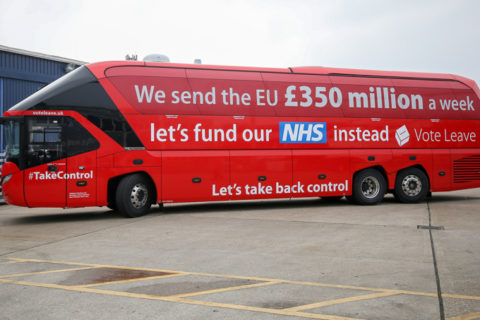
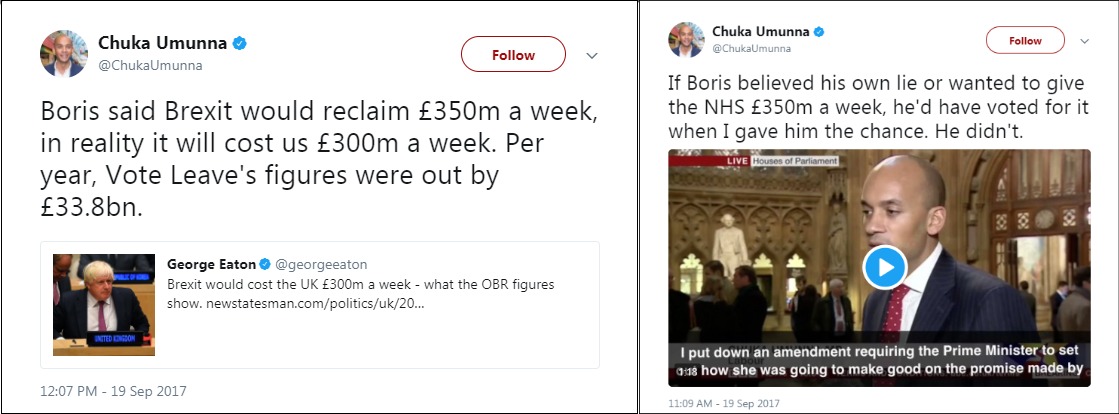
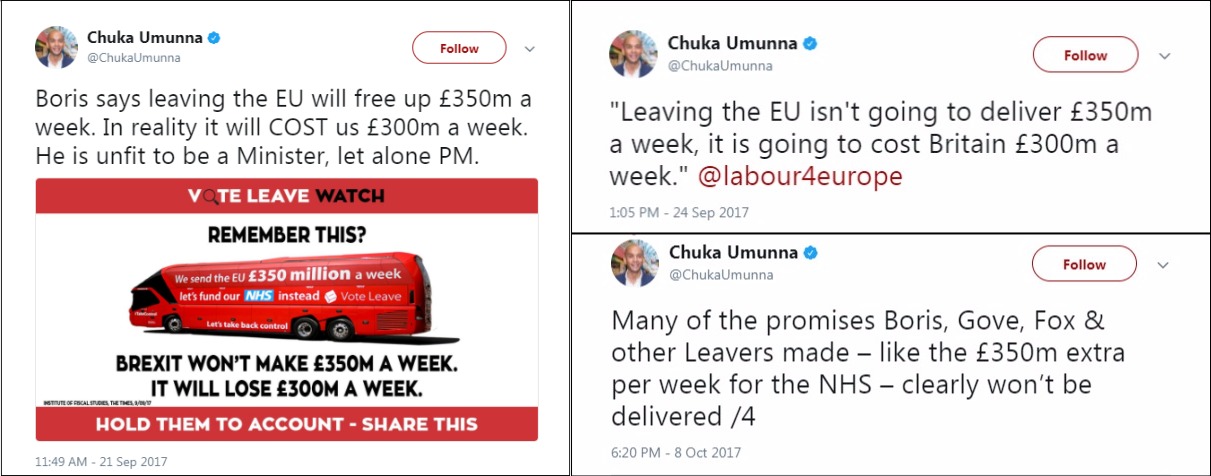
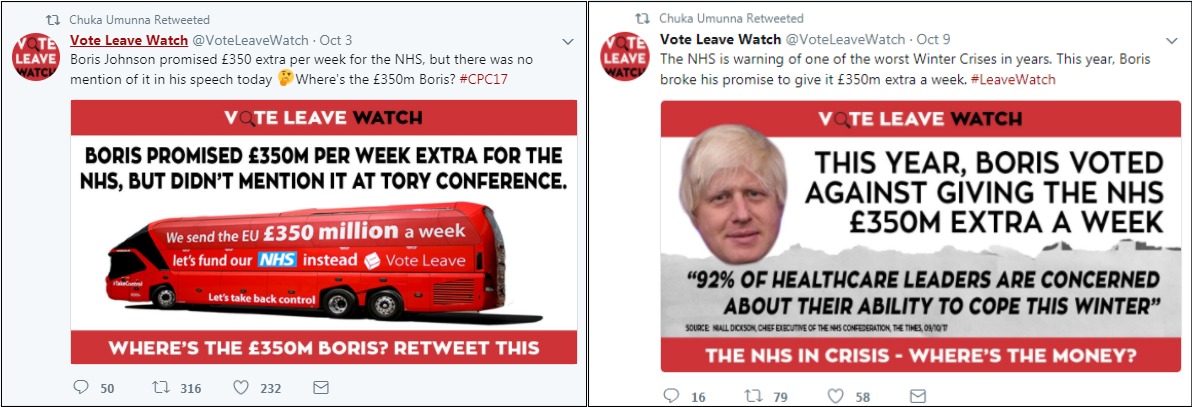
Blairite-Labour Champagne-Socialist smoothie Chuka Umunna appears to have a bit of an obsession. He seems to have convinced himself that the Vote Leave campaign’s battle-bus during the 2016 EU Referendum, with its “Take Back Control” message, was a binding promise to spend an additional £350 million on the NHS in the event of a Leave vote, and he can’t let it go.

Boris Johnson and the Vote Leave bus

It’s a meme he returns to time and time again on his own Twitter feed, like a dog worrying a bone long since chewed beyond nutrition. A quick look through his recent timeline shows tweets about it on 19th September (twice), 20th September (twice)….

…then again on 21st September, 24th September, and 8th October…..   

…or in the intervening periods, and just for a change, via re-tweets on 3rd October and 9th October off Vote Leave Watch, which is very much a Chuka creation.

In vain have people tried to explain to Chuka (and I even tried myself once or twice on Twitter) that:

  1. it clearly wasn’t remotely a promise, but a campaigning proposition;
  2. it could hardly have been a promise when made by what was a cross-party campaign group in a binary-question referendum;
  3. the only organisation which was in a position to make any such kind of “promise” (but didn’t) was the Government, which was, er, pro-Remain, 

but all to no avail.

There’s a plausible possible explanation for this. In the era of Hard-Left Corbynite-Labour, Chuka has an acute irrelevance problem.

Once touted – not least by himself – as the Blairite Leader-in-Waiting, despite a mysterious and flattering “UK’s Barack Obama” update to his Wikipedia page from a computer in his own law firm’s office, an, ahem, unfortunate slip-up about EU geography, a £20,000 donation from a gambling tycoon despite campaigning against betting shops in his own constituency, and superciliously describing London as “full of trash” and lacking suitably-exclusive hangouts for cool dudes like himself, until Labour’s 2015 General Election defeat, Chuka was considered a serious future contender for the leadership. 

The advent of Corbyn changed all that. Remember, Chuka stood for the leadership, and was even at one time the bookies’ favourite: but then suddenly withdrew from the contest just 3 days later, in circumstances which have never been satisfactorily fully explained, citing “the level of pressure and scrutiny that comes with being a candidate”.
On Corbyn’s election, he was one of those who declined to serve in Corbyn’s Shadow Cabinet, and was replaced as Shadow Business Secretary on Corbyn’s first appointments.

Since then, the growth of a new aggressively left-wing membership, plus the consolidation of hard-Left Momentum’s control of the Party, have left him, politically, in the wilderness. His brand of metropolitan-centrist left-liberal Blairism is totally out of tune, and out of favour, in a party turning to full-blown socialism.

Chuka Umunna is the Paddington Bear of UK politics. As the hard-Left Labour train departs the station on its Journey Of Destiny to True-Socialist Utopia, he’s been left behind on the station platform, clutching his suitcase (probably a Gucci one – champagne-socialists like Chuka don’t settle for anything less) with a label stuck on it.

Only in his case, and unlike Paddington’s, this label says “NOT WANTED ON VOYAGE”.


Thoroughly agree with this article? Vehemently disagree with it?

Scroll down to leave a comment

And follow A Libertarian Rebel on Twitter

The Academics and Socialism

Indoctrination of the university student and graduate population with the predominantly left-wing political attitudes prevailing in higher education has a growing effect on British elections

Note: this is the longer version of an article first published at The Conservative Woman on 2nd October 2017.

Why”, asked Laura Perrins, Co-Editor of The Conservative Woman on 22 August, “should you risk sending your children to university for a full three years of left-wing propaganda?

For the parents of any young adult raised in a household even moderately inclined towards social conservatism, EU-withdrawal, a smaller state, lower taxes and free-market economics, this is an increasingly pertinent, even worrying, question.

Because, as Laura pointed out, after three years at an educational establishment which institutionally not merely disagrees with your views, but positively hates them and thinks they (and consequently you) are evil, your children will more than likely emerge from it thoroughly marinaded in left-wing thinking (and hating you in their turn).

The young’s voting patterns in recent election results certainly seem to bear this out. The YouGov analysis of voting by age group in the 2017 General Election shows that, in all three age-groups spanning the ages from 18 to 29, the Labour vote was over 60%.

Higher Education and Academe as a bastion of left-wing indoctrination is an impression that’s widely held. But to what extent is it true?

Fortunately, we have some empirical data from within the last two years. The chart below shows the results of a poll taken shortly before the 2015 General Election, asking for the voting intentions of UK University academics.

The responses leave little room for doubt. In no discipline did the intention to vote Labour drop below 40%, while you have to go as low as 20% in every academic discipline before encountering a voting intention other than Labour or Green.

Overall, the academics’ voting intention went 83% to the four main parties of the Left (Labour, LibDems, SNP and Green), while in the General Election proper, their vote share was only 47%. In other words, university-tenured academics inclined towards parties of the Left at a frequency nearly double that of the electorate as a whole.

A similar poll of UK academics’ voting intentions was conducted in the run-up to the 2016 EU Referendum, by The Times Higher Education Supplement. Here, the results were even starker.

In no discipline was the intention to vote Remain below 80%, while in only one discipline, Engineering and Technology, did the intention to vote Leave break through the 15% threshold. As everyone now knows, the result was 52%-48% for Leave. Once again the academics leaned Remain-wards at a rate more than 1½ times that of the voting population.

So, on the face of it at least, the perception of the University experience as being an academic indoctrination process in Europhilia and Leftism has some evidential support. If you have the impression that your child has emerged from University brainwashed into an ardently-Europhile Leftist who hates you and everything you stand for, you’re probably right.

But what seems explored much more rarely is: why this should be so? Why should the supposedly academic and intellectual elite overwhelmingly incline towards leftist and statist parties and policies that concentrate decision-making power in bureaucracy rather than democracy, and reject those which favour liberal-individualism and free-market competition? And do so, moreover, at a incidence nearly double that found in the adult population as a whole?

Well, the first thing to remember is that this phenomenon isn’t new. Hayek analysed and excoriated it decades ago in his “The Intellectuals and Socialism”, famously referring to “the professional second-hand dealers in ideas”.

Politically, the Academic and Intellectual Elite has an aversion to capitalism and free-market competition because, being a system based on voluntary exchange reflecting consumer preferences, it doesn’t confer on them either the superior societal status or the monetary rewards to which they consider themselves entitled because of their (assumed) far superior intellect.

Arguably, Robert Nozick put it even better in his 1998 essay Why Do Intellectuals Oppose Capitalism?

“Intellectuals feel they are the most valuable people, the ones with the highest merit, and that society should reward people in accordance with their value and merit.”

This is especially marked when they compare themselves with people successful in what, to them, is the rather grubby business of designing, producing and marketing products that people will voluntarily part with their hard-earned, post-tax cash to own. Think, for example, how much more popular in the public mind James Dyson is than A C Grayling. The old disdain for “trade” has crossed over from the Aristocratic Landed Elite to the Intellectual Academic Elite.

Consequently, the academics and intellectuals incline, politically, away from free-markets democracy towards the more collectivist politics of markets-averse, leftist-statist bureaucracy. Not only does it value them more than competitive free-market capitalism does: but it can also use the coercive power of the State, manifested via the taxation system, to enforce on wider society at least a financial recognition of their assumed superior intellect and desired superior status.

This also explains their near-homogeneous support for remaining in the European Union. Yes, academics and intellectuals do favour the EU as an additional source of funding. But because the EU is an essentially socialistic, authoritarian, top-down bureaucracy, they also view it as a means to impose on the UK the kind of Leftist policies which they themselves are attracted to, and without the necessity and inconvenience of obtaining popular democratic consent. Remember, as we saw in the aftermath of the EU Referendum, their opinion of the demos borders on contempt.

This leads to the next question. For how long do the academics’ and intellectuals’ pro-Left, pro-EU biases continue to influence their recipients’ voting behaviours after inculcation?

Conventional psephology held that most had grown out of their youthful flirtation with socialism by about 30, by which time advancing careers, along with marriage, family and mortgage responsibilities, had altered their perspective. Indeed, as late as April this year, a YouGov poll suggested that the Left-Right crossover point comes roughly at age 34.

However, the results of the 2017 General Election have forced a re-evaluation of that hypothesis. It seems that the Labour/Left voting tendency now persists for at least a decade beyond that. As the Ipsos MORI chart below shows, the phenomenon now extends well into the 40s, and that it’s only after 45 that a Conservative-leaning tendency starts to prevail.  
This seems to bear out what Iain Martin has recently written on “the widespread assumption among those aged below 45 that Tories or pro-market people are an inherently bad bunch with motives that are inherently evil”.

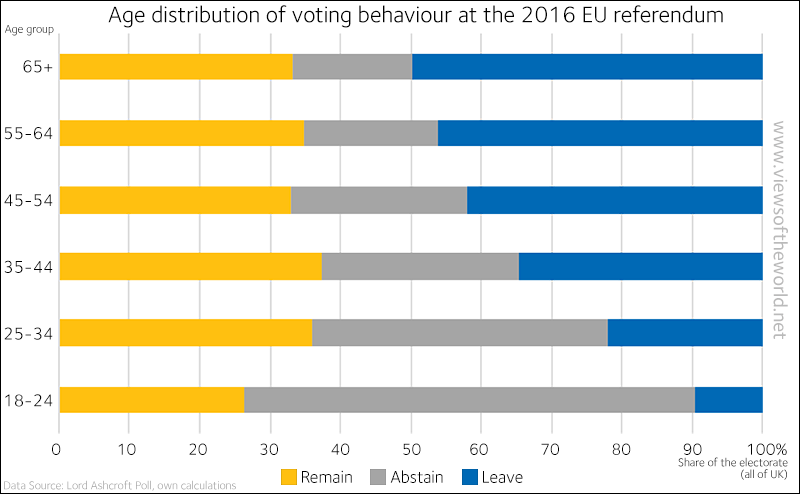
Perhaps, though, it could have been better predicted. Because the age distribution of voting patterns in the 2016 EU Referendum shows a similar pattern. Once again, it’s only at the 45-54 age group does Leave start to prevail over Remain.

Neither does this look to be a temporary aberration, attributable to the more fractious political atmosphere before, during and since the EU Referendum. The pattern seems to be persisting, and hardening. The Remain=Labour and Leave=Conservative assumptions are by definition somewhat crude proxies, but it does appear that an overall shift in age-related voting patterns may be taking root for the short-to-medium term at least.

As far as countering it is concerned, the first thing to remember is that this may not, after all, be so historically unprecedented, and so in the end be so permanent, as excitable media comment suggests.
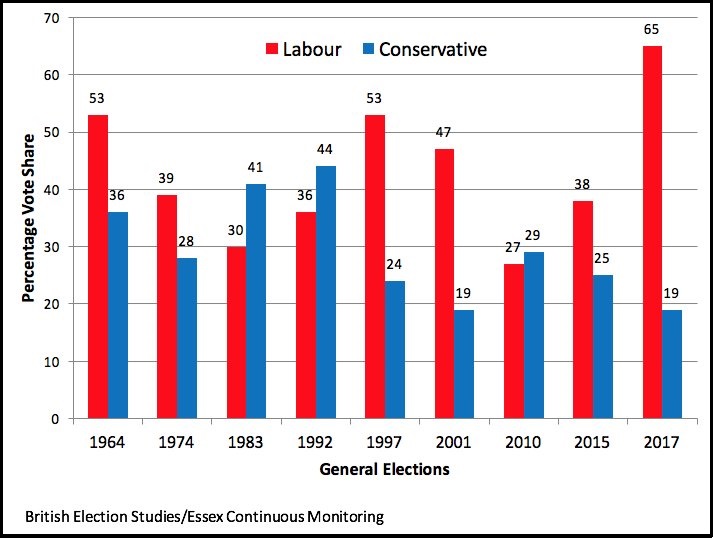
Albeit not of the same magnitude, there have been similar trends observed before, as the chart below of under-30s percentage voting patterns in General Elections since 1964 shows. The under-30s Labour vote almost halved between 1964 and 1983, and again between 1997 and 2010.       

Under 30s support Lab & Con since 1964

However, that might be where the optimism ends, at least for the time being.

In 1983, the Conservative Party, though faced with a Labour opposition similar to Corbyn’s in its socialist programme, was itself ideologically committed to a smaller state, free markets and capitalism, and unafraid to take on its opponents publicly in the battle of ideas. In 2010, it benefited from a widespread disillusionment with the dysfunctional Brown government after 13 years of increasingly tawdry New Labour.

Today’s circumstances, however, are nowhere near so propitious. First, no-one under 50 has much, if any, memory of what life in Britain was like under the last real even semi-socialist government: and given the prevalence of left-wing attitudes in higher education, they may well not have been taught an accurate history of it. To under 50s who lean Left-wards, therefore, Corbynism, however flawed, can seem fresh and exciting. 

Far worse, though, is that, as has been so starkly shown this past week, the Conservative Party is mired in intellectual atrophy, apparently completely incapable of unashamedly making the case against state-socialism and for a lower-taxed, less-regulated and more entrepreneurial economy, capitalism and free markets. So ideologically-sapped, and so devoid of confidence, does it appear, that it is reduced to offering, almost apologetically, diluted versions of previous flagship Labour policies.

Unless the Conservative Party is jolted from its torpor by the prospect of impending ejection from office and replacement by the most disastrously socialist government since the Labour Party’s formation, then the left-wing ideological indoctrination of the young via higher education – and Laura was surely right in her original 22nd August article to suggest that one of Blair’s motives in greatly expanding university access was to expose more to it – will yield results, with dire consequences, not least for those welcoming it.

Thoroughly agree with this article? Vehemently disagree with it?

Scroll down to leave a comment

Follow A Libertarian Rebel on Twitter

The Tories Don’t Deserve To Win – Labour Deserves To Lose

Neither the Tories, with their statist, triangulating Manifesto, nor Labour, with its destructive socialist vision, deserve victory in this General Election

In a few hours, this General Election will be all over bar the results and their consequences.  Yet the usual anticipation of Election Night is muted by an almost palpable sense of relief at the approaching end of a campaign offering such a lacklustre, uninspiring choice.

For Theresa May and the Tories  it was supposed to be the Brexit Election: where, wanting both a bigger Parliamentary majority and her own popular mandate to implement it, she would offer a vision of a Britain mitigating the risks but also exploiting the advantages from recovering political and economic sovereignty.

Both, paradoxically, dictate some loosening of State and regulatory shackles on the economy, a facilitation of innovation and entrepreneurship: especially as the economy inevitably goes through a period of uncertainty and flux as powers are repatriated and trading relationships either reset or forged from new. But that isn’t what we’ve got.

The first intimations were reasonably heartening, But then came the Manifesto.

2017 Manifesto on Core Beliefs

Disparaging talk of “untrammeled free markets”, belief in “the good that government can do”, and abhorrence of “inequality”. The context leaves little room for doubt that the offer to voters is one of an interventionist State, concerned not so much with opportunities, but with outcomes.  

Further on, we are promised an Industrial Policy, a National Productivity Investment Fund, worker representation on boards, and a commitment to continue spending 0.7% of GDP on virtue-signalling foreign aid.

Finally, we get to this Greenery-gullible horror. Yet it accompanies a pledge to give British voters “the lowest energy costs in Europe”, notwithstanding that those two aims are mutually incompatible.

Worse still, it’s to be achieved, not by slashing Green taxes and encouraging more competition among energy providers via supply-side measures, but by capping prices: the same policy that, as recently as 2015, the Tories rightly damned as economically-illiterate when included in Labour’s election manifesto by Green-Left Red Ed Miliband.

So, in aggregate, a largely social-democratic policy programme, advocating a version of active-state Rhenish corporatism that would not look out of place in the manifesto of any milquetoast European Christian-Democratic party.

One can speculate endlessly on the reasons why. Possibly they lie in the fact that May is an instinctive paternalist (should that be “maternalist”, I wonder?) technocrat who’s unconvinced of, as Martin Durkin puts it, the potential of free markets to liberate and enrich.

Perhaps, because Labour has gone so far Left, she was persuaded that a Clinton-Blair style triangulation, with the Tories parking their tanks on “moderate” Labour’s lawn, would work electorally. Maybe she was afraid of frightening off the 2 or 3 million Labour voters who voted for Brexit and want to see it happen, and also the One-Nation tendency in her own party still looking for any excuse to derail Brexit. Who knows?

Then there’s been the campaign itself. May  – and it has been almost exclusively May, from battle-bus, through campaign literature, to media, and all points in between – has come across as by turns either robotically evasive, or uncomfortable and unconvincing when pressed on detail.

The forced U-turn on Social Care brought her campaigning deficiencies into sharp focus, but combine that with her natural somewhat leaden, flat-footed demeanour, plus a requirement to face an inquisitorial public & press far more often than she’s ever had to do before, and the result has been, not failure, but certainly sub-par performance.

Both she and her Party, have emerged from the campaign diminished, and not just in opinion-poll ratings, either. “Strong and Stable” has become something of a stick to beat her with. The whole thing has been rather insipid, disappointing, and very far from enthusing.

Consideration of Corbynite-Labour’s hard-Left manifesto need not take us as long. “Insipid” isn’t a description that could remotely be applied to it: “terrifying” or “economically-catastrophic” hardly begins to cover it, such is the red-in-tooth-and-claw programme that unrepentant socialist Jeremy Corbyn has in mind for the country.

The appalling consequences of a Corbyn-led Labour government have comprehensively dissected, with this by Andrew Lilico being merely one of the latest.   

As Lilico points out, fiscally and economically Labour would impose on Britain the highest level of taxation since World War II: the nationalisation, almost certainly without compensation, of the most important industries: a return to widespread (and excess) unionisation: deliberately punitive taxes on financial services designed specifically to deter private capital: and the effective collectivisation of private business property through imposing public interest duties inimical to both private property rights and commercial interest.

Moving from the general to the particular, just one example can suffice to show hard-Left Corbynism’s economic wrong-headedness. Despite favouring continued uncontrolled mass immigration, Labour proposes to deal with the housing shortage by a price-cap on new houses.  

All that that is likely to achieve is a shortage of new houses. If Labour really wanted to boost the supply of low-cost new houses, it would pledge to ease planning restrictions, not threaten to impose State price and even purchaser – priority to State employees, naturally – controls on builders. 

Non-economically, a Corbyn-led Labour government would see restrictions on the police, the reduction of the Army to a notional force only, and the withdrawal of Britain from its role in international security.

And this before even considering the implications of Corbyn’s 30+-year record of not only sympathy but vocal backing for all manner of anti-British, anti-Western groups, including those engaged in active terrorism, even on British soil.

And thus we come to the end of a singularly uninspiring campaign on what should have been the most important election in Britain for decades. The great issue for which it was ostensibly called to reinforce has been barely discussed beyond trite soundbites and banal generalities.

Hard-Left Labour certainly deserves to lose this election, and lose it heavily: but the Conservatives, on their manifesto and especially on their stuttering and lacklustre campaign, really don’t deserve to win it, either.

Thoroughly agree with this article? Vehemently disagree with it?

Scroll down to leave a comment

Follow A Libertarian Rebel on Twitter

Delicious Save this on Delicious