Tag: Democratic-Accountability

Just Very Auspicious Coincidences? Or Something More?

Note: Amended, longer and updated version of the article originally published at The Conservative Woman on Saturday 12th January 2019

Both the Cock-Up and the Coincidence theories of history – especially where the history, even the very recent one, of politics is concerned – are usually more persuasive than the Conspiracy theory of it. But you’d surely have to be very phlegmatic about it indeed not to wonder if the astonishing convenience, for the Remainer Establishment-Elite’s anti-Brexit cause, of this week’s events in and around Parliament can be put down entirely to coincidence.

First, the largely synthetic outrage at last Monday, 7th January’s, “far-right Brexiteer attack” on Anna Soubry. Now, she’s on record, while being interviewed by Sky News’ Kay Burley on an earlier occasion, as calling even mildly protesting Brexiteers outside Parliament “racists and fascists”. . . 

https://www.youtube.com/watch?time_continue=2&v=zrLekZuMK1k

. . .but that, of course, was forgotten by Britain’s overwhelmingly anti-Brexit media in its orgy of confected indignation.

There were some very odd aspects about this “attack”. The perpetrators were in fact a minuscule bunch of merely obnoxious rather than menacing name-callers, naturally reviled by Remainers, but also disavowed by many Leavers as embarrassing to the overall Brexit cause: and from the videos I’ve watched, there’s precious little, if any, evidence to support in any way whatsoever Soubry’s implied allegations that she was physically assaulted, or even that she was impeded.

Yet if the demonstrators’’ action was spontaneous, as they claimed, isn’t it a quite remarkable coincidence that both EU shill and pro-Remain social-media darling Femi Olewole and hard-Left street-agitator cum occasional journalist Owen Jones just happened to be on hand to witness and report the proceedings?

Just who – or what – was the man in the black jacket appearing to take quite a prominent role, but also captured on smartphone video filming speakers and hecklers at Speaker’s Corner just a day or so earlier? And then filmed slipping something into the pocket of Soubry’s minder, who was just in front of Soubry, as he appeared to accost him but then drew back in what (at 00:48) looked like a classic Le Carré brush-pass?

https://www.youtube.com/watch?v=UOjd4poeeDk

No such questions of course troubled the media, which, with the BBC as usual in the vanguard, seized the opportunity provided by the incident to run an anti-Brexit slant at the top of virtually every news and current affairs programme for the next 24 hours. The tenor of it escalated rapidly to imply that every single one of the 17.4 million people who voted to leave the EU was a dangerous and potentially violent street-thug, prevented from visiting physical harm upon our impeccably-democratic legislators only by distance, the public-spirited consciences of aforementioned Olweole and Jones, and the fearless vigilance of the impartial media like themselves.

Anti-Brexit MPs (and that’s most of them, remember) soon joined in. Dozens of MPs demanded better police protection – protection, that is, from people for whom hurling a few intemperate epithets at manifesto-overturning politicians is about the last option they still have left, now that their democratic vote, which, they were assured would be implemented, is being blatantly ignored and even overturned.

Unsurprisingly, most of the MPs condemning the protesters for yelling “Nazi” and “Liar!” at Soubry have themselves uttered hardly a word of condemnation as 17.4 million Leave voters have been called that and much more for 2½ years. Where were those dozens of MPs now demanding that the Police provide better protection for them when Jacob Rees-Mogg’s and his young family were similarly insulted, threatened and intimidated by thuggish hard-Left protesters?

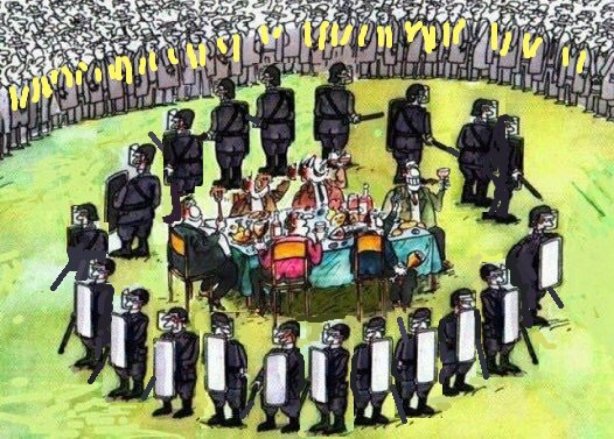
They have found it quite acceptable for Brexit voters to be dismissed as racist, fascist and xenophobic by Remain-backing, left-‘liberal’ metropolitan middle-class journalists in elegantly-crafted columns in The Guardian: yet when uncomplimentary labels are aimed at them by gruff working-class types in rough-sounding speech, they deem that to be a threat to their own security. The hypocrisy and double-standards there were, and are, nauseating.how political class insulates itself from dissent
—————————————————————————————————————————————–

UPDATE: After first publication of this blogpost at The Conservative Woman, the alleged leader of the anti-Soubry protest, James Goddard, was arrested on suspicion of a public order offence. Some aspects of this are disturbing.

Firstly, Soubry was clearly neither assaulted nor even impeded. Secondly, Goddard may not be either an elegant or eloquent orator, but if calling politicians liars, or the same things with which Soubry herself regularly damns her political opponents and her critics, are public order offences, then we are all at risk.

Thirdly, though possibly wrong, I was under the impression that an arrest under the Public Order Act must take place immediately a possible breach of the Act is apprehended: not 5 days later after political pressure has been exerted. And fourthly, as was pointed out by Spiked‘s Brendan O’Neill:

“What kind of country criminalises the insulting of politicians? An un-free one. Speech should never be a police matter. Including heated speech, angry speech, protesting speech. . . .however unpleasant it might have been”.  

—————————————————————————————————————————————–

Fast forward now to Wednesday 9th January’s Parliamentary shenanigans, which revolved around the Business Of The House motion tabled by the Government covering the procedure for – not the substance of – the second stage of the Commons debate on Theresa May’s misnamed “Withdrawal” Agreement. Business Of The House motions are not amendable, although some MPs do try it on, and a significant body of Parliamentary precedent exists to support the convention.

Out of several attempted amendments to Wednesday’s Business Of The House motion, Speaker Bercow, quite properly therefore rejected three. He then chose, however, to accept one – that tabled by resolute anti-Brexiteer ‘Conservative’ Dominic Grieve, the effect of which was to require the Government, in the event of Theresa May’s “Withdrawal” Agreement being defeated – as it almost certainly will be  – when it comes to a vote in the House next Tuesday, 14th January, to table an alternative Brexit plan within just three Commons sitting days, and the intention of which was to eliminate any possibility of a No-Deal Brexit by the Government simply running down the clock until 29th March.

Bercow accepted the Grieve amendment against not only both Parliamentary precedent and the sound arguments put forward in numerous Points of Order, but also against the legal/constitutional advice of his own Parliamentary Clerks, whose expertise on this subject is acknowledged by all sides of the House.

It was as if Bercow, whose has scarcely bothered to conceal his contempt for the Brexit vote even when sitting in the supposedly-impartial Speaker’s Chair, had been waiting for his big chance to scupper any possibility of a WTO/No-Deal Brexit, and, courtesy of Grieve, seized it.

What another remarkable coincidence. One of the normally-rejected amendments to a Business Of The House motion just happens to be put forward by arch-Remainer Grieve, and subsequently just happens to be allowed and not rejected by Remainer Bercow.

Just three weeks previously, Bercow had summoned the Government to the House to demand that it make its highly-adverse legal advice on May’s BRINO-Deal public. On Wednesday he refused to make his own Clerks’ legal advice on procedure public, and moreover physically made off with it. Despite stiff competition in the current Parliament, it’s hard to imagine any greater, more blatant, hypocrisy than Bercow’s.

The Grieve amendment was passed with the help of 17 of the usual ‘Conservative’ Party suspects who persistently parade with pride their Continuity-Remain credentials, and who find no problem in voting against the manifesto on which they were content to stand for Parliament and get elected.

And who, in addition, eagerly participated in arguably the most nauseating spectacle of a nauseating week – the blatantly anti-democratic diehard Remainers on both sides of the Commons aisle gloating how, courtesy of Bercow and Grieve, they have taken back control of Brexit for Parliament from the Executive, and boasting disingenuously that, after all, they’re only doing what Leave-voters claim to want.

Which is arguably the foulest lie of the lot. We voted for Brexit in order to leave the EU and thereafter have our affairs decided by Parliament as a consequence of having left: not to give control to Parliament to let it override the Referendum decision and not leave at all.

What would be the statistical probability of a minor, almost artificial-looking, outside-Parliament scuffle and name-calling just happening to be witnessed by two prominent anti-Brexiteers with media access, allowing a 24-hour anti-Brexit media narrative just happening to be run for the specific 24 hours preceding an unconstitutional anti-Brexit Parliamentary amendment by an anti-Brexit MP just happening to be improperly accepted by an anti-Brexit Speaker, leading to an anti-Brexit measure being voted by an anti-Brexit Parliament?

—————————————————————————————————————————————–

UPDATE: It emerged on Sunday 13th January that the remarkably-convenient coincidence, for the Continuity-Remainers’ anti-Brexit cause, of Speaker Bercow just happening to select Grieve’s No-Deal Brexit wrecking amendment as the one with which, against the professional advice of his Parliamentary Clerks, to break long-standing Commons precedent via procedural chicanery, was in fact no coincidence at all, but pre-arranged collusion. Grieve and Bercow, it was revealed, had met in secret just hours before the Speaker allowed his wrecking amendment.

Grieve also emerged as the instigator and ringleader of a Remainer backbenchers’ plot to seize control of the Brexit Parliamentary and legislative processes, via changing the Commons debating rules so that motions proposed by backbenchers would take precedence over government business. That would enable MPs to suspend article 50, put Brexit on hold, and could even lead to the referendum result being overturned. Once again a prior meeting between Bercow and Grieve figured in the revelations. 

If both stories are true – and there seems no reason to believe that they aren’t – then Bercow’s action, taken against the advice of his professional Parliamentary Clerks, in overthrowing Commons precedent to allow Grieve’s anti No-Deal Brexit wrecking amendment to the Government’s Business of the House motion, was merely just the enabler, the facilitator, the device by which the route to ensure the killing-off of Brexit by Remainer-majority backbenchers was prised open. Not so much a procedural innovation as a constitutional coup d’état.            

—————————————————————————————————————————————–

Far from merely wondering whether this past week’s events were had been pre-scripted, to contemplate otherwise now looks impossible.

Thoroughly agree with this article? Vehemently disagree with it?

Scroll down to leave a comment

Follow A Libertarian Rebel on Twitter and Gab

Sorry, Establishment-Elites: Populism isn’t going to just fade and go away

Holiday reading: “National Populism: The Revolt Against Liberal Democracy”, by Matthew Goodwin and Roger Eatwell (Pelican Books, 2008) 

Note: longer and updated version of the article originally published at The Conservative Woman earlier on Friday 4th January 2019

Until comparatively recently – say, the last ten years or so – “populism” was a relatively neutral descriptive label, confined mainly to textbooks and dictionaries of political science.

Even my own well-thumbed copy of Roger Scruton’s Dictionary of Political Thought (3rd edition, 2007) discusses it primarily in the context of the Russian Narodnik movement and the late 19th century US Populist Party. In the 1950s, it was applied most frequently to the French Poujadistes, the union of small shopkeepers and artisans which campaigned against most forms of large-scale development and industrial modernisation. Even in 2007, Scruton alluded only briefly to the early stages of its current pejorative usage.

Since about 2013-2014, though, it’s been resurrected, to be deployed in a different way by the ruling – not only political but also media, corporatist, academic and cultural – Establishment-Elites who see their continued hegemony threatened by it, especially when, as with Brexit, Trump, and growing success by anti-EU parties in Europe, it produces electoral outcomes not to their liking.

“Populism” is now the anti-democratic, globalist, ‘Liberal’-‘Progressive’ Oligarchy’s preferred term of disparagement for the growing politics of pluralist mass democracy based on self-governing nation-statehood, one that rejects rule by unelected and unaccountable supranational technocracy.

gilets jaunes comp dec 2018

It’s about this movement that political scientists and academics Matthew Goodwin and Roger Eatwell have written in their new (late October 2018) book “National Populism: The Revolt Against Liberal Democracy”, trying to explain its origins, its central tenets, and its prospects. It’s worth recalling, in passing, that Goodwin especially has elsewhere made a persuasive argument that Britain’s EU Referendum result, which so shocked the overwhelmingly pro-EU Establishment-Elite, had been “baked-in” for several years previously.     

Contrary to the assumptions of its contemptuously-dismissive opponents, the movement isn’t new. Goodwin and Eatwell show how its genesis pre-dates the 2007-08 financial crisis and the subsequent recession. However, they also argue convincingly that both events, and especially the globalist ‘Liberal’-‘Progressive’ Oligarchy’s policy-responses to them – hardship for those on low and middle incomes via austerity and greater job insecurity, but asset-value protection or even enhancement for the already wealthy via ultra-low interest rates and quantitative easing – generated an increase in inequality and sense that the economic system was skewed in the Oligarchy’s favour, both of which significantly enlarged the political space for the movement to fill.

Nor is it, as its detractors lazily claim, a movement composed solely of old, white, men. In the USA 2016 Presidential election, not only did 53 per cent of white women voters vote for Trump, but 43 per cent of all women voters opted for Trump. Between 1988 and 2017, the percentage of French female first-time voters who voted for one or other Le Pen nearly quadrupled from 9 per cent to 32 per cent. Greece’s anti-EU Golden Dawn party drew significant support from the young who felt their prospects were deteriorating. Clearly, something other than the Liberal’-‘Progressive’ oligarchy’s lazy, clichéd, prejudices was, and is, at work.

Goodwin and Eatwell identify what they call The Four D’s – the historic shifts, the long-term trends which are a growing cause of concern for millions and which are driving the movement: and which, being structural, are unlikely to fade or dissipate, or be assuaged, in the near future.

First, Distrust – the way in which the elitist nature of ‘Liberal’-‘Progressive’ democracy, forever seeking to minimise the opportunities for meaningful participation in it by the masses, has promoted distrust of politicians and institutions on the part of millions who feel they no longer have a voice in the national discussion.

Second, Destruction – particularly the perception that culturally-‘liberal’ politicians, unaccountable supranational bureaucracies and global corporates are eroding, not only traditional communities, but also national identity and societal cohesion, especially via encouraging historically unprecedented rates of mass immigration, while politically-correct agendas strive to silence any expression of opposition.

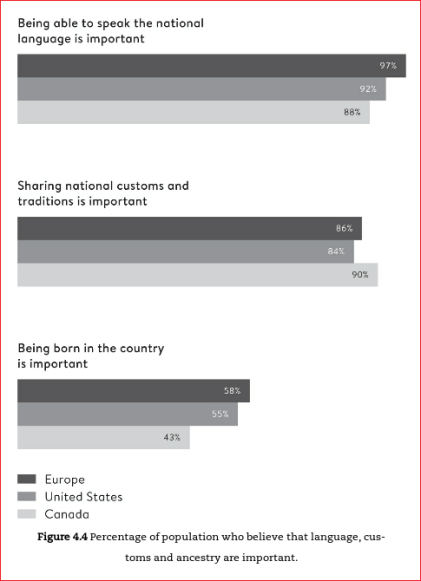
Yet this isn’t channelled into racism or xenophobia, but into demands that immigration be controlled by democratic consent, that the pace of immigration be slowed, and crucially, that it be accompanied, not by non-judgemental, relativist, divisive, separatist multiculturalism, but by assimilation and integration. Notable in the chart below is how, on both sides of the Atlantic, people say that immigrants adopting the national language and sharing the national customs, values and traditions are far more important factors than their birth-nationality or ethnicity.   

imp of speaking national language

Third, Deprivation – the growing conviction of many, fuelled by rising inequalities of income and wealth, as well as the perception of cultural discrimination consciously practised against them by the ‘Liberal’-Elites, that they are losing out relative to others, and that the future for themselves and their children is not only diminished, but actually bleak.

future prospects for kids

Fourth, De-Alignment – the burgeoning gap, and therefore weakening bond, between rulers and ruled, between the traditional mainstream political parties and the people they purport (or even no longer bother even to pretend) to represent: manifesting itself in a much more fragmented, volatile and unpredictable politics.

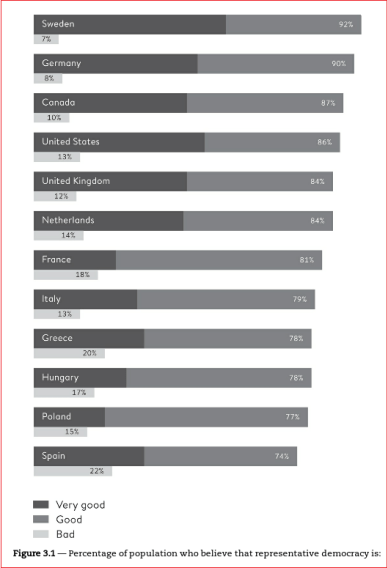
Goodwin and Eatwell also show that, again giving the lie to the dismissive prejudices of its critics, the Populism movement is not anti-democratic. Its preference for properly representative democracy remains strong.percent believing in popular democracy

Rather, it opposes aspects of ‘Liberal’-‘Progressive’ democracy as it has evolved to date, and actually wants more democracy: more direct-democracy referendums and more-listening politicians who will devolve power to the people to exercise it democratically, instead of vesting it in what too often are unelected and unaccountable, bureaucratic and technocratic, economic and political elites.

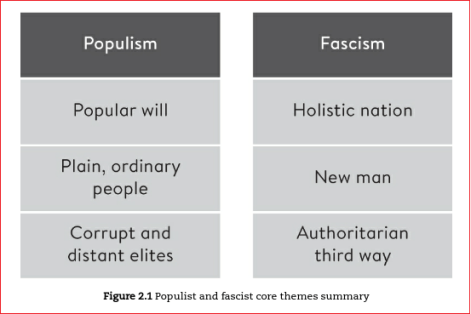
Goodwin and Eatwell demonstrate, too, that neither is Populism “fascist”, as its belittlers and defamers claim, most notably near-hysterically in the aftermath of the Brexit and Trump victories and the strengthening electoral performance of anti-Establishment parties in Europe. The movement by and large does not seek to tear down failed institutions which turned anti-democratic and replace them with autocratic ones: but to repair them so that they once again serve the interests of those they are supposed to serve.populism vs fascism core themes

The authors argue, in my view correctly, that unless elitist ‘Liberal’-‘Progressivism’ acknowledges its shortcomings, it will fail to come to terms with the new Populism, and so will struggle to contain it. The omens are not good. That bastion of ‘Liberal’-Elitism, The Sunday Times, for example, has described it as one of most dangerous developments of modern times. Set against Nazi Fascism, Marxist-Leninist Communism and Islamist-Jihadism, that seems a curious way to describe a pleading by the denigrated and forgotten for the democratic settlement to recognise and accommodate their legitimate concerns more. 

Conversely, however, if can bring itself to dilute its self-exalting smugness and intolerance, and broaden its appeal by meeting the legitimate concerns of voters who do want radical action to roll back elite-driven agendas in areas like welfare-universalism, mass immigration, rising inequality and civil liberties, it may yet accommodate itself to it.

The former will mean Populism remaining outside the mainstream, but becoming ever more widespread while the ‘Liberal’-‘Progressive’ centrism shrinks. The latter will mean Populism becoming the mainstream as more of the present mainstream adapts to meet it, signs of which are already visible. Either way, it’s here to stay, and isn’t going away any time soon.

I bought Goodwin and Eatwell’s book immediately on publication, but only over the holiday period has it been possible to go through it more slowly, in depth. I’d have no hesitation in recommending that you do, too.

Thoroughly agree with this article? Vehemently disagree with it?

Scroll down to leave a comment
Follow A Libertarian Rebel on Twitter and Gab

The Six Podcasts of Christmas

Taken in aggregate, six podcasts transmitted between 16th November and 20th December 2018 reveal the sheer extent and baleful consequences of the Brexit Betrayal being pursued by Theresa May via her Brexit-In-Name-Only “Withdrawal” Agreement 

Note: this article was originally published at The Conservative Woman on Thursday 27th December 2018

Both leading up to, and during, the dog-days between Christmas and New Year, it’s more usual to find reading recommendations rather than listening recommendations on your preferred political websites. I’m hoping to add my own “What I’m reading over this Christmas” in the next few days: but as an interim measure, and maybe also to break the mould, here are six podcasts well worth, in my view catching up on.

Among the most compelling Brexit-related podcasts around in the past year have been those by Briefings For Brexitthe group of pro-Brexit academics set up specifically to make the robust analytical, intellectual and constitutional case that perhaps sometimes goes by the board in the frenzy of 24/7, immediate-response politics.

The last six, however, have been particularly good –

In 16th November’s, Professor Gwythian Prins gives arguably one the most comprehensive, but also one of the most clear and lucid, expositions I’ve yet heard of the enormity and scale of the deliberately-engineered surrender to Brussels involved in Theresa May’s “Withdrawal” Deal.

Additionally, the details of how the associated below-the-radar subordination of our Armed Forces to the incipient EU “Defence Union” both purposely undermines NATO and jeopardises the UK’s crucial Five Eyes security and intelligence partnership with our Anglosphere allies are quite horrifying.

In 29th November’s, long-time Eurosceptic Tory backbencher Sir Bernard Jenkin not only backs up Professor Prins on May’s proposed “Withdrawal” Agreement, especially on the Northern Ireland backstop, but also demolishes the scaremongering forecasts put out by both the Treasury and the Bank of England, before warning of the political and economic dangers of being locked in to the EU’s Customs Union virtually in perpetuity.

In 7th December’s, Professor Robert Tombs outlines the already political, but potentially also constitutional, crisis in the way Britain is governed resulting from the Government’s handling of Brexit, and the dangers inherent in the growing demands for a second EU Referendum, aka “People’s Vote”, from an overwhelmingly-Remainer political, media, academic, cultural and business elite who refuse to accept the 2016 EU Referendum’s outcome.

In 11th December’s, another long-time Eurosceptic Tory backbencher, Anne-Marie Trevelyan, emphasises the further surrender of sovereignty implicit in May’s “Withdrawal” Agreement, and explains why May’s decision to cancel at short notice the Commons vote on it, because she was almost certain to be defeated, passed up the opportunity to send a strong signal to the EU that the Agreement is unacceptable.

On 14th December, a further long-time Eurosceptic Tory backbencher, David Jones, argues that May’s relatively narrow margin of victory – once the payroll vote is taken into consideration – in surviving the vote of no confidence in her leadership means that she must ditch her failed “Withdrawal” Agreement and begin negotiations with the EU for a CETA agreement similar to the one it recently signed with Canada.

Finally, in 20th December’s, Baroness Ruth Deech, lawyer and a Eurosceptic for at least 25 years, warns about the lack of a UK opt-out from the Northern Ireland backstop in May’s Agreement, and the continuing jurisdiction of the European Court of Justice (contrary to May’s claims) over the Agreement and our future payments to the EU.

The six podcasts are easily stitched together into a single continuous playlist, especially if you use a podcast management app like Overcast or Podbean, both of which in my view are superior to Apple’s proprietary one. They add up to 2 hours 43 minutes duration. Not as long, in fact, as even two of those serially-regurgitated old films which lazy TV schedulers have decided to bombard you with over the festive period.

So, a suggestion: plug in the headphones and listen, either as an alternative to sitting in post-prandial torpor through the umpteenth replaying of Love Actually or Pirates of the Caribbean, or as a catch-up opportunity while driving home after gratefully bidding goodbye to Mother-in-Law for another year.

The cumulative effect of listening to the podcast interviews in succession, rather than spread, as they might normally be, over five weeks or so, is significant. It brings home starkly the enormity of the confidence trick which May and her acolytes are trying to play on us. When politics resumes on 2nd January 2019, we still have a massive fight on our hands to prevent the most egregious betrayal.

Thoroughly agree with this article? Vehemently disagree with it?

Scroll down to leave a comment

And follow A Libertarian Rebel on Twitter

Tory Brexiteer MPs: United in Disunity, Adamant for Uncertainty

Unless the various pro proper-Brexit Tory MP factions get their act together, both to defeat May’s BRINO-Deal and force a pivot to a WTO-terms No-Deal, a proper Brexit risks being lost altogether

Note: longer and updated version of article originally published at The Conservative Woman on Monday 3rd December 2018

Barring some currently unanticipated anti-climax, the next week, culminating in the House of Commons vote scheduled for Tuesday 11th December, on Theresa May’s duplicitously conceived and deceitfully mis-represented Brexit-In-Name-Only Withdrawal Agreement, promises to be the most momentous week in our political history for the last 25 years, since the passage of the Maastricht Treaty in 1993.

It will potentially decide whether Britain’s destiny for the next few decades is to be that of a once-again independent, outward-looking, sovereign democracy, or a weakened, impotent, deferentially-grovelling satrapy on the fringes of the neo-colonial Brussels Empire.

The stakes could not be higher. Yet the principal players in the grouping of MPs in whose hands most lies the power, not only to halt but reverse the monstrous betrayal of country, and arguably of democracy itself, which, given the outcome of the 2016 EU referendum, the latter fate would be – the putative “Tory Brexiteers” – are a self-indulgent, fissiparous gaggle of biddable loyalties, concealed ambitions and flexible reliability.

We can first dismiss the so-called “Cabinet Brexiteers”. They deserve little but our eternal contempt. Once Boris Johnson, David Davis and Steve Baker had all resigned in the wake of the Chequers Summit, their “We will stay in the Cabinet and continue to press the Prime Minister to change her approach from inside” position looked increasingly unconvincing and self-serving: but, once Dominic Raab and Esther McVey had also resigned, rather than support May’s Orwellian-labelled “Withdrawal” Agreement, their position became almost comically untenable.

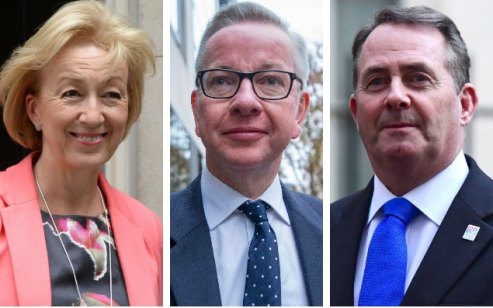
Panny Mordaunt, Andrew Leadsom, Liam Fox, Chris Grayling and Michael Gove appear to have maintained their implausible positions only up to the point when, forced to choose between upholding democracy and their manifesto pledges, or retaining the trappings & rewards of Ministerial/Cabinet office, they seem to chosen the latter, suddenly becoming converts to May’s BRINO-Deal with attempted justifications, not excluding warnings that rejection may mean Brexit not happening at all, which are wholly unpersuasive.

Leadson, Gove, Fox, 3 of the Fatuous Five

It was Mordaunt, remember, who sought the right to both stay in Cabinet, thus keeping her rewards of office, and  oppose May’s BRINO-Deal on the floor of the House of Commons, thus keeping her “Brexiteer” credentials. When May refused, she decided to stay in Cabinet and back May, rather than resign.

Gove lost the last vestiges of his fast-diminishing credibility, but enhanced his fast-growing reputation for cynical, unprincipled opportunism, by demanding the freedom to change Government Brexit policy as a condition of accepting May’s offer of the Brexit Secretary role in place of Raab, only to back down when rebuffed, not resign, and agree to stay in Cabinet as DEFRA Secretary to support May in selling the very deal he demanded the freedom to change because it was so bad.

The supposed submitters of the necessary 48 Letters of No Confidence in May’s leadership to the 1922 Committee have not been much better. There was a seeming naiveté on the part of their de facto leader Jacob Rees-Mogg in taking at face value all who had assured him that their own letters had been submitted, when in fact they had not.

The “revolt” collapsed in a welter of recriminations, doing nothing to suggest this was, or is likely to be, an effective route to stopping Parliamentary approval of May’s Withdrawal Agreement. Some some senior staunch Brexiteers, notably Iain Duncan Smith, Bernard Jenkin and Owen Paterson, appeared not to have joined the letter-writers’ ranks at all.

Rumours circulated of knighthoods and peerages dangled as inducements to support for May. Talking of which, it was interesting to speculate, such is the febrile atmosphere, whether something an ostensibly innocuous at this might be preparing the ground for a climbdown from opposing May’s shamefully-capitulating Withdrawal Deal by using some trifling, cosmetic-only amendment to the Northern Ireland backstop as an excuse.

2018.11.24 Jenkin on May BRINO-Deal

The younger, more recent, more committed to Brexit intake of Tory MPs, however, give more grounds for hope. Just to take three at random, the personal statements of opposition to May’s BRINO-Deal and pledges to vote against it from MPs Julia Lopez, Suella Braverman, and Lucy Allan, are impressive.

Conservative Home has been maintaining a running total of how many Tory MPs now oppose May’s (non)-Brexit deal. At the time of writing, and including all of the ‘definitely’, ‘probably’, and ‘maybe’ categories, stands at approximately 100.

Together with the DUP and Labour Eurosceptics, this ought to be enough to ensure the deal’s defeat – unless Labour and the other Europhile parties for whom it is not Remain-ery enough do an about-turn and support the Government. Quite what May’s position would be in the event of her widely criticised and opposed Brexit withdrawal deal passing via reliance on Labour votes is a moot point.

Moreover, not for nothing is the ‘Conservative’ Party in Parliament known as one of the most capricious and untruthful electorates in the world. The stories of pledges in public to support A, promises in private to back B, only to vote for C in reality, are legendary, which makes all the responses and surmising used in calculating numbers consumable only with a large pinch of salt.

It looks increasingly likely at the time of writing that May will seek to convert some of the waverers by framing the Commons debate in tribal political party terms, a Conservatives vs Labour contest, rather than the Leave vs Remain, or at least Clean-Brexit vs Closet-Remain   tussle which it both is and ought to be presented as. This is already obvious from May’s insistence that what promised to be farcial all-Remain TV ‘debate’ is structured on this basis, demanding to go head to head only with Jeremy Corbyn, but not with either Johnson or Rees-Mogg, both of whom she knows would, figuratively-speaking, eviscerate her.

Furthermore, although there apppears to be a Tory consensus against May’s BRINO-Deal, that consensus fractures as soon as it comes to discussion what should happen next, after its expected defeat. Incredibly, some MPs favour going back to the EU and asking for better terms, despite Brussels’ insistence none will be offered.

Others (some, it should be noted, until quite recently Remainers) are trying to revive the idea of a EEA/Norway-style option, despite its inability to cover the one point may seems able to fixate on, namely Freedom of Movement, and notwithstanding its other flaws.

Yet others, one suspects, would like nothing more than to drop the whole idea of leaving the EU, and forget about Brexit altogether – no doubt hoping that by the time the next scheduled General Election comes round, the electorate will have subsided from anger into a sullen, grudging acceptance. Some hope.

All of these must be avoided, despite the predictable efforts of Theresa May and her No 10 team to divide and rule. The defeat of May’s deceitful and damaging BRINO-Deal must trigger a coalescing of approval around an exit from the EU on No-Deal, WTO terms. Not only is it the most advantageous both financially and economically: it is the only option that delivers the elements of the settlement for which a majority of voters, in a 72 per cent turnout, voted.

Given the anger at May’s perceived betrayal reported from around the country outside the Westminster Bubble, even within the Conservative Party itself as local constituency associations flatly refuse to deliver leaflets backing May’s deal, it is likely also to be the only option that would assist the avoidance of a catastrophic breakdown of public trust in democracy and its institutions, and which might – just – ensure the ‘Conservative’ Party’s unmerited survival as a viable political force.

But unless the ‘Conservative’ Party’s so-called Brexiteers put aside their differences, resist both inducements and threats from their Party Leader, and combine both to defeat May’s BRINO-Deal and force a pivot to a No-Deal EU withdrawal to WTO terms, there is now a real risk that Brexit will be finished, and lost, with hugely damaging consequences. That their Party will be finished also, and deservedly so, is scant consolation.

Thoroughly agree with this article? Vehemently disagree with it?

Scroll down to leave a comment
And follow A Libertarian Rebel on Twitter

Fisking Mickey Fab

Deconstructing Conservative MP Michael Fabricant’s pledge to vote against Theresa May’s BRINO-Deal illustrates the modern ‘Conservative’ Party’s ‘party before country’ reputation 

I must admit to having a bit of a sneaking regard for Michael Fabricant, the Tory MP for Lichfield.

He has the refreshing qualities, all too rare in an MP, firstly of not taking himself too seriously, and secondly of not being afraid to ruffle the right-on feathers of the serially-offended with a deliciously off-message, politically-incorrect put-down.

Like his tweeting a sardonic “Well, about time”, when the sphincter-clenchingly P-C, Cameroon-‘liberal’, SJW-‘feminist’, and unrepentant expenses-fiddler Maria Miller, Tory MP for Basingstoke – she of the smirking, 32-seconds, insouciant, non-apologetic ‘apology’ to the House of Commons – finally deigned to accept the inevitable and reluctantly relinquished her Ministerial chair.

Or his observation (possibly sympathised with, if not exactly shared, by much of country, in truth) that he’d find it difficult to share a discussion panel with the illiberal, irascibly-leftist Yasmin Alibhai-Brown without resorting to violence

2014.06.20 Mickey Fab Alibhai-Brown

So it’s quite instructive to examine in detail his latest piece a couple of days ago for The Daily Telegraph on how and why he plans to vote on Theresa May’s EU Withdrawal Agreement, aka BRINO-Deal, aka Instrument of Capitulation, when it comes before Parliament on Tuesday 11th December. Perhaps a little fisking – not much seen these days – might be in order. 

TGraph headline Mickey Fab

Keep that headline in  mind. It’s highly relevant to what’s to come.

Fabricant starts well. He summarises the thrust of Theresa May’s Lancaster House speech of January 2017, especially her declaration of intent to leave the Customs Union, Single Market, and jurisdiction of the European Court of Justice, and her warning that remaining in the first two would in effect be not leaving the EU at all. Then he goes on to criticise how this has been diluted: 

“Historians will come to write the story of how Lancaster House morphed into present Government policy. It will be a story of the inflexibility of EU leaders, the botched 2017 general election, and the tin ear of British political leadership. By leaving most of the negotiations to civil servants, any semblance of political sensitivity was lost.”

Isn’t he missing something? The deliberate deception by no less than the Prime Minister herself of her Cabinet, her MPs, her party, her voters, and the country, side-lining and ignoring the preparatory work being done by the Department for Exiting the EU while cynically using it as camouflage, in a No. 10 backstairs operation to devise her Chequers Plan in secret and pre-clear it with German Chancellor Angela Merkel, before imposing it on Cabinet at ultra-short notice and declaring it to be un-amendable, threatening to sack any Cabinet Minister who objected to either its process or its content?

“After the Eastleigh by-election when Ukip won 28 per cent of the vote and came a close second to the Liberal Democrats, I told David Cameron that unless the European question was neutralised, we would never be able to form a government. Ukip, or a similar party, would always shave 6-10 per cent off Conservative votes in our marginal seats.”

Fabricant here in effect admits that his prime reason for recommending Cameron in 2013 to concede an In/Out EU Referendum was not the principled democratic one of giving the electorate the chance to have its first vote in 38 years on Britain’s continuing membership of the EU: but the narrow, partisan, party-management one of ensuring “the European question was neutralised” so as to secure Tory Party electoral advantage. Party before country, in other words.

“I realise the huge risks in voting against the Government on this issue. The Government might collapse, we might crash out of Europe in March over a precipice, or it might even jeopardise Brexit itself.”

It’s a shame to see Fabricant, apparently a committed Brexiteer, channelling the standard Continuity-Remainer / BBC description of a reversion, if there is no deal, to trading with the EU bloc on the same WTO terms as do over 100 other non-EU countries as a “crash out of Europe over a precipice”.

But his first worry seems to be that the Government might collapse. Well, I suspect that the nation could possibly suffer much worse imminently than the collapse of a justifiably unpopular Government, which even Fabricant himself rightly criticises. In comparison , the risk of Brexit not happening at all, with its enormous adverse implications for public trust in democracy itself, seems to rank only third.   

“But the risks of accepting this deal are even greater. If we leave the EU with this agreement, the sense of betrayal will be overwhelming and the Conservative Party will be out of office for a decade or more. Arlene Foster has already said the DUP will revisit the confidence and supply arrangement if the Withdrawal Agreement passes.”

Fabricant is undoubtedly right that the sense of betrayal will be overwhelming: but once again, it’s the implications of that sense of betrayal on the future electoral prospects of, and the future likelihood of occupying office for, the ‘Conservative’ Party which seem to be paramount here, not on a disastrous collapse in public trust in the entire democratic process.

“However, there is an alternative. After a Commons defeat, No 10 could regain the initiative. We could still enter into a free trade agreement with the EU – an agreement encouraged by Merkel and Macron. And contingency no-deal planning could still mean an orderly, and more complete, Brexit.”

Given May’s intransigence and stubbornness, and her subservience to her coterie of anti-Brexit advisers and officials, the idea that she could somehow pivot, from a Commons defeat of the deal into which she has invested so much personal and political capital to seeking a Free Trade Agreement alternative, seems to be in the realms of fantasy – even if it had not already been dashed, as Fabricant himself acknowledges a few paragraphs earlier, by Macron’s avowed determination. . .

“to keep us in the backstop as blackmail until the UK agrees to France’s demands on fishing rights in British waters”.

The crucial message comes in the way the concluding paragraph links back to the headline:

“I rarely vote against my Government, but conscience and the long-term future of my nation, and yes, my party too, take precedence”

It’s hard not to wonder whether Fabricant’s perception of the national interest being fortuitously in alignment with Party interest isn’t once again the major reason for his decision. After all, the ‘Conservative’ Party is saddled, by no means unfairly, with the “party before country” label: with the assumption, not just among the Left, that when it comes to the crunch, it will always prioritise its own survival above the interests of the country: that it’s what Tories always, with very few exceptions, do.

Fabricant’s citing that reason so explicitly will do little to dispel the Tories’ “party before country” reputation. He should be voting against Theresa May’s execrable BRINO-Deal to save his country, and for no other reason. In comparison, the fate of his party, and even less, its current leader, is immaterial.

Thoroughly agree with this article? Vehemently disagree with it?

Scroll down to leave a comment
And follow A Libertarian Rebel on Twitter

Just What – Or Rather Who – Is Driving Theresa May on Brexit?

Two in theory separate but in practice closely-aligned groups of anti-democratic vested interests are influencing, with her concurrence, Theresa May’s obdurate pursuit of a Soft-Remain Brexit-In-Name Only       

Note: longer and updated version of the article originally published at The Conservative Woman on Wednesday 24th October 2018

On the “what” of Theresa May’s catastrophically-inept, stubborn, secretive, submissive and duplicitous conduct of the United Kingdom’s Brexit negotiations, there is little room for doubt.

The original story, of her deceitful complicity in the covert No 10 operation that gestated her infamous Chequers Plan – which she obstinately persists in clinging to, despite its manifest flaws and rejection by both colleagues and Brussels alike – has received extensive media coverage.

Since then, the details of her successive capitulations to, and appeasement of, the EU’s intransigence, such that the position she is now reduced to claiming is a meaningful EU exit that delivers the Referendum result is scarcely distinguishable from continuing membership at all, have received equally widespread publicity.

In summary, having let herself be totally outmanoeuvred on the Northern Ireland backstop – with the connivance, on this and much else, of  a Civil Service opposed to Brexit in principle and resolved either to dilute it to insignificance, or thwart it altogether – she now proposes a £57 billion-costing, non-voting vassal-state transition until 2022, before a permanent Customs Union, adherence to EU Internal Market rules, inability to strike external trade deals, continuing subservience to the European Court of Justice, and possibly also even surrendering domestic control over tax policy.

And that’s disregarding her also signing away UK Defence and military autonomy to the incipient European Defence Union on the sly.

What UK Gov has agreed re EU Defence

So there’s no lack of knowledge or detail about what May is doing.

In contrast however, the “why?” of May’s incompetent, disingenuous and potentially-disastrous, yet doggedly determined prosecution of a soft-Remain (non)-Brexit has received little attention in comparison. This may be an understandable omission in the urgency of reporting and analysing day-to-day developments: but it’s surely as equally important. It’s time we started considering the possibilities seriously.

First, is it just an admittedly truly staggering level of ignorance and incompetence, but nothing more? May’s failings of both competence, intelligence and leadership are hardly either unknown or doubted: indeed, I’ve argued myself earlier this year that she should be ousted and replaced on those grounds alone.

But it does seem unlikely that anyone could be merely incompetent to May’s degree. Nor would it account for the combination of calculated deviousness and intolerant-of-dissent petty authoritarianism by which she had her Chequers Plan formulated behind the backs of Cabinet, MPs, Party and country, then pre-cleared with Merkel, before imposing on her Cabinet without prior warning, on pain of dismissal. Other factors must surely be in play.

A conspiracy theory occasionally advanced is that the myrmidons of the Deep-State – or the New-Class Establishment Elite if you prefer – which always was and remains viscerally opposed to Brexit, have something on May and/or her husband which would be acutely embarrassing, even resignation-inducing, if revealed, and can therefore control her approach to Brexit. Adherents hint darkly for example, about how the Home Office Inquiry into allegations of Westminster organised child sexual abuse was effectively neutralised during her reign.

But is this not also unlikely for a self-described “goody two-shoes” whose idea of taking daring risks is skipping though a field of wheat? Besides, if so, wouldn’t she have anyway used her 6-year tenure as Home Secretary to ensure that any such material was safely buried, as Jack Straw is widely rumoured to have done with MI5 files on the New Labour hierarchy’s past Communist allegiances?

In her Sunday Telegraph article of 21st October, Janet Daley suggested that a submissive May is surrendering to the EU’s playing hardball with her in the Brexit negotiations because both it and she are impressed by the constant stream of out-of office Referendum-repudiating Remainer politicians dancing attendance on it in Brussels, assuring it that Brexit can be stopped if it continues to display the intransigence it has to date.

I don’t buy this. If the EU is knowledgeable enough about current UK politics to know that May is in deep trouble, and is a pushover, then it’s surely also knowledgeable enough about current UK politics to know that the opinions of the Unreconciled Continuity-Remainer political claque epitomised by Blair, Clegg, and Major actually carry very little weight in UK. The theory that May is capitulating to its intransigence because it thinks that they represent UK public opinion and that she is in fear of it, seems to me to just not stand up.  

For what it’s worth, my theory is this: that May is knowingly, in effect willingly. being held hostage by, and dancing to the tune of, two nominally separate but very closely aligned groups.

Theresa's Puppet-Master Olly RobbinsFirstly, the Number 10, Cabinet Office, and Foreign Office officials, in whose hands – having little discernible knowledge, judgement or confidence of her own – she has been ever since taking office, who are reportedly uniformly opposed to Brexit, and of whose private and unreported contacts behind the scenes with EU officials we are unaware.

Secondly, the pro-Remain side of Big-Business that’s essentially crony-corporatist rather than competitive free-market capitalist, and which channels its collective view to Government through the CBI, which represents predominantly that particular type of business organisation.   

There a reason why May, instinctively a big-government statist, might be particularly receptive, both to the blandishments of this particular lobby, and to the idea that “business” equals the CBI.  

To the extent that she is ideologically wedded to anything at all, May seems much more inclined to the EU’s preferred model of state-interventionist, crony-corporatist “Rhenish capitalism” than she does to the quintessentially Anglosphere small-state, low-tax competitive free-market model of capitalism. She did after all join the Conservative Party in 1973 when it was led by Heath, who thought very much along those lines.

Remember, too, the CBI was fiercely pro-Remain, despite its undistinguished record of having being wrong about almost every major issue for the last 100 years. including nationalisation, Prices and Incomes Policy, the Exchange Rate Mechanism, and, most of all, the UK joining the Euro.

EU Lobby LandCBI-type pro-Remain Big-Business finds EU membership most congenial. First, the EU’s regulation-heavy regime is highly susceptible to corporate lobbying – in 2016 there were an estimated 37,000 lobbyists in Brussels alone – for regulation and restrictive practices that favour the interests of large producers over those of consumers, and which tend to entrench oligopoly rather than generate competition. In addition, the EU’s secretiveness and lack of transparency at the very least facilitate outright corruption.

Second, the large CBI-type corporates that do the lobbying have the economies of scale to cope with the mountains of EU-originating red tape, forced compliance with which cripples their smaller, nimbler potential rivals, especially innovative start-ups. And the deal which May currently wants to accept would in effect keep all UK business, not just the mere 15-20 per cent of it involved in exporting to the EU, subject to the EU regulation which Big-Business specifically lobbies for in pursuit of its own anti-competitive interestContinuing membership for all intents and purposes thus acts acts as a barrier to entry for its competitors.

There has already been persuasive circumstantial evidence of Big-Business complicity in, if not influence on, the Government’s conduct of Brexit. Readers will remember how, in the earlier iteration of Project Fear about a No-Deal Brexit, in the run-up to May’s infamous Chequers Summit, Business Secretary and arch-Remainer Greg Clark emerged as not merely been the willing mouthpiece of pro-Brussels, crony-corporatist Big-Business, but perhaps its persuasive script-writer too.

And it’s still going on. But keep that name in mind. Because for some time, there have been unsubstantiated rumours that the same Greg Clark – possibly the ideal choice for the role of the Government’s Big-Business’ fixer, being so utterly uncharismatic and unremarkable as to be virtually anonymous – had long assured Japanese motor manufacturers in the North-East that Britain would be remaining in the Customs Union come what may, despite all the guarantees for public consumption that Brexit would involve exit from both it and the Single Market.

Corroboration, however, is now starting to emerge. In an article for Conservative Home on Tuesday 16th October, Stewart Jackson – former Peterborough MP and more recently Chief of Staff to David Davis when the latter was May’s Brexit Secretary – openly called Greg Clark’s dealings with Nissan “dubious”and condemned Clark’s refusal to publish his correspondence with the company, despite Clark having pledged to do so to the House of Commons.

Jackson went to say that pro-Remain Chancellor Philip Hammond, plus Clark and his officials, were briefing, from January of this year, that the UK would be staying in the Customs Union, and that the Irish backstop was the cleverest possible wheeze to ensure that this happened. Significantly, perhaps, those allegations have not been refuted.

Jackson is not alone. Recently, Daniel Moylan, former both deputy chairman of Transport for London and chairman of Crossrail, has openly disparaged online the anti-Brexit “fightback of vested interests and their Cabinet advocates”, and also speculated  whether, as now seems highly likely at least, such a secret promise was indeed given by Clark, with May’s blessing, to the motor industry.

If so, then it would at the time have been totally inconsistent with the vision of Brexit that May was publicly advancing so clearly in her Lancaster House and later Mansion House speeches. And even now, the UK negotiating team appears to be closing down every significant element of Brexit: one by one: laws, trade deals, money.

The theory, therefore, about why May is prosecuting Brexit in the way that she is – deceitfully and secretively negotiating the softest of Soft-Brexits, not in the wider interests of the British people and economy and honouring the Referendum result and her own 2017 Manifesto pledges, but in the narrow sectional interests of anti-Brexit Whitehall and pro-Remain Big-Business – at least appears plausible.

And it leads on to another, equally intriguing, one.

For two years, the Cameron and then May Governments have been excoriated for having failed to plan in advance for the possibility of a Leave vote in the EU referendum, for instructing officials not to prepare for one, and for not doing very much to plan its implementation for several months afterwards.

But what if we were all looking in the wrong direction, and Plan B was there all the time, hiding in plain sight? What if a contingency plan for a Leave vote was prepared, in secret, and the title of that contingency plan was: ‘Theresa May’? And prepared because it had been determined, at the deepest, innermost levels of the State, that whatever the Referendum result, even an 80:20 win for Leave, Britain’s exit from the EU could not be allowed to proceed?

May coronation July 2016 1On this theory, there was an intention that a Leave vote would never be honoured if it occurred, but muted, if not thwarted. So did Cameron assist by resigning to be conveniently replaced, in a rigged MPs-only coronation, by a Theresa May who, although a Remainer, had basically spent the entire campaign hiding behind the sofa, so that she was available and not too tainted by it when Cameron resigned?

A May who then proceeded, under the sway of, and with the full co-operation and support of, the equally pro-Remain, anti-Brexit Civil Service, backed up by a similarly inclined Big-Business and reliably on-message media, purposely to delay, dilute and diminish Brexit, including calling the unnecessary 2017 General Election? 

By writing, in concert with her closest confidantes only, a Manifesto whose contents even Cabinet Ministers were unaware of, and hardly saw before its launch? And then by deliberately throwing the election via a lacklustre campaign and crucial manifesto gaffe on long-term social care halfway through it, in order to weaken her own Commons majority and thus make it harder to get any pro-Brexit legislation through an anti-Brexit Parliament?

Fanciful? Maybe. But we live in strange political times. Who would have thought, three and a half years ago, that in the Autumn of 2018 we would have a Prime Minister whom large parts of her party believe to be complete disaster, but is kept in place out of genuine fear of her being replaced by a 1970s Trotskyist throwback as Leader of the Opposition?

Thoroughly agree with this article? Vehemently disagree with it?

Scroll down to leave a comment
And follow A Libertarian Rebel on Twitter

A Political Pantomime, Mere Theatre for the Impressionable? Or Something More?

Instead of risking a Tory MPs ‘No Confidence’ vote which she might well survive, could Theresa May now be pressured into resigning? 

Note: this article was originally published at The Conservative Woman on Tuesday 16th October 2018

The Cabinet, so the Telegraph reported this morning, has been told to force Theresa May to drop her Chequers plan or she will face a no-confidence vote ‘within days’.

Tory Brexiteers, it goes on, are, threatening to force a no-confidence vote in May’s leadership, within days, if Ministers do not persuade her to do so. Rumours abound that the Chairman of the 1922 committee is about  to receive the final letters needed to make up the requisite 48.

Steve Baker Newsnight re Chequers-MinusOn Monday night Steve Baker, the former Brexit Minister, told the BBC’s Newsnight programme: “I’m afraid there’s something of a grisly job to be done here. Either the Cabinet need to change the Prime Minister’s mind on where she’s going — or it’s clear that if a Chequers-based deal comes back it will be voted down.”

But will it? Or is it more of Parliament’s game of Brexit Bluff as set out by Guido Fawkes here? Another damp squib? Never under-estimate the extent to which Tory MPs’ individual and collective survival instincts, especially facing the prospect of losing seats and sinecures to a surging Corbyn Red Tide if voting down May’s now Chequers-Minus plan led to a General Election, will make them put Party before Country in an instant.

And, as far as the threat about triggering a Vote of No Confidence among Tory MPs in May’s leadership  is concerned, is this mere theatre for the impressionable?

It was as recently as July, a mere three months ago, that the ‘vote of no confidence’ drama was last in the air.  But, as I hinted then, with a Tory Parliamentary party so stuffed with Remainers, payroll-careerists & time-servers, May would probably win a confidence vote, entrenching her for another year, so that the surer option was (and still is) to force her to resign. It’s perhaps worth re-visiting why.

Graham Brady Chair 1922 Committee v2The internal submission of 48 Conservative MPs’ letters to the Chairman of the 1922 Committee triggers a party leadership election, but the way this is governed by the Party’s election rules makes it fraught with real and potential obstacles if the objective really is a successful defenestration of May.

First, she has already indicated that she would contest a fresh leadership election. Whether this is attributable to merely the bloody-minded, tin-eared stubbornness and lack of sensitivity for which she is rightly infamous, or something altogether darker, a Machiavellian anti-democratic determination not to allow Britain not leave the EU in any meaningful sense, is debatable.

May coronation July 2016 1Second, given the precedent of their 2016 arranged coronation of May, it’s highly likely that the Remainer-majority Parliamentary party would do anything to prevent the contest going out to the membership to elect a pro-proper-Brexit leader, because it seems inconceivable that a Remainer could win a whole-membership ballot in the current fractious anti-May mood.

Third, with an estimated 185 Remain-voting Tory MPs against an estimated 138 Leave-voters, and with the pro-proper-Brexit vote possibly split between two or more candidates, May might actually win quite comfortably, even with MPs for marginal constituencies fearing for their seats if she stays. If she won so decisively, we’d arguably be even worse off than we are now.

Slightly better, but not much, would be if (assuming some honourable Remain-voting MPs nevertheless think the Referendum result must be respected in full, and that May clearly has no intention of doing so) she won narrowly, leaving her a lame-duck leader. Any other  leader who survived so narrowly would realise that the game was up and that their position was untenable. But not May, I suggest.

So in either case we’d probably be stuck with her: and in view of the revelations of the past three months, Heaven only knows what further subterfuge and double-dealing she would inflict on both Brexit and thereby on democracy alike. And it begins to look as though even the damage being done to the Tories’ future electoral prospects from her duplicity and compulsive EU-deference doesn’t trouble her unduly.

Summary 4 polls since Tory Conf Oct 2018, & May can't even beat the Trots

As for the alternative possibility, of a Vote of No Confidence on the floor of the Commons, presumably proposed by a Labour Party encouraged by May’s visible weakness, although unlikely, it would probably be unwise to rule out.

But, as Michael Mossbacher pointed out in the July/August issue of Standpoint, even Unreconciled Continuity-Remainers Clarke and Soubry have previously made it clear they would traipse through the Government lobby to defeat a No-Confidence vote tabled by Labour. Bearing in mind the extent to which May’s Chequers-Minus dilutes Brexit even further, I suspect that’s now even more likely.  And to initiate such a vote but then lose it would do Corbyn no good, either.

The key factors that’s changing all the calculations, though, is the position of the DUP. May’s willingness to concede the EU’s demands effectively for the economic break-up of the United Kingdom, via either a single or dual Northern Ireland backstop, has, not unreasonably, infuriated them. As one commentator has put it, to Ulster’s Unionists, the backstop looks like the surrender of a Britishness paid for in blood, and they’ve priced May’s fall from power into their strategy.

They’ve already indicated they could happily continue their Confidence and Supply Agreement with a Conservative Party led by a different, unequivocally pro-Brexit leader, who guaranteed the integrity of the United Kingdom as a single political and economic entity. They’ve threatened to vote down the Budget, dealing May an almost certainly fatal blow.DOP MPs Auturmn 2018If May secretly believes she really is a “bloody difficult woman” (not, I imagine, a widespread view in Brussels, unless the phrase translates as “pushover”), then she’s about to be schooled by a real one. An Arlene Foster whose school bus was bombed and saw her father nearly murdered by the IRA isn’t going to kowtow to a Theresa May who thinks her riskiest ever exploit was skipping though a field of wheat.

Should the DUP either suspend its Confidence and Supply Agreement if May survived a vote of confidence by Tory MPs, or abstain by enough votes to collapse the Budget, that probably means a General Election. If May has to rely on the votes of a Labour Party led by IRA sympathisers Corbyn and McDonnell to pass a Chequers-Minus type deal that threatens Northern Ireland’s status as part of the United Kingdom, then her Confidence and Supply Agreement with the DUP is dead.

Intriguingly, the interests of the Cabinet’s anti-Chequers refuseniks, the backbench real Brexiteers of the European Research Group, and the DUP, are becoming more and more aligned. If they’re not talking, they should be. Could the three groups caucusing to exert pressure on May from three different directions to stand down be the most potent way of removing her, without running the risks of losing either Parliamentary Tory Party or full House of Commons votes of confidence?

So perhaps those rumours about the final letters going in to the 1922 Committee Chairman to make up the required 48 aren’t just theatre for the impressionable after all. Fingers crossed.

Thoroughly agree with this article? Vehemently disagree with it?

Scroll down to leave a comment

And follow A Libertarian Rebel on Twitter


Treacherous Theresa’s Cunning Plan

A week was a long time in political treachery that looked long planned, but had to wait for a potentially tricky Party Conference to be over before it could proceed

Note: this article was originally published at The Conservative Woman on Thursday 11th October 2018

After my post of 20th July, on the stench of treachery surrounding the conduct of Brexit pervading the upper echelons of the ‘Conservative’ Party and reaching its apotheosis in the person of its Leader, I did wonder if I’d exaggerated. Needlessly, as it turned out: because developments in the week after the Party Conference ended on Wednesday 3rd October suggest that, if anything, I under-estimated it.

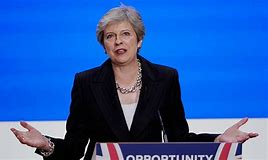
May doing Tory Conf speech Oct 18But, to place it in context, Theresa May’s Conference Speech first justifies careful re-reading. Re-examining it in the light of her subsequent actions reveals some intriguing clues which, albeit with hindsight, ought to have alerted us to what was coming during the ensuing week. 

Astonishingly, the word ‘Chequers’ did not appear even once in the speech’s text: curious, considering how often previously she had not been shy about naming it, and how obstinate she had been at promoting it. But given that she was unprecedentedly booed when she attempted to defend it at a Conference event two days previously, it’s more than likely that some frantic late-stage re-drafting to excise it was ordered.

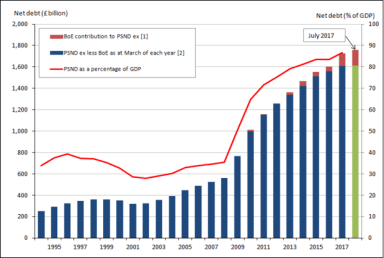
Eyebrows were raised by May’s proclamation of the imminent ‘end of austerity’, hinting at pay-rises for the (predominantly Labour-voting) public sector: especially as the annual Budget Deficit is only now finally being brought under control, not eliminated, despite the ‘Conservative’ Party having been in office since 2010, and notwithstanding the National Debt, even on a conservative calculation, remaining at a near-record high of approximately 86 per cent of GDP.

UK national debt vs GDP to 2017-18Then there were the coded barbs, one of them quite disingenuously out of context, aimed at Boris and, by extension, his European Research Group confrères pressing May for a Canada-Plus or a Plan Alpha-Plus Brexit which are closer, not only to what Britons say they voted for on 23rd June 2016, but also to May’s own vision set out in her Lancaster House and Mansion House speeches.

Between the somewhat laboured platitudes about how compromise becomes a dirty word’, and theEven if we do not all agree on every part of this [Chequers] proposal, we need to come together’, there was this:

Those of us who do respect the result – whichever side of the question we stood on two years ago – need to come together now. If we don’t – if we all go off in different directions in pursuit of our own visions of the perfect Brexit – we risk ending up with no Brexit at all.’

Given the rapturous reception given to Boris’ own speech the previous day, it’s hard to construe this as anything other than an attack on those who challenge May’s dogged adherence to her Chequers Plan.

Because, significantly, there was no corresponding criticism, even in coded form, of the Wollaston-Soubry claque of Continuity-Remainers who are increasingly open about their intention either to stop Brexit altogether, or at least adulterate it to the point of meaninglessness.

On this interpretation, again in the light of subsequent events, May’s warm-up act, Attorney-General Geoffrey Cox’s soaring rhetoric culminating in a peroration quoting Milton’s Methinks I see in my mind a noble and puissant nation rousing herself like a strong man after sleep’ to project a vision of post-Brexit Britainwas all part of the theatre: designed, I suspect, to pre-lull us into acceptance of the nebulous and signally non-specific bromides about honouring the Referendum result in May’s own speech, and disarm us for the deceptions which were to come.

They weren’t long in coming. The following morning, Thursday 4th October, at Brexit Central, former Cabinet Minister Peter Lilley exposed the statistical trick that was used to sell the Chequers plan to Cabinet, centred on the proportion of imports which would become embroiled in the plan’s proposed Facilitated Customs Arrangement. At least 16% of other countries’ exports to post-Brexit Britain would face this mechanism, rather than the mere 4% claimed by those seeking to promote Chequers.

On the same day, in The Times, Danny Finkelstein explained in considerable detail how May might use the current Parliamentary arithmetic – notably the extent of opposition to Chequers among committed Brexiteers on her own backbenches, and the offsetting inclination of many Blairite-rump Labour MPs to support May’s own pro-Chequers, anti-Brexit Continuity-Remain Tory MPs – to ‘concede’ a second EU Referendum, in which ‘Remain’ might be one of the options on the ballot-paper.

How fast things can move when the movers want. As quickly as Friday, 5th October, it emerged via The Guardian that May had plans for a secret charm offensive to solicit like-minded Labour MPs to support her – that’s support her in defeating her own MPs trying to hold her to her Manifesto promises, remember – in backing her Brexit deal, even at the cost of disadvantaging their own Party Leader.

The ostensible reason being given was to avoid, ‘in the national interest’, a No-Deal outcome. This was, and still is, baloney: the purpose looked then, and it still does now, to a far greater extent being to negate any possibility of May’s Soft-Remain, Brexit-In-Name-Only Chequers Plan being supplanted by either the much more clean-Brexit Canada-Plus deal the EU has already indicted its willingness to offer, or the Institute of Economic Affairs’ Plan Alpha-Plus.

Corroboration arrived late on the evening of Saturday 6th October, via an article for Sunday 7th October’s The Observer, confirming that May was overtly pitching for so-called ‘moderate’ Labour votes, not only on Brexit, but on a range of policies – explaining, perhaps, those promises in her Conference speech to turn on the public-spending taps.

Then, in its Monday 8th October edition, The Daily Telegraph revealed that May’s government, including Ministers and Whips had for several months actually been in covert contact with at least 25 Labour MPs, to push her Chequers Deal through Parliament by relying on their votes, against a very substantial minority of her own MPs.

We were thus confronted, yet again, with evidence of May deceitfully plotting to dilute or even negate Brexit, in secret, against her own Parliamentarians, Party and voters, with the shameful collusion of her Cabinet. A Cabinet, moreover, that appeared to have raised not a whimper of objection to the Brexit negotiations not even being on the agenda for that week’s Cabinet meeting.

Although perhaps one should no longer be surprised at its collective lack of backbone. One of most nauseating sights of the whole ‘Conservative’ Party conference was that of May’s Cabinet during her Leader’s Speech. She produced her Chequers Plan in secret behind their backs, then imposed it on them on pain of dismissal, after pre-clearing it with Angela Merkel: yet, just three months later, they sat and sycophantically applauded her like obedient performing seals.

CPC18 May's Cabinet's performing seals comp

The Times divulged on Wednesday 10th October that, unsurprisingly in view of all that had gone before, May was now preparing to railroad her supine Cabinet  into even further concessions to, and compromises with, Brussels before EU leaders met this week, including a commitment to keep the whole of the United Kingdom in what is effectively a Customs Union with the EU, with no guarantees of eventual exit. This is non-Brexit Remain in all but name.

As if that was not enough, May had evidently also authorised the renewed ramping up of Project Fear Mk II against leaving the EU without any deal, no matter how abject a state of vassalage the country was reduced to as a result. Also in The Times of Wednesday 10th October was a story about Whitehall is making contingency plans for the wholesale slaughter of sheep in the event of No-Deal – wryly, but accurately, summed up by one commenter as ‘Back my Chequers Plan or the Baby Lambs get it’.

Considering all this, and bearing in mind just how far May’s Soft-Remain, Brexit-In-Name-Only Chequers Plan diverges, not only from widely-held Brexit criteria, but even her own claims in her own Party Conference Leader’s Speech it’s now surely impossible to dispute the verdict of Leave Means Leave’s John Longworth in The Daily Telegraph of Monday 8th October: “We are heading for a monumental sell-out, a great betrayal of the British people, and a fraud on democracy.

I believe that that so much having happened in a mere seven days from May surviving her Party Conference intact was no coincidence: that this denouement was pre-planned well in advance but kept under wraps until Conference was safely in the past: and that May’s ‘negotiations’ increasingly have the look of an elaborate charade, being played to a pre-arranged script, to cover a stitch-up that was agreed long ago behind closed doors.

That all-pervading stench of treachery has become even fouler.

Thoroughly agree with this article? Vehemently disagree with it?

Scroll down to leave a comment

And follow A Libertarian Rebel on Twitter

The Speech Boris Ought To Deliver Today

(but which he almost certainly won’t)

Note: this article was originally published at The Conservative Woman earlier today, Tuesday 2nd October 2018

Forget about Theresa May’s set-piece Prime Minister’s speech to the Conservative Party Conference tomorrow. No-one, not even normally loyal supporters, expects anything much of it, or of her. Given the utter disaster that her Conference speech was last year, and so low is the bar she consequently has to clear, that just getting to the end of it without major mishap will be success of a kind.

No: today’s the day. The day when Boris supposedly comes clean, sets out his stall, and unashamedly makes his pitch to be both Party Leader and Prime Minister. The day when, in a Conservative Home event scheduled to last from 1.00 pm until 2.00 pm, he makes a speech clearly calculated to be the big event and talking-point of the conference, and upstage May’s predictably pedestrian by comparison effort tomorrow into the bargain.

But the runes aren’t necessarily overwhelmingly favourable. Out in front of the pack with Party members and activists he may be: but in the event that May is deposed, whenever and for whatever reason, he has to surmount the obstacle of a Parliamentary vote by Tory MPs to decide which two leadership candidates are placed before the membership.

And a majority of those 315 Tory MPs are determined that he won’t be one of them. Many purely because they are either closet or overt Remainers, who form a majority of Tory MPs anyway and would oppose any Brexiteer becoming Prime Minister, and others who, irrespective of their Brexit stance, harbour personal antipathy towards Boris for a variety of reasons, some arguably justified, but others less so.

So rather than tilting at an immovable windmill, a shrewd Boris should box clever, and confound both expectations – and his enemies – by doing the completely unexpected.

He should start by repeating the essence of his resignation speech, namely its forensic, entirely policy-focused, criticisms of May’s Chequers Plan approach to Brexit and which were careful not to attack May personally, and its plea that it was not too late for a different, more robust approach more in tune with the desire expressed by British voters via the Referendum result for clear economic, judicial and political separation from the EU’s institutions.

Boris resignation speech 18 July 2018

He ought then to go on to note regretfully how this hasn’t happened, with not only the eminently foreseeable result of the EU’s peremptory rejection of Chequers despite even more concessions, but its accompaniment by the intransigent Eurocrats’ contemptuous and malevolent humiliation of May personally.

And then continue by expressing his sorrow at how, despite other and better Brexit plans being available, the Prime Minister has inexplicably persisted in sticking to her Chequers  Plan, despite its manifest flaws and unpopularity.

He should then turn to the Conservative’s non-Brexit difficulties. It’s deeply disturbing, he should say, that extreme-Left Corbyn socialism appears to have been allowed to somehow gain such a foothold among the electorate, despite the abundance of evidence from everywhere it’s been tried that it doesn’t work: that the Tories are out-polling Labour by barely the statistical margin of error in polling: that the business presence at a hard-Left Labour Party conference was notable for its extent: and that anticipation of a Corbyn government is as high as it is.

UK voting intentions 30Sep2018

He ought then to follow this up by noting ruefully the present leadership’s seeming inability to come up with any significant counter to Corbyn’s apparent appeal by forcefully making the arguments for a smaller, less-activist state and freer markets, and by devising innovative supply-side solutions to the housing and elderly-care crises, but resorting too readily either to negative scaremongering or watered-down versions of Corbyn’s own policies.

And then conclude, with infinite regret, that he’d come to the inescapable conclusion that the current leadership was unlikely to reverse this trend, so that however reluctantly, he could see no other option than a change of helmsman.

This is the point at which Boris should drop the bombshell that no-one’s expecting.

He should say that he’s aware of his own shortcomings: that he accepts that his colourful and occasionally chaotic, even louche, private life is a turn-off for many people: that he acknowledges he’s almost certainly temperamentally unsuited to the mundane attention to detail that the highest office demands, even of those once thought capable of handling it: that he recognises his limited appeal among his MP colleagues: and that, consequently, while convinced with regret that a change of leadership is inevitable both for Brexit and domestic political reasons, he personally would not be a candidate.

But follow this immediately by a declaration that he pledges himself to exploit such popularity as he does enjoys with the Party’s grassroots and activists, and the wider public, to campaign up and down the country for a committed Brexiteer putative, and hopefully actual Prime Minister.

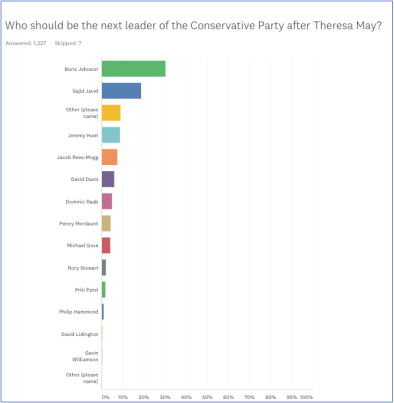
Tory Leader poll Mon 01Oct 2018

And subsequently support him or her, in the capacity of Party Chairman, to lead the campaigns both for a proper, not ersatz, Brexit and the defeat of Corbyn. Because if May falls, the hapless Brandon Lewis will fall with her, and there will be a vacancy.

With this strategy, Boris would at a stroke destroy the main objection to a change of Party Leader and Prime Minister: that he seeks that change only as a vehicle for his own vaulting ambition. He would eliminate the obstacle of Tory MPs who, though they might be open to May’s replacement with a Brexiteer PM, wouldn’t support it if it meant Boris in Number Ten.

He would negate the disadvantage of his own mercurial temperament by deploying it in a role for which it’s far more suited. He would in effect have loaded the rifle, aimed and cocked it, but invited a more popular and accurate marksman to pull the trigger and fire it.  

This strategy and that speech would throw May and her soft-Brexit acolytes, anticipating a straight-out leadership challenge from Boris, right off balance. And it would provide a Conference talking-point like no other. It might even make Boris go down in history, as the statesman who secured Brexit by sacrificing his own ambition for the sake of the cause.

If only.

Thoroughly agree with this article? Vehemently disagree with it?

Scroll down to leave a comment

And follow A Libertarian Rebel on Twitter

The Fight for the Soul of the Tory Party

By deposing the Leader and Prime Minister largely responsible for its current ideological paralysis, the Conservative Party must resolve its intellectual vacuum about what modern conservatism stands for

Note: this is the longer and updated version of the article originally published at The Conservative Woman on Monday 1st October 2018

“There are some of us, Mr Chairman, who will fight, and fight, and fight again, to save the party we love”.

In 2018, 58 years after they were addressed by its then Leader Hugh Gaitskell to the 1960 Labour Party Conference, opposing its move towards the hard-Left and its embrace of unilateral nuclear disarmament, those words need once again be addressed to a party conference. Only this time, to the Conservative Party Conference, and moreover not by its Leader, but at her.

As if Theresa May’s duplicitous preparation and imposition on her Cabinet of her now justly infamous Chequers Plan were not bad enough, she has carried on championing it even after its crushing, personally humiliating dismissal by the EU.

May humiliated Salzburg Summit 3She continues to cling obstinately, not only to Chequers as the sole Brexit option she is prepared to consider, but also, incredibly, to Olly Robbins, her thoroughly discredited No 10 Brexit adviser, whose brainchild it was, and on whose ‘expert’ advice that the EU would accept it she persists in relying, to the exclusion of all others.

Yet not merely other, but superior, alternatives exist, being urged on her constantly by allies and opponents alike, which both better reflect the desire manifested in the Brexit vote for clear political, judicial and economic separation from Brussels, and give better opportunities for a newly-independent post-Brexit Britain to forge new trading links around the world.

The Institute of Economic Affairs’ Plan A Plus maximises the scope for eliminating damaging tariffs and regaining control over our fisheries, as well as facilitating new Free Trade Agreements with the world’s dynamically-growing economies outside the stagnating and scelerotic EU: Chequers keeps us tied into it as closely as possible.

IEA Plan A Plus Launch Sep 2018The Canada Plus arrangement gives us total freedom of control over immigration policy, and independence from the EU’s ‘Common Rule Book’: Chequers gives us neither.

Yet they fall on deaf ears. May has her Chequers Plan, she insists that nothing else is acceptable, and that, for her, is that. To the evidence, both that it is less popular than No-Deal, and that its unpopularity exacerbates that of herself and her party, she is impervious.Unpopularity of Chequers dealBut there is worse to come. May’s obdurate adherence to Chequers is being compounded by her acceptance at the very least, or even endorsement if not something more, of a grotesquely cynical ramping up of Project Fear.

The scaremongering operation born out of the Treasury’s pre-Referendum antipathy to Brexit is now being pushed once again by May in full Stockholm-Syndrome mode – on new ‘expert’ advice from her preferred source? – but this time against a No-Deal Brexit as an alternative to Chequers, as part of a deliberate “Chequers or Chaos” strategy.

We saw a foretaste of it in the run-up to the early-July Chequers Summit, with Airbus warning of an exodus from the UK in the event of No-Deal, very soon, curiously, after discussions with Business Secretary and arch-Remainer Greg Clark. But since then, there have been plenty other examples. To quote just two or three:

After having previously instructed them to spend their summer holidays touring Europe to drum up support for her Chequers Plan, May was in early September ordering Ministers to stress to the public that there was no alternative to it

Or try the Association of British Insurers’ warning that it would become illegal in the event of a No-Deal Brexit for insurance-based pensions to be paid to UK-nationality recipients resident in the EU. Fortunately, fairly easy to demolish.

Then, as recently as last week, May’s government theatrically appointed a Food Supplies Minister, “to oversee the protection of food supplies in the event of a No-Deal Brexit”. Such an appointment has previously confined to wartime and was not even deemed necessary in the rolling strikes and disruptions to distribution experienced in the 1974 industrial crisis and the 1978-79 Winter of Discontent.

In summary, not only do we have a Remainer Prime Minister sticking resolutely to a Brexit plan already rejected out-of-hand by an EU no doubt confident that further concessions can be wrung from a desperate Theresa May in deep political trouble, but shunning all other, and better alternatives. We also have a Remainer Prime Minister colluding in, if not directing, a co-ordinated attempt to frighten the British public into accepting it.Project Fear 2018

It’s perhaps hardly surprising that 56 per cent of those polled by Sky Data think Brexit will be worse than expected. The Remainer dominated media and political elite, including even the Governor of the Bank of England, have done little for the last 28 months except attempt to talk the nation into a state of catatonic panic. Mrs May must be so pleased.

Were Brexit the sole source of the Conservatives’ predicament, the crisis might – just – be containable. But overlying May’s Brexit shambles is the Party’s severe ideological vacuum, epitomised by the instinctively statist, authoritarian, May, devoid of any discernible guiding philosophy, personality, or leadership ability, and of which her self-inflicted Brexit shambles is arguably merely a part – its apparently total inability to come up with any ideas, vision or policies to counter the 1970s-throwback, reheated hard-Left socialism of Corbyn’s Labour.

Not before time, commentators have been lining up this past week to highlight the depth, and cause, of this malaise, and rightly condemn it.

In The Daily Telegraph, Allister Heath correctly laid the vast majority of the blame for Corbynomics being so ostensibly popular with Middle England on the faux-‘Conservative’ Party which has largely stopped countering it and in effect capitulated to it.

McDonnell’s Mad Marxism is very likely to be an electoral winner, warned Maggie Pagano at Reaction, not because of any intrinsic merits, but thanks to Theresa May’s Tories’ timidity & incompetence.

The Conservatives, observed Ryan Bourne accurately, also in The Daily Telegraph, have now spent so long agreeing with Labour’s negative portrayal of our economic system, and even imitating its policies, that they have now deprived themselves of any effective criticisms of them.

Ministers like Philip Hammond, noted The Spectator editor Fraser Nelson, are incapable of fighting back other than with left-wing prescriptions like surreptitious tax rises or expensive new spending projects, so that Corbyn is actually leading the nation’s intellectual conversation.

The Conservative Party must re-embrace freeing individuals & businesses from creeping Nanny-State paternalism & authoritarianism, in favour of aspiration, opportunity & meritocracy, pleaded former International Development Minister Priti Patel MP, writing in the Parliamentary magazine The House.

Red-Labour has been made electable by the pseudo-Tories, fumed Gerald Warner at Reaction, condemning the so-called ‘modernised’ Conservative Party for squandering the once-in-a-lifetime chance given to it by Brexit to cease being an empty, principle-free shell.

The Conservatives, fulminated The Spectator editorial in its pre-Conference edition, are functioning as Corbyn’s Useful Idiots: years of failing to make the case for basic liberty and the free enterprise system, of stealing Labour policies in pursuit of electoral advantage, have left them unable to explain why Corbyn is wrong.

And when usually loyal Conservatives like Charles Moore and Tim Montgomerie legitimately ascribe culpability for the Party’s ideological paralysis to May and call for her to go, in effect saying, rightly, that she is all but guaranteeing the advent of a hard-Left Labour government led by Corbyn and McDonnell, her days are surely numbered.

So in Birmingham, over the next two days, there are parallel Brexit and non-Brexit battles taking place. The unofficial, but never far from the surface, impending leadership contest is almost immaterial, because the ideological struggle over the shape, not only of Brexit but of Conservatism, will determine its outcome.

Will the Party continue on its present ever-Leftward drift, preoccupied with fashionably politically-correct social-justice and identity-politics, and convinced, bizarrely, that the only way to stop full-strength Corbyn economically is to offer diet-Corbyn instead? Or will it somehow re-discover the moral and intellectual firepower to oppose Corbynism absolutely and offer a distinctive and optimistic vision of a freer, less-taxed and better-off society?

For anyone wanting the latter, an irredeemably intransigent, incompetent, inflexible Theresa May, a disaster for her party, the country and arguably democracy itself, and who ideally should not even be giving the Leader’s Speech on Wednesday at all, must be forced to declare that it will be her last. If ever there was a need for a repeat-in-reverse on Tuesday of Macmillan’s Night of the Long Knives, it’s now.

Drastic though it is, the present circumstances do justify a palace coup – whereby she is told by a co-ordinated procession of individual colleagues visiting her one by one as with Thatcher in 1990, and in no uncertain terms, that the game is up: that she cannot lead the party through Brexit, much less into the next General Election which could follow a failure to get her Brexit deal through Parliament before March 2019: and that her only alternative is to resign, with effect from the conclusion of her speech, in favour of a pro-Brexit caretaker Prime Minister.

Labour Party Conferences may well be mainly characterised by a succession of extreme-Left demagogues delivering two-minute rants from the platform on arcane and largely indecipherable motions. But at least policy is discussed and even voted on, albeit after a fashion.

But in almost comically stark contrast, the obsessively stage-managed, anodyne, debate-free rallies of the slavishly-loyal, listening dutifully to ministers’ set-piece speeches, which now comprise the formal proceedings of Conservative Party conferences, have become notorious – rightly mocked even by The Daily Telegraph as merely “paying through the nose for the privilege of clapping”.

Conference audience dutifully applauding

If the Party, despite its current dire ideological and political predicament, yet again prefers to close ranks, eyes and ears, and contrives to hold a synthetically-orchestrated, reality-ignoring Conference: and if the pro-Brexit, anti-May dissenters yet again recoil from openly mounting a challenge, both to her conduct of Brexit specifically and her party leadership generally: then a Corbyn government is a near-certainty, and they will have no-one but themselves to blame.

That modern-day equivalent of Gaitskell’s “fight for the soul of the Party” needs to be taking place. In Birmingham. Here and now.

Thoroughly agree with this article? Vehemently disagree with it?

Scroll down to leave a comment

And follow A Libertarian Rebel on Twitter